
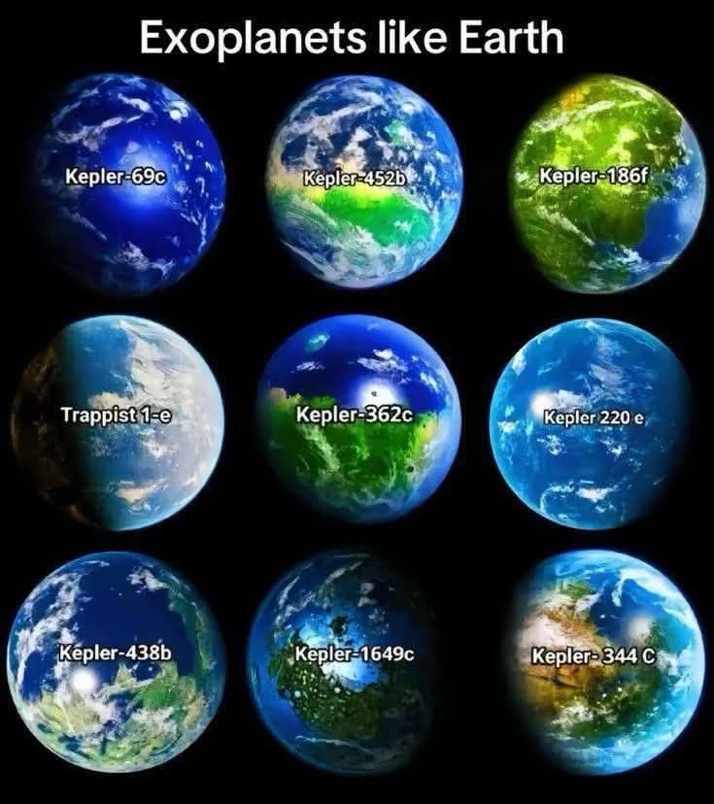
These artistic renderings beautifully capture some of the most intriguing potentially habitable exoplanets discovered during the Kepler era, evoking worlds that might harbor liquid water and Earth-like conditions.Your description matches classic NASA composite illustrations showcasing candidates in the “habitable zone” — the orbital region where surface temperatures could allow liquid water.Spotlight on the highlighted planets:Kepler-186f (announced 2014): The first validated Earth-sized planet (about 1.1 times Earth’s radius) in the habitable zone of a red dwarf star, roughly 500 light-years away. It orbits a cooler, dimmer star than the Sun, so its “year” is just 130 days.
Kepler-452b (announced 2015): Often dubbed “Earth 2.0” or “Earth’s cousin,” this super-Earth (about 1.6 times Earth’s radius) orbits a Sun-like (G-type) star every 385 days, at a distance very similar to Earth’s from the Sun. It’s about 1,400 light-years away and one of the most Earth-like in terms of stellar type and orbit.
TRAPPIST-1e (part of the system announced 2017): One of seven Earth-sized planets orbiting the ultra-cool red dwarf TRAPPIST-1, just 40 light-years away. TRAPPIST-1e is particularly promising — in the middle of the habitable zone, with a 6-day orbit, potential for rocky composition, and possible water oceans based on JWST observations.
These worlds represent milestones in exoplanet hunting: Kepler revolutionized the field by finding thousands of planets via the transit method, showing that small, rocky worlds in habitable zones are common. While none are confirmed to be truly “Earth-like” yet (atmospheres and compositions remain uncertain), they fuel excitement about future missions like JWST and the upcoming Habitable Worlds Observatory.The allure of these illustrations lies in imagining alien sunsets, oceans, and perhaps even life — a reminder that our cosmic neighborhood might be teeming with Earth analogs. Which of these worlds intrigues you the most, or is there another habitable zone candidate you’d like to explore?
Please like subscribe comment your precious comment on universe discoveries
Full article source google
 Universe discoveries
🙏🌹
Aum Shanti
LikeLike