
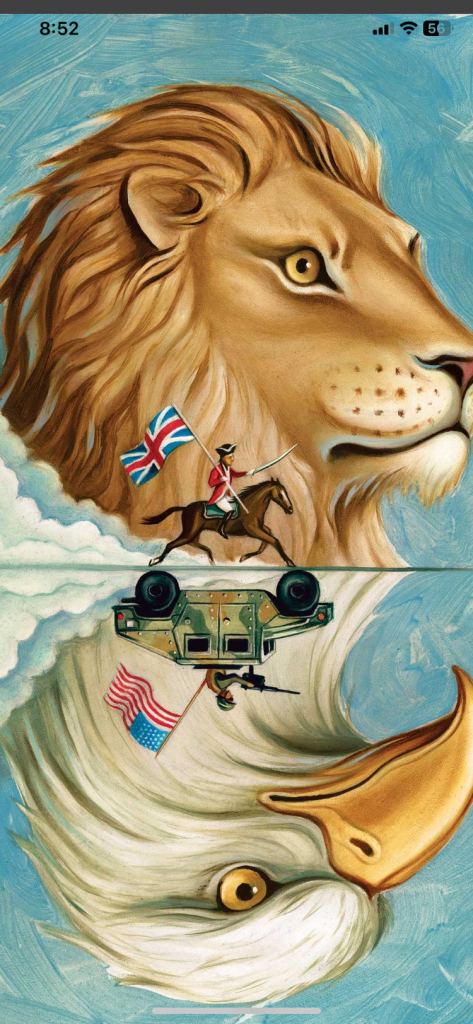
The transition from the
British Empire to American global dominance (often called the “American Empire”) was a gradual shift over two centuries, driven by world wars, economic replacement, and a change in how power is exercised.
The transition occurred through these key phases:
1. The Revolutionary Break (1775–1783)
The United States was born from the “First British Empire.” After a decade of protests over taxation without representation, 13 colonies declared independence in 1776. With the Treaty of Paris (1783), Britain recognised U.S. sovereignty, marking the first major loss for the British Empire and forcing it to pivot its focus toward Asia and Africa (the “Second British Empire”).
2. The Era of Rivalry and “Great Rapprochement” (1812–1900)
- War of 1812: A final major military conflict between the two confirmed that the U.S. would remain independent and Britain would keep Canada.
- Economic Growth: Throughout the 19th century, the U.S. expanded across the continent (e.g., the Louisiana Purchase) and developed a massive industrial base that began to rival Britain’s.
- The Rapprochement: By the late 1890s, the two nations shifted from enemies to allies as they found common strategic interests against rising powers like Germany.
3. The World Wars: The Torch Passes (1914–1945)
The two World Wars were the turning point where the U.S. effectively replaced Britain as the global hegemon:
- Economic Debt: Britain bankrupted itself fighting both wars and became deeply indebted to the U.S. through programs like Lend-Lease.
- Naval Dominance: By 1945, the U.S. Navy surpassed the Royal Navy as the world’s most powerful, a title Britain had held for over a century.
- Global Systems: The Bretton Woods system established the U.S. dollar as the world’s primary reserve currency, replacing the British pound.
4. Decolonization and the Cold War (1945–Present)
As Britain granted independence to colonies like India (1947), the U.S. stepped in to fill the “power vacuum” to prevent Soviet influence.
- Difference in Style: While the British Empire relied on direct territorial control, the “US Empire” is often described as one of intellectual property, economic influence, and a global network of military bases rather than formal colonies.
- Suez Crisis (1956): This event is widely seen as the final confirmation of Britain’s decline, as U.S. opposition forced Britain to withdraw from Egypt, proving Britain could no longer act globally without U.S. approval.
Us major wars from beginning till now and latest us Iran 🇮🇷 conflict
Since its independence, the United States has transitioned from a continental power to a global hegemon through several major conflicts. As of
early 2026, the U.S. is currently engaged in heightened tensions with Iran, following direct military strikes and ongoing nuclear disputes.
Major U.S. Wars: A Historical Timeline
Historical records typically identify 12 major wars that shaped the nation’s role on the world stage:
- American Revolution (1775–1783): Won independence from the British Empire.
- War of 1812 (1812–1815): Often called the “Second War of Independence” against Britain over trade and maritime rights.
- Mexican-American War (1846–1848):Resulted in the acquisition of massive western territories, including California and Texas.
- American Civil War (1861–1865): The deadliest war in U.S. history, fought over slavery and national unity.
- Spanish-American War (1898):Established the U.S. as a colonial power with the acquisition of Puerto Rico, Guam, and the Philippines.
- World War I (1917–1918): Marked the U.S. entry as a dominant global superpower.
- World War II (1941–1945): Fought against the Axis Powers; ended with the U.S. as one of two global nuclear-armed superpowers.
- Korean War (1950–1953): A Cold War conflict that ended in a stalemate, leaving the peninsula divided.
- Vietnam War (1955–1975): A long, controversial conflict aimed at containing communism in Southeast Asia.
- Persian Gulf War (1990–1991):Successfully liberated Kuwait after an invasion by Iraq.
- War in Afghanistan (2001–2021): The longest war in U.S. history, launched after the 9/11 attacks to dismantle al-Qaeda and the Taliban.
- Iraq War (2003–2011): Overthrew Saddam Hussein’s regime; the U.S. maintains a residual presence for counter-terrorism.
Latest US-Iran Conflict (2025–2026 Updates)
Tensions reached a critical point in mid-2025and remain extremely high as of February 2026:
- Direct Military Action (June 2025): For the first time since 1979, the U.S. directly attacked facilities inside Iran. In June 2025, the U.S. joined Israel in striking three Iranian nuclear sites in Fordow, Isfahan, and Natanz using bunker-buster bombs.
- Current Brinkmanship (January–February 2026):
- Protest Crackdown: In early 2026, President Trump threatened further military strikes if the Iranian government executed demonstrators involved in nationwide protests that began in late 2025 over economic conditions.
- Naval Standoff: On January 31, 2026, Iran announced a two-day live-fire naval exercise in the Strait of Hormuz. This followed the U.S. deployment of the aircraft carrier Abraham Lincoln and other naval assets to the region.
- Khamenei’s Warning: On February 1, 2026, Supreme Leader Ali Khamenei warned that any war initiated by the U.S. would trigger a “regional war”.
- Negotiation Status: While the Trump administration has signaled a desire for a “fair and balanced” new nuclear agreement, Iran has officially stated it is unwilling to negotiate under the direct threat of attack.
Please like subscribe comment your precious comment on universe discoveries
Full article source google
 Universe discoveries
🙏🌹
Aum Shanti
LikeLiked by 2 people