
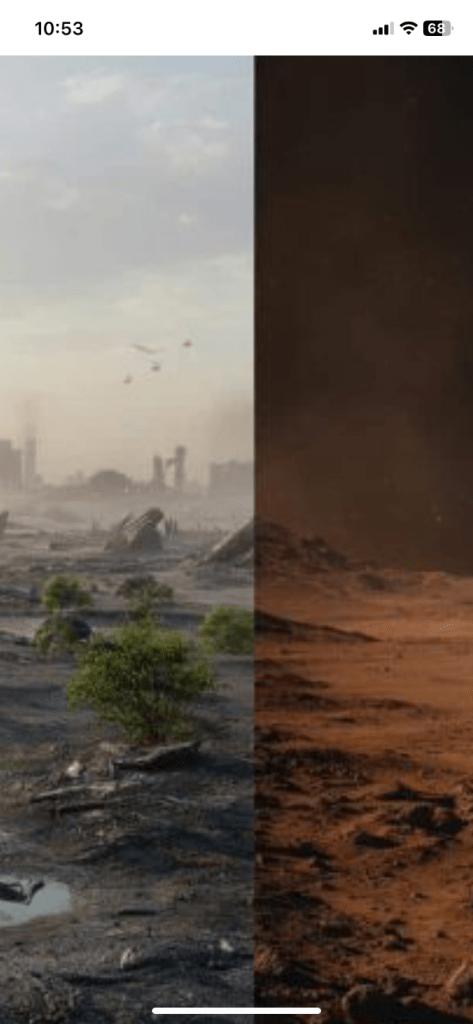
The room goes quiet the moment his slide changes. On the screen, a fire-scarred Earth spins slowly next to a dusty, rusty marble: Mars. An astrophysicist at the back of the hall clears his throat, leans into the mic, and drops the line that will later blow up on social media: “Even after a nuclear apocalypse, Earth would still be paradise compared to Mars.”
Some people laugh. Others shift uncomfortably, thinking of Elon Musk’s promises of a “backup planet” and stainless-steel rockets tearing through the sky.
The scientist keeps going, patient but sharp. He talks about air so thin your blood would boil, radiation that cuts through flesh, and dirt you can’t grow potatoes in without serious cheating.
The message lands with a thud.
What if the dream of escaping to Mars is blinding us to the world we’re quietly wrecking under our feet?
Elon Musk’s Mars dream meets a cold scientific reality
Scroll through Elon Musk’s feed and you’ll see it: gleaming Starships, animated Mars colonies under domes, talk of “making life multiplanetary”. It feels bold, cinematic, almost comforting.
The story is simple: if we mess up Earth, we’ll have Mars. A second chance, a cosmic reset button, sponsored by reusable rockets and Silicon Valley optimism.
Then an astrophysicist steps in and says, “Not quite.”
Even after a nuclear nightmare, Earth would still give us a head start that Mars never will. It doesn’t make apocalypse “okay”. It just underscores how wildly generous this planet remains, even when mistreated, compared to the cold indifference of the red world Musk dreams about
Why surviving on Mars is way harder than Musk’s memes suggest
When space scientists talk about Mars, they don’t imagine sleek sci‑fi cities first. They think about life-support spreadsheets.
Want to live on Mars? You need a sealed habitat, oxygen generators, water recyclers, radiation shielding, spare parts, medical supplies. You need energy for all that gear, 24/7, with no blackout days, because one power failure might mean no air to breathe.
On Earth, you walk out your door and your lungs fill with oxygen someone else didn’t have to manufacture. On Mars, every breath comes from an industrial process that can fail.
That’s the detail you rarely see in the glossy renderings.
We’ve all been there, that moment when a sci‑fi movie shows farmers smiling in a glass dome on Mars. It looks peaceful, orderly, almost cozy. The reality is closer to living inside a submarine, forever.
Ask engineers at NASA or ESA to list the problems. They’ll talk about water locked in ice you need to mine and melt. Dust that clogs every moving part. Martian soil laced with perchlorates — toxic chemicals you’d have to clean out before growing a single tomato.
Add to that the 20‑minute delay in communications with Earth, and the brutal psychological cost of knowing you cannot just “go outside” if something goes wrong.
On post‑nuclear Earth, you’d be scavenging and rebuilding in a nightmare. On Mars, you’d be fighting physics itself.
Strip away the romance and the comparison becomes oddly clear. On Earth, our survival is strongly supported by biosphere systems we didn’t build: oceans, forests, microbes, clouds. Even damaged, they still buffer temperatures, recycle carbon, and slowly repair.
Mars has no biological safety net. No self-healing forests. No oceans to moderate climate. No ozone layer to soften the Sun’s rage.
Every system you rely on in a Mars base is fragile technology inside a place that wants you dead. Let’s be honest: nobody really runs life‑critical systems perfectly, every single day, for decades, without serious glitches.
*That’s why so many scientists flinch when they hear people talk about Mars as an “escape route” for humanity.* It reverses the basic logic of survival.
Please like subscribe comment your precious comment on universe discoveries
Full article source google
 Universe discoveries
🙏🌹
Aum Shanti
LikeLike
Very nice.
LikeLike
Interesting post, greetings
LikeLiked by 1 person