
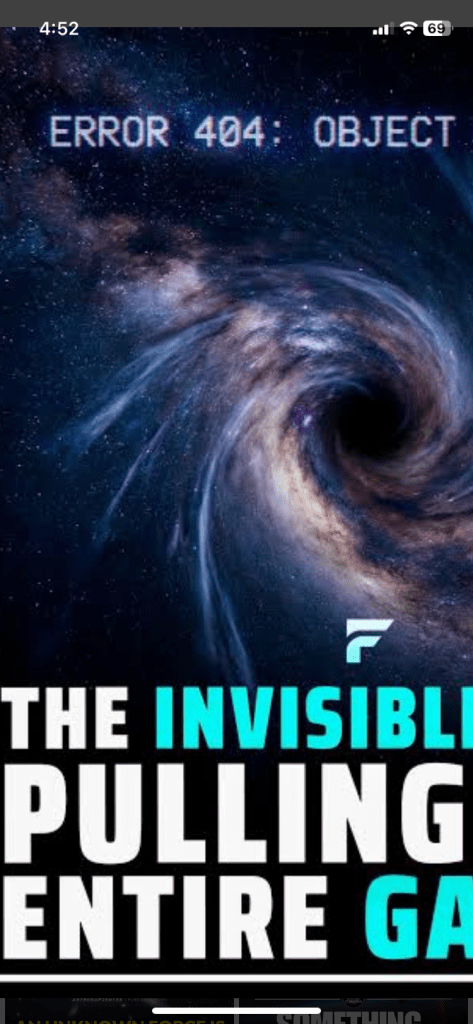
It is fascinating to think about the sheer scale of the forces at play in our galaxy. On spot on that there is a massive object at the center of the Milky Way—
Sagittarius A*—which is a supermassive black hole with a mass of about 4 million Suns.
However, the “pull” involved is a bit more like a cosmic dance than a slow descent into a drain. Here is a breakdown of what’s actually happening:
1. Orbiting, Not Falling
The Sun and our entire solar system are moving at a staggering speed of about 828,000 km/h (514,000 mph). Because we are moving so fast sideways relative to the center, we aren’t “falling into” the black hole. Instead, we are in a stable galactic orbit.
- Think of it like the Earth orbiting the Sun: gravity pulls us in, but our forward momentum keeps us swinging around in a circle.
2. The Distance is Immense
We are currently about 26,000 light-yearsaway from Sagittarius A*. To put that in perspective:
- Even though the black hole is massive, its gravitational “grip” at our distance is actually quite weak compared to the combined gravity of all the stars, dust, and dark matter closer to us.
- Most of the “force” pulling on the Sun comes from the total mass of the inner galaxy, not just the central black hole itself.
3. The “Great Attractor”
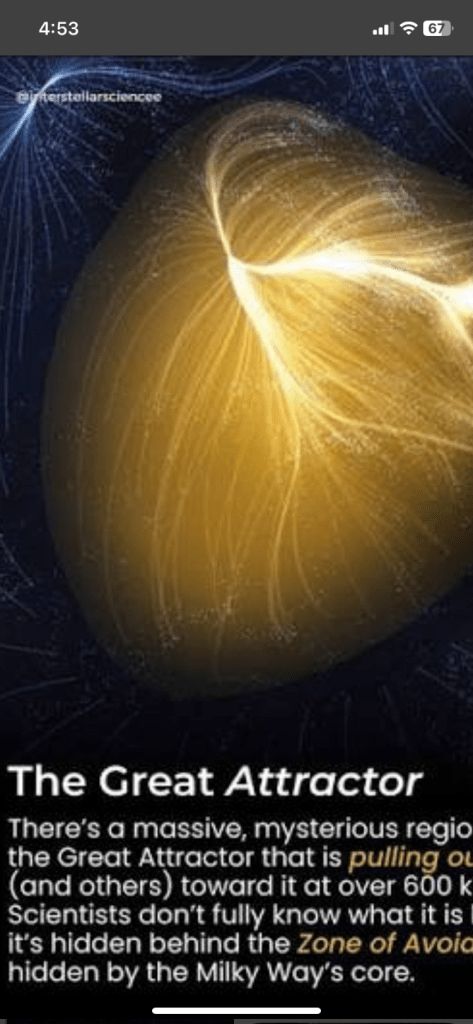
If you feel like the entire galaxy is being pulled toward something even bigger, you’re right! On a much larger scale, the Milky Way and our neighboring galaxies are being drawn toward a mysterious region of space called the Great Attractor.
- This is a gravitational anomaly located about 150–250 million light-years away.
- It is so massive that it is pulling thousands of galaxies (including ours) toward it.
Interesting Note: It takes the Sun roughly 230 million yearsto complete just one single trip around the center of the Milky Way. The last time we were in this exact spot in our orbit, dinosaurs were just beginning to appear on Earth!
what the “Great Attractor” actually is, or perhaps how scientists discovered the black hole at our galaxy’s center?
It is a bit mind-bending to realize that while we are orbiting the center of our galaxy, our entire galaxy is also racing through the universe toward a hidden destination.
Here is the breakdown of how we discovered the “beast” at our center and the mysterious force pulling us from afar.
1. How We Found the Black Hole (Sagittarius A*)
Because black holes swallow light, we can’t see them directly with traditional telescopes. Scientists had to become “cosmic detectives” by watching how nearby stars behaved.
- The “Wobble” Clue: In the 1990s, astronomers (notably Andrea Ghez and Reinhard Genzel) tracked the stars at the very center of the Milky Way for over 20 years.
- The Smoking Gun: They found stars moving at incredible speeds—up to 3% the speed of light. These stars were whipping around an “invisible” point.
- The Math: By calculating the speed and the tight diameter of these orbits, they proved that the only thing dense enough to exert that much gravity without emitting light was a supermassive black hole.
In 2022, the Event Horizon Telescope finally gave us a visual “photo” of the glowing gas swirling around this black hole, confirming its existence once and for all.
2. What is the “Great Attractor”?
The Great Attractor is a massive gravitational anomaly located in intergalactic space. While our Sun orbits the center of the Milky Way, the Milky Way itself is being pulled toward this point at about 2 million km/h.
- A Massive Wall of Gravity: It isn’t a single object like a giant black hole. Instead, it is a central point of gravity caused by a massive concentration of matter (thousands of galaxies and dark matter) known as the Laniakea Supercluster.
- The “Zone of Avoidance”: For a long time, we couldn’t see what it was because the thick dust and stars of our own Milky Way blocked our view. This hidden area is called the Zone of Avoidance.
- X-Ray Vision: It wasn’t until we used X-ray and radio telescopes—which can “see” through the dust—that we realized the Great Attractor is likely the heart of a massive cluster of galaxies (the Norma Cluster).
The Big Mystery: Even with the Great Attractor explained, astronomers found that we are actually moving even faster than the Attractor’s gravity accounts for. This suggests there is something even bigger beyond it, called the Shapley Supercluster, pulling us further still!
Please like subscribe comment your precious comment on universe discoveries
Full article source google
 Universe discoveries
🙏🌹
Aum Shanti
LikeLike