Writing blogs is miracle I am a writer blogger and my site mission is to give information on maximum information to audiences
Winston churchil and the first world war
During the First World War, Winston Churchill’s career was a dramatic mix of high-level strategic leadership, a major political downfall, and a brief period of personal service in the trenches of the Western Front.
Key Roles and Actions
First Lord of the Admiralty (1911–1915):At the war’s outbreak, Churchill was the civilian head of the Royal Navy. He is credited with modernizing the fleet—switching from coal to oil power—and mobilizing the navy so it was ready for combat the moment war was declared.
Gallipoli Campaign: Churchill was the chief architect of the 1915 attempt to knock the Ottoman Empire out of the war by forcing the Dardanelles straits. The operation was a disastrous failure, resulting in over 250,000 casualties and costing Churchill his position at the Admiralty.
Service in the Trenches (1916): Following his political demotion, he resigned from the government to serve as a Lieutenant-Colonel in the Royal Scots Fusiliers. He spent roughly six months in a relatively quiet sector in Belgium, where he was known for personally visiting the front lines and going on patrols in No Man’s Land.
Minister of Munitions (1917–1918): He returned to government under David Lloyd George, where he oversaw the massive production of shells, aircraft, and tanks—a technology he had early on championed and funded while at the Admiralty. History Hit +7
Innovations and Contributions
The Tank: Churchill was one of the few early believers in “landships.” He used naval funds to create the Landships Committee, which eventually led to the development of the tank as a way to break the stalemate of trench warfare.
Naval Air Service: He was a pioneer in military aviation, establishing the Royal Naval Air Service and even taking flying lessons himself to understand its potential.
Defense of Antwerp: In late 1914, he personally went to Antwerp to organize its defense against the German advance. While the city eventually fell, the delay helped save vital Channel ports. Britannica +4
The war served as a “formative apprenticeship” for Churchill, providing him with a first-hand understanding of modern strategy, technology, and economic mobilization that he would later use as Prime Minister in World War II. International Encyclopedia of the First World War +1
Winston Churchill and Second World War
In World War II, Winston Churchill became the symbol of British resistance. After replacing Neville Chamberlain as
Prime Minister in May 1940, he rejected any talk of a negotiated peace with Nazi Germany, famously declaring he had nothing to offer but “blood, toil, tears and sweat.”
Strategic Leadership
The Blitz and Battle of Britain: Churchill used his powerful oratory to sustain civilian morale during the German bombing campaigns. His speeches—like “We shall fight on the beaches”—are considered some of the greatest in political history.
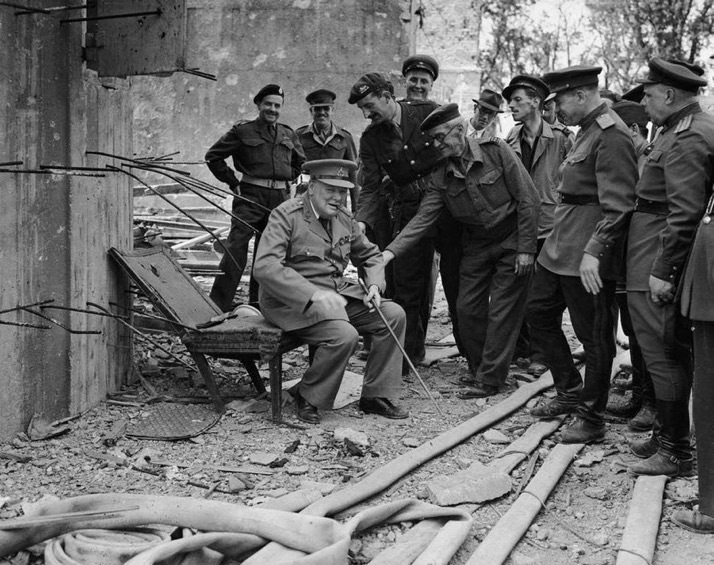
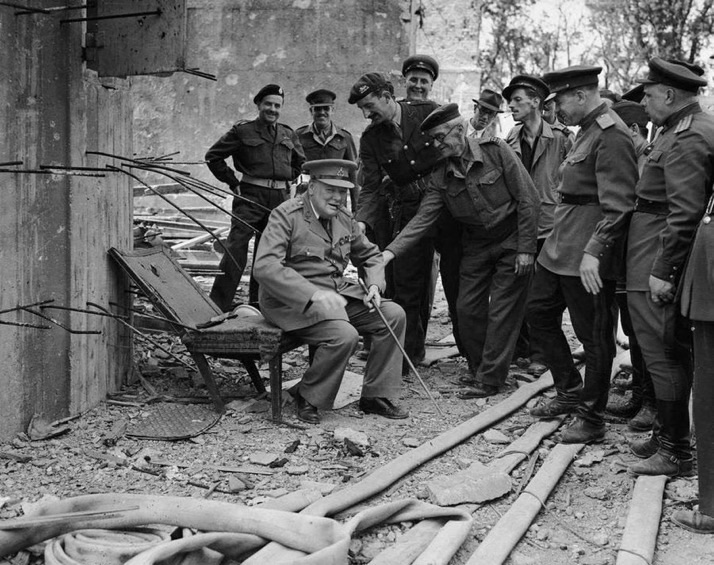
The “Grand Alliance”: He worked tirelessly to build a coalition with Franklin D. Roosevelt (USA) and Joseph Stalin(USSR). Despite his deep distrust of communism, he famously said, “If Hitler invaded Hell, I would make at least a favourable reference to the Devil in the House of Commons.”
Ironclad Resolve: He made the controversial decision to sink the French fleet at Mers-el-Kébir in 1940 to prevent it from falling into German hands, signaling to the world that Britain would stop at nothing to win.
Key Contributions & Controversies
V for Victory: He popularized the “V” hand gesture as a sign of defiance and hope across occupied Europe.
Technological Edge: Recalling his WWI experience, he pushed for innovations like radar, code-breaking (at Bletchley Park), and specialized landing craft for the D-Day invasions.
The Bengal Famine (1943): One of the darkest parts of his legacy; his wartime policies and refusal to divert shipping to India contributed to a famine that killed millions.
Post-War Vision: Even before the war ended, he was wary of Soviet expansion, later coining the term “Iron Curtain” to describe the division of Europe.
The 1945 Election
In a shock to the world, Churchill was voted out of office in July 1945, just weeks after victory in Europe. The British public respected him as a “war leader” but preferred the Labour Party’s platform for rebuilding the post-war economy and creating the NHS.
Winston Churchill thoughts about world war 1 and 2
Winston Churchill’s thoughts on the two World Wars were shaped by his belief that they were not entirely separate events, but rather two stages of a single, continuous struggle for the survival of Western civilization. He famously referred to the period from 1914 to 1945 as
“another Thirty Years’ War”.
Perspectives on World War I (The Great War)
Churchill viewed the first conflict as a tragedy of failed diplomacy and missed opportunities.
The “Senseless” Slaughter: While he was a “warrior” by nature, Churchill was deeply critical of the static, high-casualty trench warfare on the Western Front. He spent much of the war trying to find “mechanical” or “lateral” solutions (like the tank or the Gallipoli campaign) to avoid the “catastrophic bloodlettings” of the infantry.
A Fragile Peace: In his memoir “The World Crisis”, he argued that the post-war settlements were mishandled. He believed the Allies failed to either fully reconcile with Germany or effectively restrain its future military growth, creating the “geopolitical nightmare” of a vengeful Germany.
Consistent Philosophy: He often cited the “Roman wisdom” of “Spare the conquered and war down the proud,”arguing that the Allies were too “violent in peace” after 1918. Britannica +4
Perspectives on World War II
Churchill saw the second war as an “unnecessary war” that could have been prevented if democracies had stood up to Hitler earlier. Wikipedia +1
The Struggle for the Soul: He framed WWII not as a traditional territorial dispute, but as a “moral crusade” against a “monstrous tyranny” that threatened to sink the world into a “new Dark Age”.
A Personal Destiny: Churchill famously wrote that when he became Prime Minister in 1940, he felt as if he were “walking with destiny” and that his entire previous life—including his failures in WWI—had been a preparation for that specific trial.
Fear of the Vacuum: Toward the end of the war, his thoughts turned to the future. He feared that a total German collapse would create a power vacuum for the Soviet Union to fill, leading him to later warn of the “Iron Curtain”. Audible +3
Summary of His War Philosophy
Churchill summarized his outlook on conflict through the famous “moral” he gave to his six-volume history, The Second World War:
“In War: Resolution. In Defeat: Defiance. In Victory: Magnanimity. In Peace: Goodwill”. Wikipedia
Please like subscribe comment your precious thoughts on universe discoveries

History Hit +7
Britannica +4
Audible +3
 Universe discoveries
🙏🌹
Aum Shanti
LikeLike