
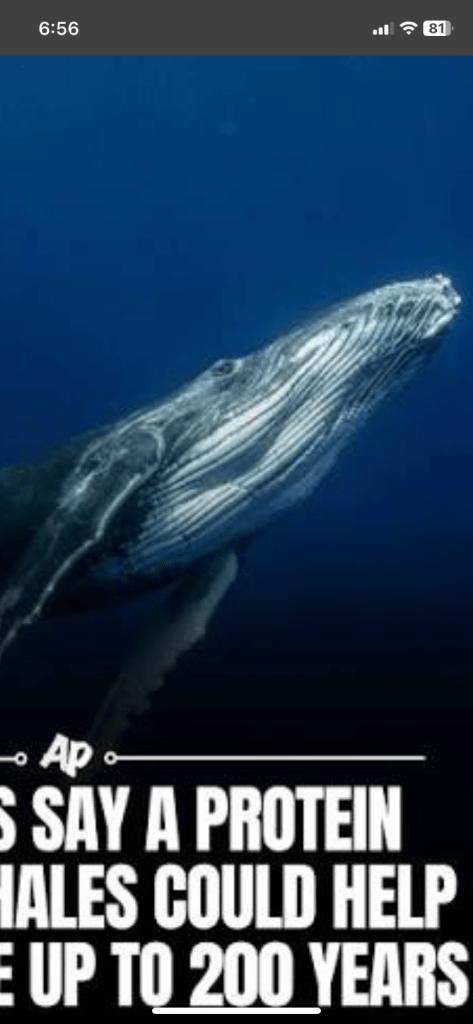
Researchers from the University of Rochester have identified a protein called CIRBP (Cold-Inducible RNA-Binding Protein) in bowhead whales that may be the key to their 200-year lifespan. Bowhead whales are the longest-living mammals on Earth and rarely develop cancer, despite having trillions of cells—a phenomenon known as Peto’s Paradox.
Key Findings from the Study
- Massive Protein Levels: Bowhead whales produce roughly 100 times more CIRBP than humans.
- Precision DNA Repair: The protein acts as a “molecular guardian,” repairing serious genetic damage known as double-strand DNA breaks with high accuracy.
- Successful Cross-Species Tests: When scientists introduced the whale version of CIRBP into human cells and fruit flies in a laboratory setting, it significantly improved DNA repair efficiency. In fruit flies, it even extended their lifespan.
- Cold-Activation: The protein is “cold-inducible,” meaning it is triggered by cold exposure—an adaptation for whales living in Arctic waters. This has led researchers to speculate whether lifestyle factors like cold showers could potentially influence human CIRBP levels.
NDTV +5
Potential Impact on Humans
While the research published in Naturesuggests that human DNA repair capacity has “substantial room to improve,” scientists caution that clinical applications are still years away. The long-term goal is to develop therapies that mimic this “repair over destroy” strategy to slow aging, reduce cancer risk, and potentially extend the human lifespan toward the 200-year cycle
Specific Experiments on Human Cells
The team used human fibroblasts (skin cells) in laboratory cultures to test the effects of introducing the whale version of the protein: Nature
- Enhanced Repair Efficiency: When whale CIRBP was overexpressed in human cells, it significantly increased the frequency of two major DNA repair processes: Non-Homologous End Joining (NHEJ) and Homologous Recombination (HR).
- Reduced Genomic Instability: The human cells treated with the protein showed fewer micronuclei, which are small fragments of DNA that typically signal chromosomal damage and instability.
- Protection Against Stress: Cells with boosted CIRBP resolved DNA damage sites (measured by $\gamma$H2AX foci) more quickly after being exposed to bleomycin, a chemical that causes DNA breaks.
- Cancer Resistance: Unlike humans, who require multiple genetic mutations (oncogenic “hits”) to develop cancer, whale cells were found to resist malignant transformation despite having fewer traditional tumor suppressor genes, suggesting their longevity relies on this superior repair rather than just killing off damaged cells.
Nature +1
How Cold-Activation Works
CIRBP is a “cold-shock” protein that acts as a molecular chaperone. Its activation is triggered by environmental and biological factors: Archive ouverte HAL +2
- Temperature Sensitivity: In laboratory tests, lowering the temperature of human cells by just a few degrees (e.g., to
32∘
- The “Arctic Advantage”: Bowhead whales live in freezing Arctic waters and maintain a core body temperature of roughly
- Molecular Mechanism: When cold stress occurs, the protein moves from the cell’s nucleus to the cytoplasm. It binds to the 3′-untranslated region (3′-UTR) of specific mRNAs, stabilizing them and promoting their translation into proteins that assist in DNA repair and cell survival.
- Recruitment to Damage: During DNA damage, CIRBP is recruited to break sites by PARP-1, a sensor that flags DNA breaks. CIRBP then helps coordinate the “repair crew” to fix the damage accurately.
While scientists have suggested that cold showers might nudge human CIRBP levels upward, this remains a hypotheticallifestyle implication that requires more rigorous human testing. Researchers at the University of Rochester and other institutions are exploring how environmental and dietary factors might activate this “dormant” protein in humans
Current Scientific Evidence on Cold Exposure
- Cold Showers and Ice Baths: In lab tests, lowering the temperature of human cells by just a few degrees (to roughly
- Activation Thresholds: To potentially reap benefits, some experts suggest water temperatures below 16∘C (60∘F) or even 21∘C (70∘F), though the exact duration and temperature needed to trigger a clinical response in humans are still unknown.
- Outdoor Exercise: Working out in cold weather (e.g., winter morning walks in minimal clothing) is also being discussed as a potential way to activate the body’s cold-stress response
Other Potential Lifestyle Triggers
Research suggests that CIRBP is a general stress-response protein, meaning it can be influenced by more than just temperature:
- Fasting and Ketogenic Diets: Studies in mice have shown that fasting and ketogenic diets can induce CIRBP expression, likely because these states cause a slight drop in core body temperature
- UV Exposure: Moderate UV radiation has been shown to increase CIRBP levels in certain human tissues, though this must be balanced against the risk of skin damage.
- Glucose Deprivation: Like fasting, depriving cells of glucose can act as a stressor that upregulates the protein
Longevity-Focused Shopping Considerations
If you are interested in supporting these cellular pathways through nutrition or recovery tools, consider products often linked to longevity and muscle recovery:
This “longevity blend” includes resveratrol, an antioxidant often studied alongside proteins like CIRBP for its role in cellular repair and heart health.
Marketed as being processed at extremely cold temperatures to maintain protein bio-activity, which may appeal to those interested in cold-optimized nutrition.
Contains Rhodiola and Ginseng, adaptogens frequently used to help the body manage the same types of environmental stress that trigger cold shock proteins.
Bowhead whales’ secret to long life may lie in a protein known as CIRBP
Phys.org
Please like subscribe and comment your precious comment on universe discoveries
Full article source google
 Universe discoveries
What a fascinating and well-presented piece! 🌊
You’ve taken a complex scientific discovery and explained it with such clarity and flow—it’s both informative and exciting to read. The connection between CIRBP, longevity, and Peto’s Paradox is especially intriguing, and you’ve highlighted the implications beautifully. A brilliant blend of science and curiosity—truly thought-provoking! ✨
LikeLike
🙏🌹🐬
Aum Shanti
LikeLike