
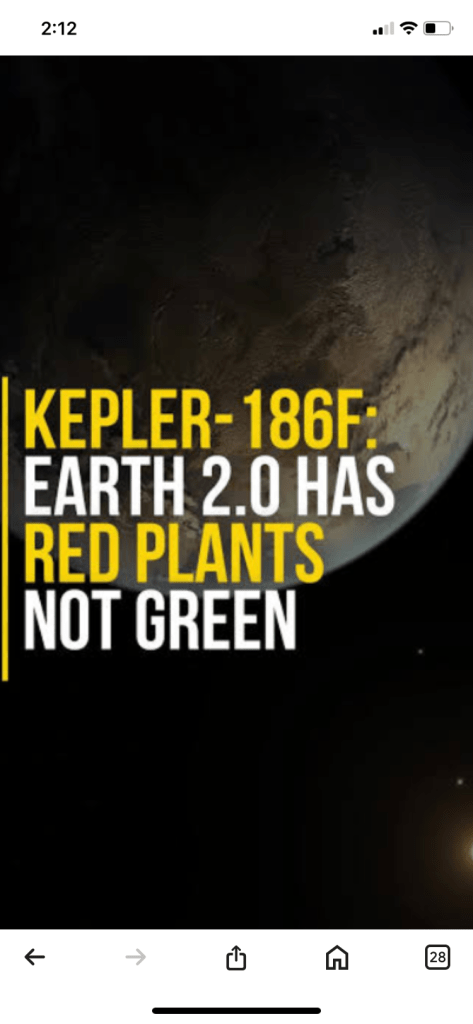
It’s important to clarify the distinction between scientific observation and artistic interpretation when discussing Kepler-186f. Here’s a breakdown:
- Kepler-186f:
- This is an exoplanet discovered by NASA’s Kepler Space Telescope.
- It’s significant because it’s the first Earth-size planet found in the habitable zone of another star, meaning liquid water could potentially exist on its surface.
- Kepler-186f orbits a red dwarf star, which is much cooler and redder than our Sun.
- Red Plants and Artistic Interpretation:
- The idea of red plants on Kepler-186f is a scientific hypothesis and artistic interpretation, not a confirmed observation.
- Scientists theorize that if plant life exists on Kepler-186f, it might have adapted to the redder light of its star by using different pigments than Earth plants.
- This could result in plants with red, orange, or other colorations.
- NASA has created artistic renderings of what plant life could look like on this planet, and those renderings often show red vegetation.
- So to be clear, we do not know for sure what color plant life would be on that planet.
- Key Points:
- The possibility of red plants stems from the understanding that different stars emit different wavelengths of light, which would influence the evolution of photosynthesis on orbiting planets.
- Kepler-186f is “Earth-like” in size and habitable zone location, but its star is very different from our Sun.
In summary, while we don’t have direct evidence of red plants on Kepler-186f, the scientific understanding of stellar radiation and photosynthesis makes it a plausible and intriguing possibility.
Possibility of red plants on other planets

When considering the possibility of red plants on other planets, it’s important to understand the factors that influence plant color. Here’s a breakdown of the science:
- Photosynthesis and Light:
- Plants on Earth are typically green because they use chlorophyll to absorb red and blue light for photosynthesis, reflecting green light.
- However, the color of a star significantly impacts the light available for photosynthesis.
- Planets orbiting red dwarf stars, which emit more red light, could potentially have plants that utilize different pigments, leading to red or even black coloration to maximize light absorption.
- Pigments:
- Besides chlorophyll, other pigments like carotenoids (which produce red, orange, and yellow colors) and phycobilins (found in some algae and cyanobacteria) can influence plant color.
- The presence and prevalence of these pigments on an alien planet would determine the color of its flora.
- Exoplanet Possibilities:
- Scientists theorize that planets around different types of stars could host plants with a wide range of colors.
- NASA research indicates that planets around cooler, redder stars might have plant life that has adapted to absorb red-wavelength photons, resulting in a redder color palette.
In essence, while green is dominant on Earth, the potential for red (or other colored) plant life on exoplanets is very real, driven by the diverse conditions found throughout the universe.
Can Kepler 186 has life
The question of whether Kepler-186f can harbor life is one of the most exciting and complex questions in exoplanet research. Here’s a breakdown of the factors involved:
Factors Supporting Potential Habitability:
- Habitable Zone:
- Kepler-186f resides within the habitable zone of its star. This means it’s at a distance where liquid water could potentially exist on its surface, a crucial ingredient for life as we know it.
- Earth-Sized:
- It’s an Earth-sized planet, which is significant because rocky planets like Earth are considered more likely to support life.
Factors That Create Uncertainty: - Red Dwarf Star:
- Kepler-186f orbits a red dwarf star. These stars are different from our Sun in several ways:
- They emit less light, which could affect the planet’s climate.
- They can produce powerful flares that could strip away a planet’s atmosphere.
- Tidal locking is a possibility, meaning one side of the planet always faces the star. This would create extreme temperature differences.
- Atmospheric Composition:
- We don’t yet know the composition of Kepler-186f’s atmosphere. This is a critical factor in determining its habitability. An atmosphere with the right greenhouse gases could trap enough heat to maintain liquid water, while a thin or nonexistent atmosphere would render the planet inhospitable.
- Lack of Definitive Data:
- Currently, we lack direct observations of Kepler-186f’s surface and atmosphere. Our understanding is based on estimations and models.
In summary: - Kepler-186f is a promising candidate for habitability, but it’s far from a certainty.
- The presence of liquid water, a suitable atmosphere, and other necessary conditions for life are still unknown.
- Future missions and advancements in technology will be needed to provide more definitive answers.
Therefore, while Kepler-186f has the potential to harbor life, we cannot say for sure that it does.
Please like subscribe comment your precious thoughts on universe discoveries
Full article source google
https://www.amazon.in/b?_encoding=UTF8&tag=555101-21&link
This is Amazon link if you want to buy anything from Amazon you can click on link to help my website universe discoveries grow freinds
https://www.buymeacoffee.com/Satyam55
Please donate me a coffee to help grow my website universe discoveries freinds
 Universe discoveries
🙏🌹
Aum Shanti
LikeLike
Very interesting!
LikeLike
Yes 👍 dear freind it shows that according to nature and composition of planet 🌍 plants can be of different colours and the life possibility also in other types of substance other than carbon as we know on earth 🌍
LikeLiked by 1 person