
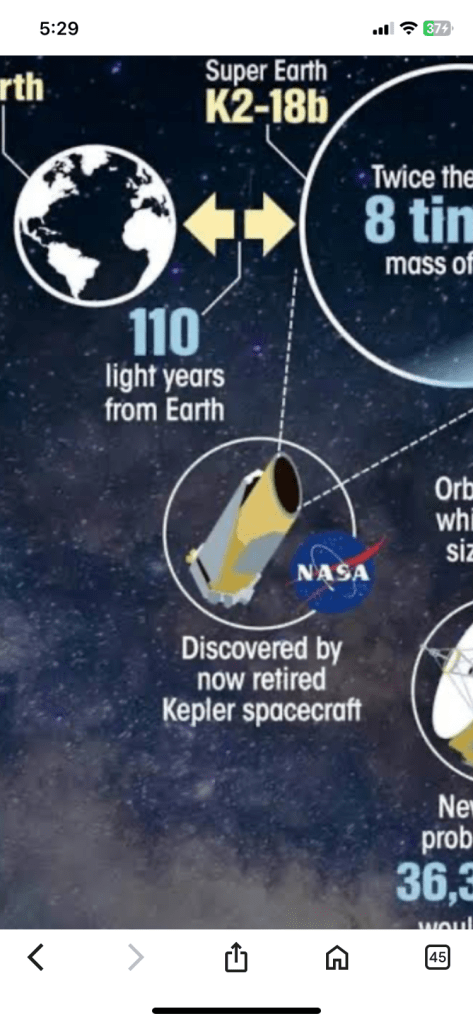
While K2-18b is a very promising candidate for potentially hosting life, it has not been confirmed to have alien life.
Here’s what we know about K2-18b and why there’s so much excitement:
- Habitable Zone: It orbits its star within the “habitable zone,” meaning it’s at a distance where liquid water, crucial for life as we know it, could exist on its surface.
- Water and Carbon-Bearing Molecules: Observations from the James Webb Space Telescope (JWST) have indicated the presence of water vapor and carbon-bearing molecules in its atmosphere.
- Possible Biosignature – Dimethyl Sulfide (DMS): Most notably, there has been a tentative detection of dimethyl sulfide (DMS) in K2-18b’s atmosphere. On Earth, DMS is almost exclusively produced by biological processes, particularly by marine phytoplankton. This is a significant finding as it could be a “biosignature” – a chemical fingerprint indicating the presence of life.
- “Hycean World” Candidate: K2-18b is considered a strong candidate for a “Hycean world,” a hypothetical type of planet that is larger than Earth but smaller than Neptune, with hydrogen-rich atmospheres and potentially global liquid water oceans.
Important Caveats: - Tentative Detection: The detection of DMS is still considered tentative, and more research and observations are needed to confirm it.
- Non-Biological Explanations: While DMS is strongly associated with life on Earth, scientists are still exploring if there could be non-biological processes on K2-18b that could produce this chemical in such quantities.
- No Direct Evidence of Life: Even if DMS is confirmed and its biological origin on K2-18b is strongly suggested, it does not constitute direct proof of alien life. It’s strong evidence, but not a confirmation of organisms themselves.
- Conditions for Life vs. Actual Life: Being in the habitable zone and having water and potential biosignatures means the conditions might be right for life, but it doesn’t guarantee that life has actually emerged or exists there.
In summary, K2-18b is incredibly exciting and represents the strongest hint yet of potential alien life on an exoplanet. However, the scientific community emphasizes that more research is needed before we can definitively say that alien life exists on K2-18b.
https://youtube.com/shorts/NzfQeMCfeNc?si=WIAI-sFBgE90sEkN
Click on link above to see the video of Kepler
Astrophysicist nikku Madhusudan of Indian 🇮🇳 origin has found compelling hints of potential biological activity on Kepler 18 b

No scientist has found alien life on K2-18b. It’s crucial to understand the distinction between “finding alien life” and “finding signs that could indicate alien life.”
However, a team led by Astrophysicist Nikku Madhusudhan of the University of Cambridge has been at the forefront of the research that has yielded the most compelling hints of potential biological activity on K2-18b.
Here’s what Dr. Madhusudhan’s team and other researchers have found using the James Webb Space Telescope (JWST):
- Detection of Water Vapor, Methane, and Carbon Dioxide: These are significant findings as they indicate a potentially habitable environment.
- Tentative Detection of Dimethyl Sulfide (DMS): This is the most exciting finding. On Earth, DMS is overwhelmingly produced by biological processes, primarily by marine phytoplankton. The detection of DMS in K2-18b’s atmosphere, while still tentative and requiring further confirmation, is considered a potential “biosignature” – a chemical fingerprint that could indicate the presence of life.
Important points to remember: - Not a Confirmation: The detection of DMS is a strong hint and very exciting, but it is not definitive proof of alien life. Scientists are still exploring all possible explanations, including non-biological ones, though terrestrial understanding suggests a biological origin for DMS.
- Ongoing Research: The scientific process involves rigorous testing and verification. More observations and independent analyses are needed to confirm the presence of DMS and to rule out any non-biological sources.
- Team Effort: While Nikku Madhusudhan is the lead author on key studies, these discoveries are the result of collaborative efforts by international teams of astronomers and scientists using advanced instruments like the James Webb Space Telescope.
So, while Dr. Madhusudhan and his team have made groundbreaking observations that have pushed the boundaries of our search for life beyond Earth, they have been careful to state that they have found “signs” or “hints” of life, not confirmed its existence.
Please like subscribe comment your precious comment on universe discoveries
Full article source google
 Universe discoveries
🙏🌹
Aum Shanti
LikeLike
Interesting information shared. ❤
LikeLike