
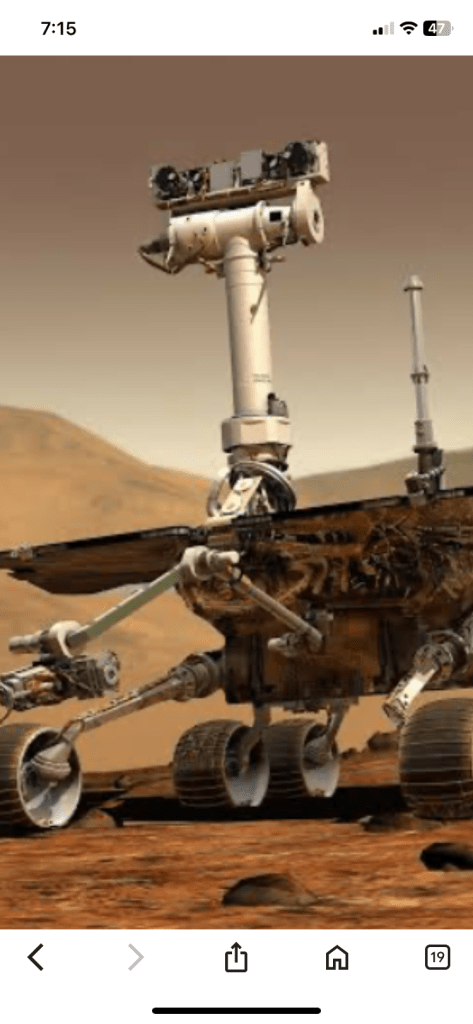
Reports circulating, including one from Unión Rayo, indicate that NASA’s Curiosity rover has indeed discovered traces of organic molecules on Mars. This finding, while not direct evidence of living organisms, is highly significant and has major implications for our understanding of the universe and humanity’s future.
Here’s a breakdown of what this means:
What was found?
- NASA’s Curiosity rover, specifically through its Sample Analysis at Mars (SAM) instrument, has detected the largest and most complex organic compounds found on Mars to date. These include long-chain hydrocarbons like decane, undecane, and dodecane.
- These molecules were found in a 3.7-billion-year-old rock sample from Gale Crater, an ancient lakebed on Mars. This period is roughly when life was emerging on Earth.
Why is this significant? - Building Blocks of Life: Organic molecules are the fundamental building blocks of life as we know it. Their presence suggests that Mars once had the necessary chemical ingredients for life to form.
- Past Habitability: The discovery reinforces the idea that ancient Mars was a more habitable environment, with liquid water present for millions of years.
- Preservation of Biosignatures: The fact that these complex organic molecules have been preserved for billions of years indicates that potential biosignatures (signs of past life) could still exist on Mars, despite the harsh radiation and oxidation on the surface.
- Advancement of Organic Chemistry: Finding larger, more complex organic molecules suggests that prebiotic chemistry on Mars may have advanced further than previously thought, approaching the complexity needed for the origin of life.
What does it NOT mean? - No immediate proof of current or past life: While exciting, this discovery is not direct proof of living Martian organisms (past or present). Organic molecules can also form through non-biological processes (abiotic sources).
- No “Martians” found: This is not evidence of alien plants, animals, or intelligent beings.
Implications for humanity’s future: - Understanding Life’s Origins: If life did exist on Mars, even microbial life, it would revolutionize our understanding of how life originates and whether it’s a common phenomenon in the universe. It could help answer fundamental questions about our own origins on Earth.
- “Plan B” for Earth: The ongoing exploration of Mars, including the search for habitable environments, is part of a broader effort to assess Mars’ potential as a future destination for human colonization. While terraforming Mars to be Earth-like is a distant prospect, understanding its resources and challenges is crucial.
- Astrobiology and the Search for Life Beyond Earth: This discovery fuels the field of astrobiology and informs the strategies for searching for life on other planets and moons in our solar system and beyond.
- Technological Advancements: The challenges of Mars exploration continue to drive innovation in various fields, from robotics and propulsion to life support systems and sustainable living in extreme environments.
In summary, while the headlines might be dramatic, the scientific findings are nuanced. NASA has indeed found crucial evidence of complex organic chemistry on Mars, a significant step that strengthens the case for past habitability and increases the tantalizing possibility that life once existed there. The ongoing research and future sample return missions will be vital in further unraveling Mars’s secrets and potentially changing our understanding of life in the cosmos.
Signs of life on Mars? Thanks to the Curiosity rover, NASA was able to study Mars and look for these signs. During this mission, Curiosity found organic compounds and hydrocarbons, which are important clues. This discovery is part of a bigger goal: space exploration and the possible colonization of Mars. Scientists also study the Martian atmosphere and measure time in Martian days to understand how life could survive there. So, let’s see what NASA discovered more in detail and the importance of it.
Why are we looking toward Mars?

Earth is having many problems, like the damage to the ozone layer, which is a part of the sky that protects us from the sun. But it’s getting thinner, and that makes living here more difficult over time. That’s why scientists from all over the world, including those from NASA, are looking at other planets where maybe we could live in the future.
One of those planets is Mars, which is pretty close to Earth compared to other planets. The big question scientists ask is: Could life exist on Mars? Or at least, did life exist there a long time ago?
Will we be able to live on Mars someday?
A question many people ask is: Will we be able to live on Mars like we live on Earth? The answer right now is: not completely. The air on Mars is very toxic and dangerous for humans. This is because of something called rust, which covers almost the whole surface and gives the planet its red color. We wouldn’t be able to breathe or survive there without special suits or without building a protected environment.
But not everything is lost. Scientists are thinking about ways to change Mars’ air, so that one day it could be more like Earth’s. One idea (even if it sounds extreme) is to use nuclear explosions to change the gases in Mars’ air. That idea hasn’t been used yet and it’s not approved, but it shows they are looking for solutions.
Please like subscribe comment your precious comment on universe discoveries
Full article source google
 Universe discoveries
🙏🌹
Aum Shanti
LikeLike