

Mars became a frigid desert while Earth sustained life primarily due to the loss of Mars’s protective global magnetic field and subsequent atmospheric stripping by the solar wind.
Here’s a breakdown of the key factors:
Mars’s Desertification:
- Loss of Magnetic Field: Early in its history, Mars had a substantial global magnetic field, similar to Earth’s. This magnetic field acted as a shield, deflecting the solar wind (a stream of charged particles from the sun) and protecting its atmosphere. However, geological evidence suggests that Mars lost this magnetic field around 4 billion years ago. Scientists believe this loss may have been due to its smaller size, allowing its core to cool and solidify, thus shutting down its internal “dynamo” that generates the magnetic field. Some theories even suggest a massive asteroid impact could have played a role in disrupting its dynamo.
- Atmospheric Stripping: Without a global magnetic field, Mars’s atmosphere was directly exposed to the relentless solar wind and radiation. The solar wind essentially “sputtered” away atmospheric gases, knocking atoms into space. This process was particularly efficient early in Mars’s history when the young sun had much more intense ultraviolet radiation and winds.
- Loss of Water: A thick atmosphere is crucial for retaining heat and allowing liquid water to exist on the surface. As Mars’s atmosphere thinned, the planet became colder, and liquid water either froze or evaporated into space. Carbon dioxide, a major component of Mars’s atmosphere and a greenhouse gas, was also lost to space, further contributing to the cooling.
- Lack of Geological Activity: Unlike Earth, Mars is not tectonically active. This means it lacks the ongoing volcanic activity that on Earth helps to replenish atmospheric gases through outgassing.
Earth’s Ability to Sustain Life: - Strong Global Magnetic Field: Earth has a robust global magnetic field generated by the convection of molten iron in its core. This magnetosphere acts as a vital shield, protecting our atmosphere from the solar wind and preventing it from being stripped away.
- Thick Atmosphere: Earth’s relatively thick atmosphere (primarily nitrogen and oxygen) traps heat, creating a moderate temperature range suitable for liquid water. It also provides essential gases for life and protects the surface from harmful solar radiation.
- Abundant Liquid Water: Earth is often called the “Blue Planet” because of its vast oceans. The presence of liquid water is a fundamental requirement for all known life, acting as a solvent and a medium for chemical reactions. Earth’s water is constantly recycled through the water cycle (evaporation, condensation, precipitation). While the exact origin of Earth’s water is still debated, it’s believed to have been present during its formation or delivered later by icy asteroids and comets.
- Plate Tectonics and Carbon Cycle: Earth’s active plate tectonics play a crucial role in regulating its climate and maintaining a stable atmosphere. Volcanic activity releases gases, including carbon dioxide, into the atmosphere, which contributes to the greenhouse effect. The carbon cycle, involving the exchange of carbon between the atmosphere, oceans, land, and rocks, helps to regulate Earth’s temperature over long timescales.
In essence, Earth’s internal dynamics (generating a magnetic field and driving plate tectonics) and its favorable distance from the sun have allowed it to retain a thick, protective atmosphere and abundant liquid water, creating the conditions necessary for life to thrive, while Mars’s lack of these crucial elements led to its transformation into the cold, dry desert we see today.
Scientists view

For decades, scientists have puzzled over why Earth stayed warm and alive while Mars turned cold and dry. Both planets began with similar ingredients—rocky surfaces, carbon, water, and sunlight—but their paths split dramatically
A new study led by Edwin Kite from the University of Chicago offers a compelling explanation: Mars had brief wet periods sparked by the slowly brightening sun, but its own geology shut them down, pushing it back to desert.
Published in the journal Nature, the study builds on recent discoveries by NASA’s Curiosity rover, which found carbonate-rich rocks in Mars’ surface. These rocks reveal a hidden story of a planet that may have once supported water, but couldn’t keep it for long.
Short Bursts of Warmth, Long Ages of Cold
On Mars, ancient riverbeds and lake basins carved into the surface show that liquid water once flowed freely. These wet periods came and went over billions of years. Kite and his team now believe that each warm spell began when the sun’s brightness slowly increased. That sunlight melted ice or snow, letting water run across the surface.
But here’s the catch: as water moved across Martian soil, it pulled carbon dioxide from the air and locked it into rock as carbonate. This reduced the greenhouse gases in the atmosphere, cooling the planet and ending the water flow.
The same process happens on Earth. Carbon is taken from the air, stored in rock, then released later through volcanic eruptions. This keeps the climate fairly stable. But Mars has been mostly volcanically quiet for a long time. With little to no volcanic outgassing, Mars had no way to bring back the carbon it lost.
Our models suggest that periods of habitability on Mars have been the exception, rather than the rule,” said Kite, who also works with the Curiosity team. “Mars generally self-regulates as a desert planet.”
Mars vs. Earth: A Delicate Balance
Earth’s climate has remained stable for more than 3.5 billion years. That balance depends on carbon cycling between the atmosphere and the planet’s crust. Volcanic eruptions push carbon out, while weathering and sedimentation draw it in. This feedback loop has helped maintain Earth’s mild climate.
Mars’ Patchy Oases and Chaotic Orbits
Kite’s team used a detailed model to simulate how Mars’ climate changed over billions of years. The model included chaotic shifts in the planet’s orbit, carbonate formation, and carbon loss to space. Their results showed that warm phases were patchy, not global. Snowmelt or shallow groundwater might have fed small oases, but most of the planet stayed dry.
A New Way to Understand Habitability
This new research reshapes how we view Mars’ past and raises questions about what makes planets habitable. Earth may seem lucky, but its long-term climate stability depends on a delicate carbon balance—one that Mars lost early in its history.
With ongoing missions like Curiosity and Perseverance, and data from orbiting spacecraft, scientists are piecing together a clearer story. Mars didn’t just lose its habitability by accident. It was wired to become a desert from the start.
Mars in science fiction
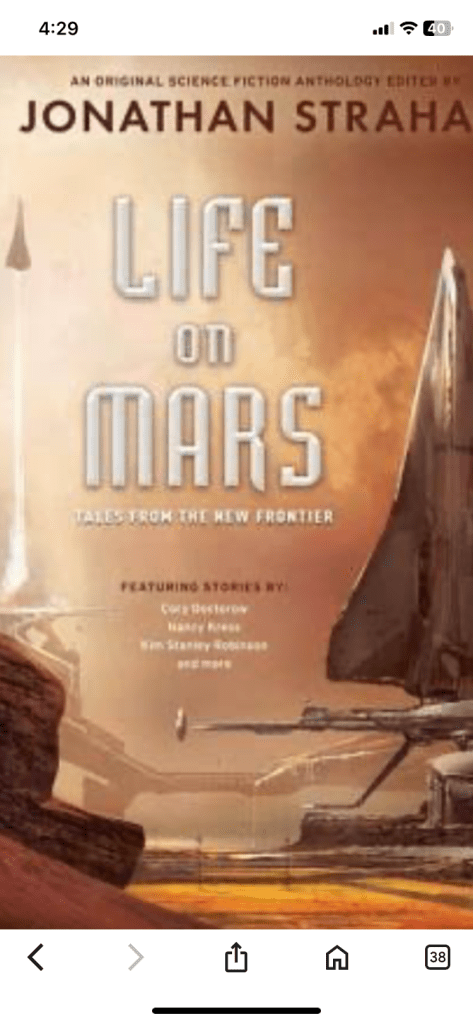
Mars has held a truly unparalleled place in science fiction, often serving as a canvas for humanity’s hopes, fears, and reflections on itself. Its prominent reddish hue, relative proximity, and early scientific speculation about “canals” and potential life made it the most popular extraterrestrial setting in fiction for many years.
Here’s a breakdown of key aspects of Mars in science fiction:
Early Inspirations and Themes (Late 19th – Mid 20th Century):
- The “Canals” and Dying Civilizations: A major catalyst was the misinterpretation of Italian astronomer Giovanni Schiaparelli’s “canali” (channels) as “canals” by Percival Lowell in the late 19th century. This sparked the widespread belief that Mars was home to an ancient, dying civilization that had built these structures to irrigate their desiccating planet. This idea fueled countless stories.
- The Benevolent/Utopian Martian: Early works often depicted Martians as wise, peaceful, and technologically advanced beings, sometimes offering a utopian vision or a critique of human society. Examples include:
- Kurd Lasswitz’s Two Planets (1897): Imagined a technologically superior Martian civilization.
- The Hostile/Invading Martian: The most iconic portrayal, largely due to H.G. Wells:
- H.G. Wells’s The War of the Worlds (1898): This novel established the trope of Martians as technologically superior, ruthless invaders seeking Earth’s resources as their own planet died. It reflected anxieties about imperialism and technological warfare. This book had a profound impact on the genre and popular culture, especially with Orson Welles’s famous 1938 radio broadcast.
- The Decadent/Exotic Martian: Edgar Rice Burroughs introduced a more adventurous and fantastical Mars:
- Edgar Rice Burroughs’s “Barsoom” series (starting with A Princess of Mars, 1912): This series portrayed a Mars (called “Barsoom” by its inhabitants) with a dying but still vibrant civilization, warring tribes, exotic creatures, and a swashbuckling hero, John Carter, who gains superhuman strength due to Mars’s lower gravity. These stories blended science fiction with adventure and romance.
- The Dying Planet and Human Colonization: The idea of Mars as a dying world, either previously inhabited or simply waiting for human settlement, became a pervasive theme.
- Ray Bradbury’s The Martian Chronicles (1950): A poignant collection of interconnected stories exploring humanity’s colonization of Mars, the subtle, fading Martian civilization, and the bittersweet consequences of human expansion. It often used Mars as a mirror to reflect on human flaws and desires, including colonialism, prejudice, and the longing for new beginnings.
- The Exotic Life Forms: Not all Martians were human-like.
- Stanley G. Weinbaum’s “A Martian Odyssey” (1934): Featured genuinely alien and often bizarre life forms, moving away from purely humanoid depictions.
Later Eras and More Scientific Realism (Late 20th Century – Present): - Post-Viking Missions: As robotic probes like Mariner and Viking revealed a cratered, barren, and atmosphere-thin Mars, the romantic notions of canal-building civilizations faded. Science fiction began to incorporate this new scientific understanding, shifting towards more realistic portrayals of colonization challenges and terraforming.
- Terraforming and Colonization: The ambition to make Mars habitable for humans became a central theme.
- Kim Stanley Robinson’s “Mars Trilogy” (Red Mars, Green Mars, Blue Mars, 1992-1996): This monumental series is a seminal work on Mars colonization and terraforming. It meticulously explores the scientific, political, social, and philosophical complexities of transforming Mars into a habitable world over centuries, grappling with questions of environmental ethics, identity, and humanity’s future.
- Survival and Exploration: Modern stories often focus on the harsh realities of living and working on Mars, emphasizing scientific problem-solving and human resilience.
- Andy Weir’s The Martian (2011, adapted into film 2015): A highly popular and scientifically grounded story about an astronaut stranded on Mars who must use his ingenuity and scientific knowledge to survive. This represented a shift towards more hard science fiction.
- Various other novels and films: Many contemporary works delve into the challenges of establishing permanent human bases, resource extraction, and the psychological toll of isolation on the Red Planet.
Recurring Themes and Concepts: - The “Red Mirror”: Mars often serves as a metaphorical “red mirror” reflecting Earth’s own issues – colonialism, environmental degradation, war, and the search for new frontiers.
- Humanity’s Future/Destiny: Mars is frequently depicted as humanity’s next step, a crucial escape valve for an overpopulated Earth, or a proving ground for our resilience and ingenuity.
- The Nature of Alien Life: From invading monsters to wise elders, and from dying civilizations to potential microbial life, Mars has been a constant testing ground for our imagination regarding extraterrestrial beings.
- Technological Advancement: Stories set on Mars often showcase advanced technology, particularly in areas of space travel, life support, and planetary engineering (terraforming).
- Survival and Adaptation: Whether it’s the physical challenges of a harsh environment or the psychological ones of isolation, survival is a persistent theme.
Mars continues to be a fertile ground for science fiction, evolving with our scientific understanding of the planet while retaining its profound capacity to inspire and challenge us.
Please like subscribe leave your precious comments on universe discoveries
Full article source google
In this website universe discoveries we cover universe latest discoveries topics history technology and Sharemarket knowledge we try to educate our new and old generation so please help us and donate a coffee so we can do it for ever
 Universe discoveries
🙏🌹
Aum Shanti
LikeLiked by 1 person