
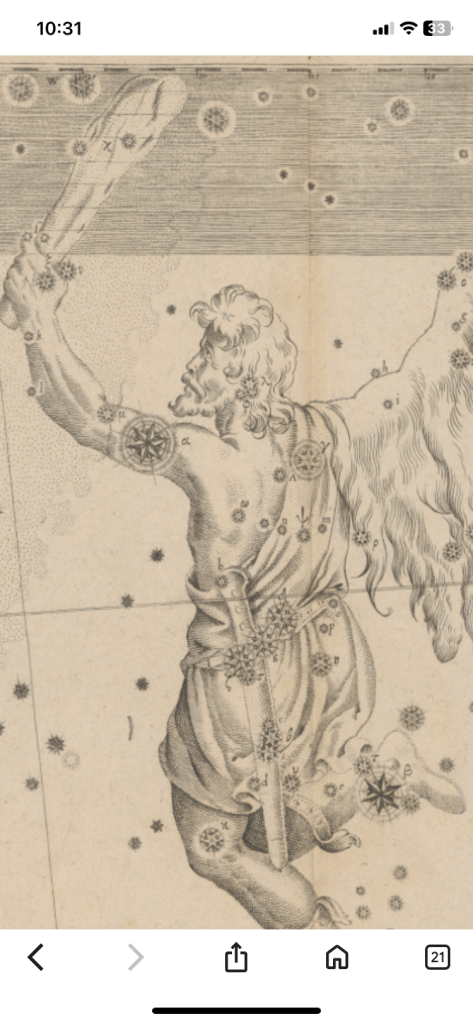
Based on scientific knowledge, the Orion’s Belt is a part of the constellation Orion and
has no connection to the home of any deity. However, some ancient mythologies and spiritual traditions have associated the stars of Orion’s Belt with gods and other supernatural beings.
Scientific and astronomical perspective
- Orion’s Belt is an “asterism”—a simple, recognizable star pattern—within the larger Orion constellation.
- The three stars that form the belt—Alnitak, Alnilam, and Mintaka—are not physically close to each other, but appear to be in a line when viewed from Earth.
- Alnitak is approximately 800 light-years away, Alnilam is 2,000 light-years away, and Mintaka is about 915 light-years away.
- These are enormous, luminous blue supergiant stars that are extremely hot and much larger than our sun.
- The region around Orion’s Belt is a massive stellar nursery, an area of the galaxy where new stars are forming from clouds of gas and dust.
Mythological and spiritual significance
While it is not a divine home in a physical sense, Orion’s Belt has been revered as a celestial home or symbol of gods in several cultures:
- Ancient Egypt: In Egyptian mythology, the stars of Orion were associated with the god Osiris, the god of the afterlife, rebirth, and resurrection. Some texts describe Orion as the resting place for Osiris’s soul, and there is a discredited fringe theory that the Giza pyramids were aligned with the belt stars.
- Babylonian Religion: The Babylonians called Orion “The True Shepherd of Anu,” with Anu being the chief god of the sky.
- Chinese Mythology: The Chinese knew the belt as “San Xing” (“Three Bodies”), with the three stars representing the gods of prosperity, luck, and longevity.
- Inca Traditions: Some Andean traditions view Orion’s Belt as connected to the “Chakana,” or Inca Cross, which serves as a spiritual bridge to other dimensions and sources of wisdom.
- Starseed Beliefs: Modern “Starseed” beliefs, often associated with New Age spirituality, suggest that some individuals originate from the Orion constellation.
In summary, the notion of Orion’s Belt being the “home of god” is not supported by science but is a theme found within the religious and mythological beliefs of some ancient and modern spiritual traditions.
Could orion belt be home 🏠 of ancient aliens
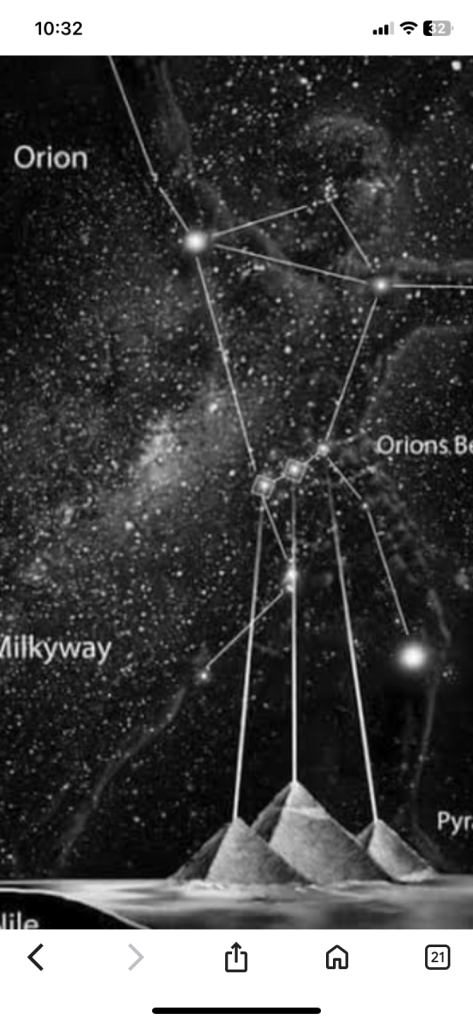
The idea that Orion’s Belt is the home of ancient aliens is a concept associated with fringe theories, most notably the Orion correlation theory. There is no scientific or mainstream archaeological evidence to support this claim.
Orion Correlation Theory
The most famous theory connecting Orion’s Belt to ancient civilizations and often, by extension, to alien intervention, is the Orion correlation theory.
• The Claim: This theory posits a precise correlation between the relative positions of the three largest pyramids of the Giza pyramid complex in Egypt and the three stars that make up Orion’s Belt—Alnitak, Alnilam, and Mintaka—as they appeared in the sky around the 11th millennium BC (though other dates are sometimes cited).
• The Interpretation: Proponents of the “ancient aliens” hypothesis use this perceived alignment as evidence that extraterrestrials influenced or assisted the ancient Egyptians in building the pyramids. The constellation Orion was associated with the god Osiris, the god of the afterlife and rebirth, in ancient Egyptian mythology, which is a fact often woven into these theories.
• Scientific View: The Orion correlation theory is considered a fringe theory and is not accepted by mainstream Egyptologists or astronomers. Critics point out that the alignments are not exact and that the concept relies heavily on selective interpretation.
Orion’s Belt: An Astronomical View
In reality, Orion’s Belt is an asterism (a recognizable pattern of stars) within the Orion constellation.
• It is made up of three supergiant stars: Alnitak, Alnilam, and Mintaka.
• These stars are located at vast distances from Earth—hundreds to over a thousand light-years away—and are not physically close to each other in space; their arrangement is merely an illusion of perspective from Earth.
• While astronomers have discovered exoplanets (planets outside our solar system) in the wider Orion constellation, there is no credible evidence of alien life or civilizations connected to the Belt’s three stars.
Other Alien-Connected Star Systems
It’s worth noting that other star systems, though not Orion’s Belt itself, are often cited in alien theories. For instance, the Zeta Reticuli star system is frequently mentioned in UFO lore, specifically in connection with the Grey aliens following the accounts of the Betty and Barney Hill abduction incident.
What is so special about Orion belt

Orion’s Belt is special for a variety of reasons, spanning from its prominence in the night sky to its significance in both science and ancient mythology.
1. The Easiest Star Pattern to Recognize
Orion’s Belt is arguably the most recognizable asterism (a prominent pattern of stars that isn’t an official constellation) in the night sky.
• Distinctive Shape: It consists of three bright stars—Alnitak, Alnilam, and Mintaka—lined up in a nearly perfect, straight row. This arrangement makes it incredibly easy to spot from almost anywhere in the world during the winter months in the Northern Hemisphere.
• A Celestial Pointer: Because it is so distinct, it’s often used by stargazers to locate other important stars and objects. Following the line of the Belt points towards the brightest star in the entire sky, Sirius (down and to the left), and also towards the bright red star Aldebaran (up and to the right).
2. A Cosmic Lighthouse and Star Factory
From a scientific perspective, the stars of the Belt and the region around them are exceptional:
• Giant, Hot Stars: The three belt stars are incredibly massive and luminous blue supergiant stars. They are many times larger and tens of thousands of times brighter than our Sun.
• Alnitak and Mintaka are not single stars, but actually complex multiple-star systems.
• Proximity to Star Formation: Hanging directly below the Belt is Orion’s Sword, which is home to the Orion Nebula (M42). This is the closest major star-forming region to Earth, making it a vital laboratory for astronomers studying stellar birth.
• Surrounded by Nebulae: The stars in the Belt are also illuminating vast clouds of gas and dust, most famously the Flame Nebula (near Alnitak) and the ghostly Horsehead Nebula, making the whole area a beautiful and active region of the galaxy.
3. Rich Historical and Cultural Significance
The prominent visibility of Orion’s Belt has given it deep meaning across different ancient cultures:
• Ancient Egypt: The stars in the belt were associated with the god Osiris, the god of the afterlife, and the entire constellation represented the resting place of his soul.
• Multiple Names: The easily recognizable trio has earned common names in various cultures, such as:
• The Three Kings (or Three Wise Men)
• The Three Marys
• In Spanish and Portuguese, Las Tres Marías or As Três Marias.
• Navigational Aid: Because the Belt lies very close to the celestial equator (the projection of Earth’s equator onto the sky), it was a valuable tool for ancient mariners and navigators.
Please like subscribe comment your precious comments on universe discoveries
Full article source google
https://www.buymeacoffee.com/Satyam55
https://www.amazon.in/b?_encoding=UTF8&tag=555101-21&link
https://youtube.com/shorts/Rc16tneFwQ0?si=gjnto3P-ppcpper8
Click on the above link to know about Orion constellation
https://youtu.be/ZoanqJNy7bg?si=IVNduVYBvLoVekYV
One more video on Orion and are gods are from orion
 Universe discoveries
🙏🌹
Aum Shanti
LikeLiked by 1 person