
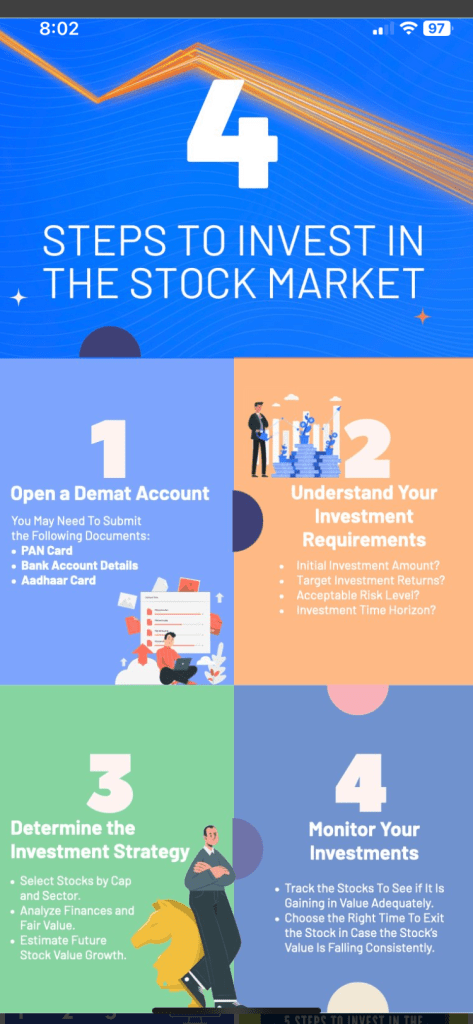
For beginners, investing in the share market requires understanding the basics, opening a Demat and trading account, researching investments, and managing risk
. Before you begin, it is important to define your investment goals, understand your risk tolerance, and determine how much you can afford to invest.
Understand the fundamentals
- Stocks vs. Shares: A “stock” is a financial instrument representing ownership in a corporation, while a “share” is a single unit of that ownership. When you buy stock, you own a piece of the company.
- Stock Market: This is where stocks and other financial products like bonds and mutual funds are bought and sold. Exchanges like the Bombay Stock Exchange (BSE) and the National Stock Exchange (NSE) provide the platform for these trades.
- IPOs: When a company first lists its shares on a stock exchange to raise capital, it is known as an Initial Public Offering.
- Dividends: Some companies share their profits with shareholders, paying out these earnings as dividends.
Get started with investing
- Open an account: You will need to open a Demat account to hold your shares electronically and a trading account to facilitate the buying and selling of those shares. Choose a reputable, SEBI-registered broker by comparing their fees, trading platform, and customer support.
- Fund your account: Once your accounts are set up, transfer funds from your bank account to your trading account.
- Learn research and analysis: Before investing, research companies by examining their financials, business model, and growth prospects.
- Fundamental Analysis: This involves evaluating a company’s financial health, management, and industry to determine its intrinsic value. Look at metrics like the Price-to-Earnings (P/E) ratio and the Debt-to-Equity ratio.
- Technical Analysis: This focuses on studying historical price movements and market trends to predict future price direction.
- Practice with a simulator: Consider using a stock market simulator to practice trading with virtual money before you start investing real capital.
Create and manage your portfolio
- Diversify your portfolio: To minimize risk, spread your investments across different stocks or asset classes instead of putting all your money into a single company.
- Choose investment types: As a beginner, consider starting with relatively stable investments:
- Blue-Chip Stocks: Shares of large, well-established, and financially sound companies.
- ETFs (Exchange-Traded Funds): These funds track market indexes and offer instant diversification.
- Mutual Funds: These pool money from many investors to invest in a diversified portfolio of stocks or bonds.
- Monitor and adjust: Regularly review your investments and stay informed about market news. Your investment strategy should evolve with your goals and life circumstances.
Manage investment risk
- Understand risk tolerance: Your risk tolerance is your ability and willingness to take on risk. Consider your time horizon and financial cushion when determining your comfort level.
- Set clear goals: Define your investment objectives, whether they are long-term (e.g., retirement) or short-term (e.g., saving for a home).
- Invest what you can lose: Only invest money you can afford to lose, without jeopardizing your financial stability.
Guide to invest in mutual funds

For beginners, investing in mutual funds involves defining your financial goals, choosing the right fund type based on your risk appetite and investment horizon, completing the KYC process, and starting a Systematic Investment Plan (SIP) or a lump sum investment
. Mutual funds pool money from multiple investors to invest in a diversified portfolio of securities like stocks and bonds, managed by a professional fund manager.
Steps to invest in mutual funds
- Assess your financial goals and risk appetite: Before investing, identify your investment purpose, time horizon, and risk tolerance.
- Long-term goals (10+ years) like retirement or child’s education often align with higher-risk equity funds, which invest primarily in stocks.
- Medium-term goals (5-10 years)may suit hybrid funds that balance a mix of stocks and bonds.
- Short-term goals (less than 5 years) are better suited for lower-risk debt funds or liquid funds that invest in fixed-income instruments.
- Complete Know Your Customer (KYC) compliance: To invest in mutual funds, you must complete the KYC process with a PAN card and proof of address. This can be done online or offline.
- Choose a fund type: Understand the main mutual fund categories to make an informed choice:
- Equity funds: Invest in stocks and offer higher growth potential but come with greater risk.
- Debt funds: Invest in fixed-income securities like bonds, offering more stable returns with lower risk.
- Hybrid funds: Invest in a mix of equity and debt to balance risk and potential returns.
- Index funds: Passively managed funds that replicate a market index like the Nifty 50, providing diversification at a lower cost.
- ELSS (Equity Linked Savings Schemes): A type of equity fund that offers tax benefits under Section 80C but has a mandatory 3-year lock-in period.
- Decide on your investment method: You can invest in two ways:
- Systematic Investment Plan (SIP): Invest a fixed, regular amount over time. This helps average out your investment cost through “rupee cost averaging” and is recommended for beginners.
- Lump sum: Invest a large, one-time amount.
- Choose a direct or regular plan:
- Direct Plan: Purchased directly from the Asset Management Company (AMC). It has a lower expense ratio (management fees) because there is no intermediary commission.
- Regular Plan: Purchased through a distributor or broker, which involves a commission and a higher expense ratio.
- Invest and monitor: You can invest online through a fund house website, an investment app, or through a broker. Once invested, regularly monitor your fund’s performance against its benchmark and review your portfolio to ensure it aligns with your financial goals.
Key factors to consider when choosing a fund
- Expense Ratio: The annual fee charged by the AMC for managing the fund. Lower ratios mean more returns for you.
- Past Performance: While not a guarantee of future returns, a fund’s consistent performance across various market cycles indicates a reliable track record.
- Fund Manager’s Experience: The experience and track record of the fund manager and their team can be a good indicator of the fund’s potential.
- Assets Under Management (AUM): A large AUM can indicate stability, but it’s not the sole criterion.
- Exit Load: A fee charged if you redeem your units before a specified time period.
Investing in ETF
An Exchange-Traded Fund (ETF) is an investment fund that holds multiple underlying assets and is traded on a stock exchange, similar to an individual stock. ETFs are popular for offering diversification, lower costs than actively managed mutual funds, and trading flexibility. To invest, you must first open a Demat and trading account, then research and select ETFs that align with your financial goals.
How to invest in ETFs
- Open an account: You will need a Demat account to hold ETF units electronically and a trading account to buy and sell them. You can open these with an online broker or a traditional broker-dealer.
- Fund your account: Transfer money from your bank account to your trading account to begin investing.
- Use an ETF screener: Utilize tools on brokerage platforms to filter ETFs based on criteria such as trading volume, expense ratio, holdings, and past performance.
- Place your trade: Once you have selected an ETF, you can place an order to buy units during market hours. You can buy and sell ETF units at any point during the day, with the price fluctuating based on market demand.
Key factors for choosing an ETF
- Fund Type: Choose an ETF based on your investment goals.
- Equity ETFs: Invest in stocks and are suitable for growth-focused investors.
- Bond ETFs: Invest in fixed-income assets and are better for stable income.
- Commodity ETFs: Track commodities like gold or silver.
- International ETFs: Allow investment in foreign securities for global diversification.
- Expense Ratio: The annual fee for managing the fund. Since most ETFs are passively managed, their expense ratios are generally low compared to actively managed mutual funds.
- Liquidity and Bid-Ask Spread: Higher liquidity generally means a narrower bid-ask spread, which reduces the cost of buying and selling.
- Performance and Tracking Error: Check the ETF’s past performance and its tracking error, which is the difference between the ETF’s return and the return of the index it tracks.
ETF vs. Mutual Fund
- Trading: ETFs trade on exchanges throughout the day, like stocks, while mutual funds are priced only once daily, after the market closes.
- Cost: ETFs generally have lower expense ratios than actively managed mutual funds due to passive management.
- Investment Process: Investing in ETFs requires a Demat account, while mutual funds can be purchased directly from a fund house with just a bank and KYC-compliant PAN.
Tips for beginners
- Define Your Strategy: Have a long-term investment plan with clear goals and risk assessment.
- Avoid Chasing Past Performance: Do not assume that an ETF’s past performance guarantees future returns.
- Diversify: While ETFs offer inherent diversification, it is wise to be mindful of geographic or sector concentration to manage risk.
- Consider a Long-Term View: Refrain from trading frequently, which can lead to higher costs from commissions and bid-ask spreads.
Trading in options and future
Options and futures are derivative financial instruments used for hedging, speculation, and leveraging positions in the market, but they function differently regarding obligation, risk, and potential returns. Before trading, you must open a derivatives trading account, understand market trends, and implement a risk management strategy.
Futures contracts
- What they are: A futures contract is an agreement to buy or sell an underlying asset—such as a stock, index, or commodity—at a pre-agreed price on a specific date in the future.
- Obligation: Unlike options, a futures contract obligates both the buyer and the seller to complete the transaction on the expiry date.
- How they work: If you buy (go “long”) a futures contract, you profit if the underlying asset’s price increases. If you sell (go “short”), you profit if the price decreases.
- Leverage: Futures trading allows you to control a large position with a small upfront investment, called a margin. This can magnify profits but also carries the risk of unlimited losses.
- Risk: The risk in futures trading is unlimited and can exceed your initial investment, unlike options trading where the risk for the buyer is limited.
Options contracts
- What they are: An options contract grants the holder the right, but not the obligation, to buy or sell an underlying asset at a set strike price by a specific date.
- Obligation: The buyer has the choice to exercise the option, while the seller must fulfill the contract if exercised.
- Types: Call options give the right to buy, suitable if you expect prices to rise; put options give the right to sell, suitable if you expect prices to fall.
- Premium: The buyer pays a non-refundable premium to the seller. The buyer’s maximum loss is the premium, while the seller’s loss can be unlimited.
- Other factors: Options are categorized by moneyness (in-the-money, at-the-money, out-of-the-money) and are subject to time decay as they near expiration.
How to start trading F&O
- Open an account: Choose a broker offering derivatives trading and complete the necessary verification.
- Learn the fundamentals: Understand core terms like strike price, premium, margin, and expiry dates.
- Choose a strategy: Select a strategy aligning with your market outlook and risk tolerance.
- Manage risk: Employ techniques like stop-loss orders and managing position sizes.
- Monitor and execute: Track the market and make trades according to your plan.
Key considerations
- Risk: F&O trading is highly leveraged and inherently risky, especially futures which have unlimited risk. Most retail traders experience losses in F&O.
- Expertise: Success requires a strong understanding of market trends and risk management.
- Holding period: F&O contracts have fixed expiry dates and are not suitable for long-term investing.
Please like subscribe comment your precious thoughts on universe discoveries
Full article source google
 Universe discoveries
🙏🌹
Aum Shanti
LikeLiked by 1 person