
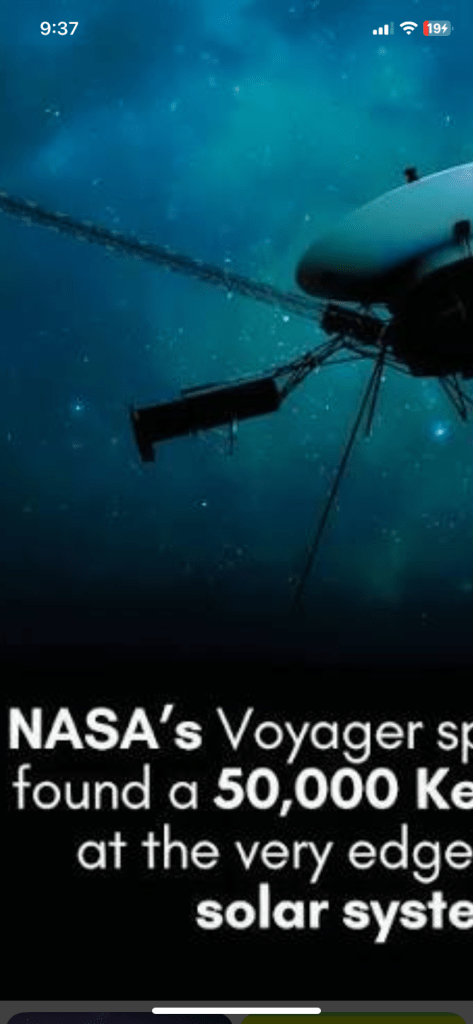
NASA’s Voyager 1 and Voyager 2 spacecraft confirmed the existence of a superheated “wall” of plasma at
the heliopause, the boundary where the Sun’s solar wind meets the interstellar medium.
Key Characteristics of the “Wall”
- Temperature: Sensors detected temperatures spiking between 30,000 and 50,000 Kelvin (approximately 54,000 to 90,000°F).
- Composition: It is not a physical wall but a dense region of charged plasma particles and neutral hydrogen atoms that pile up and heat as they collide at the edge of the heliosphere.
- Distance: This boundary is located approximately 120 astronomical units (AU) from the Sun (roughly 11 billion miles or 18 billion kilometers).
- Shielding Effect: Often described as a “cosmic shield,” this region helps protect the solar system by deflecting or absorbing about 70% of harmful galactic cosmic rays.
Why the Spacecraft Didn’t Melt
Despite the astronomical temperatures, the Voyager probes passed through safely because the region is an extreme vacuum.
- Low Density: The particles are so sparse that they rarely collide with the spacecraft.
- Heat vs. Temperature: In space, “temperature” measures the kinetic energy (speed) of individual particles. Because there is so little matter, there is not enough mass to transfer substantial thermal energy to the probes’ surfaces.
Mission Status in 2025
- Voyager 1: Launched in 1977, it crossed the heliopause in 2012 and is currently more than 24 billion kilometers from Earth.
- Voyager 2: It crossed in 2018 and continues to provide the first direct measurements of the temperature and density of interstellar plasma from over 21 billion kilometers away as of late 2025.
- Future Research: In 2026, NASA plans to launch the Interstellar Mapping and Acceleration Probe (IMAP) to further study this boundary and how it interacts with the galaxy.
Please like subscribe comment your precious comment on universe discoveries
Full article source google
 Universe discoveries
🙏🌹
Aum Shanti
LikeLike
A fascinating and clearly presented glimpse into one of the most mysterious frontiers of our solar system. I love how this breaks down complex science into something both awe-inspiring and easy to understand—especially the explanation of how such extreme temperatures can exist without harming the Voyager probes. It really highlights the elegance of space physics and the incredible foresight behind these missions. A wonderful reminder of how much there still is to discover beyond our cosmic doorstep. 🚀✨
LikeLike
LikeLike