
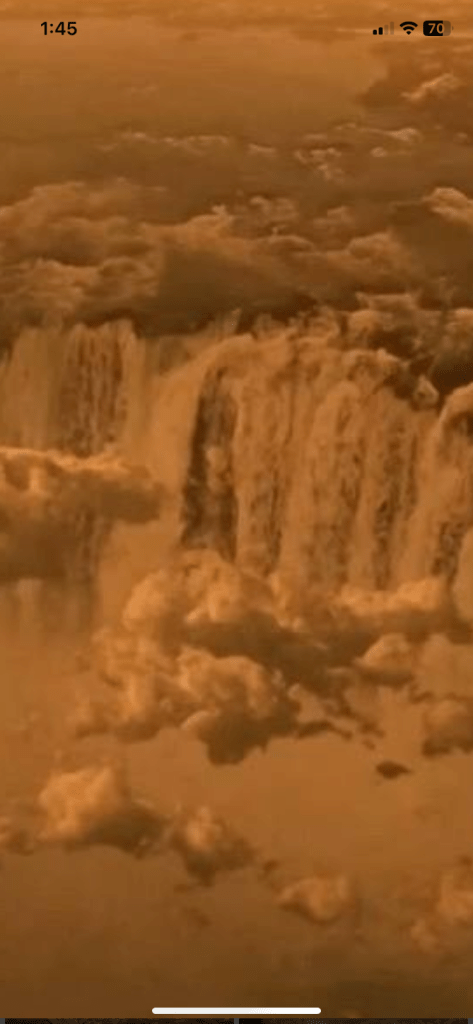
The water fall was approximately 4 kilometers high. This clearly indicates that the planet once had a great deal of water.
The structure is located in the Echo Canyon region. According to current theory, billions of years ago, this area housed a system of giant, interconnected lakes.
The waterfall was part of this geological formation.
Mars is now a dry, cold desert, but about 3 billion years ago, the planet looked very different.
Back then, the Martian atmosphere was saturated with greenhouse gases, and rivers and seas flowed here.
Scientists still hope to find water on Mars today. It is believed that reserves are hidden beneath the surface of the Red Planet
That incredible structure is known as
Echus Chasma, a massive canyon on Mars that once hosted what scientists believe were the largest waterfalls in the solar system.
Located north of the Valles Marineris canyon system, these “ghost waterfalls” were a planetary-scale spectacle approximately 3.8 billion years ago
Key Features of the Echus Chasma Falls
- Immense Height: The cliffs at Echus Chasma rise about 4,000 metres (13,000 feet) high. To put that in perspective, they are roughly four times taller than Angel Falls in Venezuela, the tallest waterfall on land on Earth
- Massive Width: The “lip” or edge of these falls spanned an impressive 10 kilometres (6.2 miles), which is nearly 10 times wider than Niagara Falls.
- Geological Impact: The sheer volume of water—estimated to be 10 times greater than that of all the Great Lakes on Earth combined—carved out the Kasei Valles, a channel system stretching over 3,000 kilometres across the Martian surface.
- Current State: Today, the area is a dry, silent gorge. The valley floor is remarkably smooth because it was later flooded by basaltic lava after the water disappeared.
While Echus Chasma is the most famous, NASA’s Mars Reconnaissance Orbiter has also captured images of other “Niagara Falls of Mars,” such as smaller lava-driven cascades in unnamed craters where molten rock once poured over rims just like water.
The Scale of Echus Chasma
Located north of the Valles Marineris canyon system, these falls were formed approximately 3.8 billion years ago by catastrophic flooding
Geological Legacy
The force of this water was so immense that it carved out the Kasei Valles, an outflow channel system that extends for over 3,000 kilometres across the Martian surface. Today, the valley floor of Echus Chasma is smooth because it was eventually flooded by basaltic lava after the water disappeared.
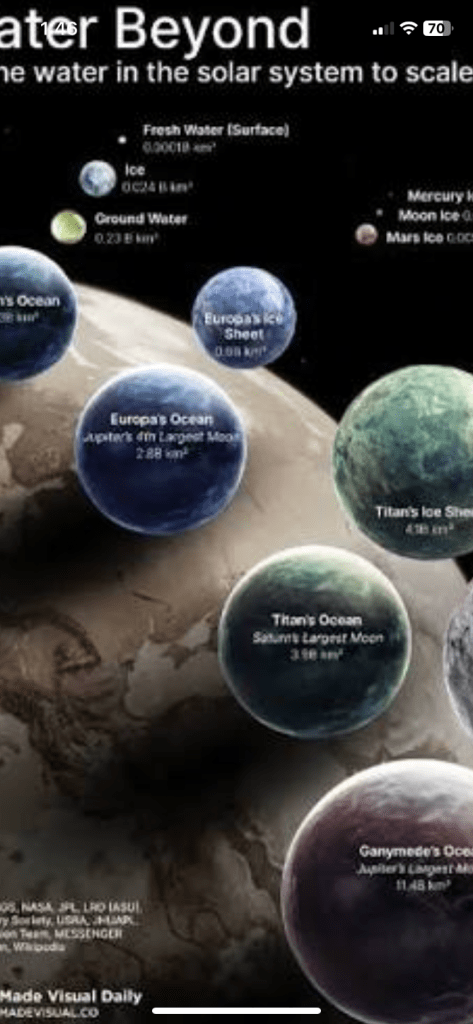
While Earth is currently the only place in our solar system with active, liquid water falling over cliffs, our neighboring planets and moons hold some truly staggering “waterfalls”—both ancient relics and alien versions made of strange materials.
While Earth is the only planet with stable liquid water on its surface, water is actually one of the most common substances in our solar system. It exists in various forms—ice, vapor, and liquid—on almost every major celestial body
Major Locations of Water
NASA now recognizes over 15 “ocean worlds” in our solar system that have liquid water today or show evidence of a watery past.
- Earth: The only world with permanent liquid oceans, lakes, and rivers on its surface, covering about 71% of the planet.
- Jupiter’s Moons:
- Europa: Scientists are nearly certain a salty subsurface ocean lies beneath its icy crust, potentially holding twice the volume of Earth’s oceans.
- Ganymede: The largest moon in the solar system, it likely has a vast underground saltwater ocean, possibly in multiple layers.
- Callisto: Thought to have a deep subsurface ocean beneath an ice layer about 200 km thick.
- Saturn’s Moons:
- Enceladus: A global subsurface ocean is confirmed; it actively vents water vapor and ice through geysers at its south pole.
- Titan: Believed to have a salty subsurface ocean. While its surface has lakes and rivers, they are made of liquid hydrocarbons (methane and ethane) rather than water.
- Mars: Once had a thick atmosphere and global oceans 3.8 billion years ago. Today, most of its water is frozen in polar ice caps or trapped as ground ice, though small amounts of briny liquid may exist transiently.
- Icy Giants (Uranus & Neptune): Both are thought to have “slushy” or supercritical water-rich mantles beneath their thick atmospheres. Recent studies also suggest some Uranian moons, like Ariel and Miranda, may have (or once had) subsurface oceans.
- Dwarf Planets: Ceres (in the asteroid belt) and Pluto (in the Kuiper Belt) both show evidence of past or present subsurface liquid water.
Forms and Origins
- Ice Everywhere: Water ice is found even in permanently shadowed craters on Mercury and the Moon, where the sun never shines.
- Comets and Asteroids: These are considered “time capsules” rich in water ice; it is widely believed that impacts from these bodies delivered much of Earth’s water.
- Solar System Origin: All water in our solar system originated from the same shared source: vast stellar nurseries in our galaxy that create enough water every day to fill Earth’s oceans 60 times over.
Please like support subscribe and comment your precious comment on universe discoveries
Full article source google
 Universe discoveries
🙏🌹
Aum Shanti
LikeLiked by 1 person