

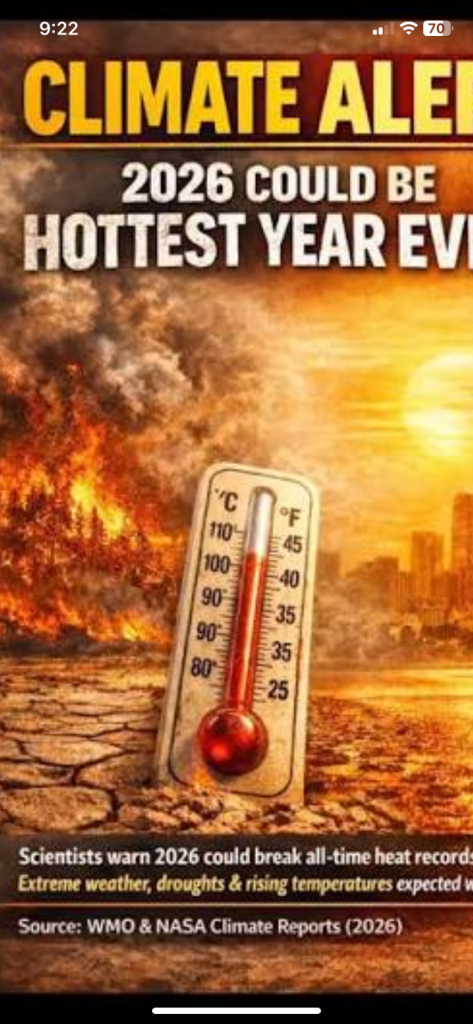
2026 is currently on track to be one of the four hottest years ever recorded. While it may not surpass the all-time record set in 2024, scientists have noted a “risk” that it could become the new warmest year if certain climate conditions intensify later in the year
Current Global Forecasts
Major meteorological organizations have issued the following estimates for 2026:
- UK Met Office: Predicts a central global temperature anomaly of 1.46∘C𝟏.𝟒𝟔∘𝐂 above pre-industrial levels, with a likely range between 1.34∘C𝟏.𝟑𝟒∘𝐂 and 1.58∘C𝟏.𝟓𝟖∘𝐂.
- Carbon Brief: Estimates a range of 1.37∘C𝟏.𝟑𝟕∘𝐂to 1.58∘C𝟏.𝟓𝟖∘𝐂, with a best estimate of 1.47∘C𝟏.𝟒𝟕∘𝐂, placing it as the likely second-warmest year on record.
- Environment Canada: Forecasts 2026 to be among the hottest years, specifically noting a potential 1.44∘C𝟏.𝟒𝟒∘𝐂 increase globally
Key Influencing Factors
- El Niño/La Niña Transition: Modest La Niña conditions early in 2026 are slightly suppressing global temperatures. However, there is an increasing likelihood (60–80% chance) of a Super El Niñodeveloping by mid-to-late 2026, which could push temperatures toward or past the 2024 record.
- Greenhouse Gas Emissions: Persistent warming is primarily driven by human-induced emissions, making record-breaking or near-record heat the “new normal” regardless of natural cycles.
- India’s Extreme Heat: India is already a global focal point for these rising temperatures, with 19 of the world’s 20 hottest cities recently recorded within the country as of April 2026.
Is iran us war add more heat in 2026
The ongoing military conflict between the
US, Israel, and
Iran in 2026 is actively contributing to global heating and environmental degradation. While 2026 is already projected to be one of the hottest years on record due to natural cycles like El Niño and long-term emissions, the war is creating a significant “carbon spike” through direct military operations and the destruction of energy infrastructure
Direct Impact on Global Temperatures
- Massive Carbon Emissions: In just the first 14 days of the conflict (late February to early March 2026), an estimated 5.1 million metric tonnes of CO2𝑪𝑶𝟐 equivalentwere released. For perspective, this two-week total exceeds the entire annual emissions of over 84 countries, such as Iceland.
- Black Rain” and Soot: Airstrikes on oil refineries and fuel depots, particularly near Tehran and in the Strait of Hormuz, have caused “apocalyptic” smoke clouds and acidic black rain. The resulting soot (black carbon) has a potent short-term warming effect by absorbing solar radiation in the atmosphere and accelerating the melting of ice if deposited on glaciers.
- Resource Diversion: Expert analysis from the Climate and Community Institute (CCI) indicates that the war is “supercharging” the climate crisis by diverting billions of dollars away from green energy transitions and toward military spending and future reconstruction.
Conflict Status (as of April 2026)
As of late April 2026, the direct military intensity has fluctuated due to diplomatic efforts:
- Ceasefire and Talks: A conditional ceasefire was brokered by Pakistan in early April 2026. President Trump recently extended this ceasefire (as of April 21–22) to allow for ongoing peace talks in Islamabad.
- Naval Blockade: Despite the truce, a US naval blockade of Iranian ports remains in place. Iran considers this an “act of war” and has threatened to keep the Strait of Hormuz closed until the blockade is lifted.
- Energy Crisis: The closure of the Strait has caused global oil prices to surge above $100 per barrel, leading some nations to reactivate coal plants for energy security, further increasing 2026’s total carbon foot print
Current monitoring by the Conflict and Environment Observatory (CEOBS) has identified over 400 incidents of environmental harm across the Middle East due to this conflict, warning that the “environmental scars” may persist for decades
Please like subscribe comment your precious comment on universe discoveries
 Universe discoveries
🙏🌹
Aum Shanti
LikeLike
Very nice.
LikeLiked by 1 person