
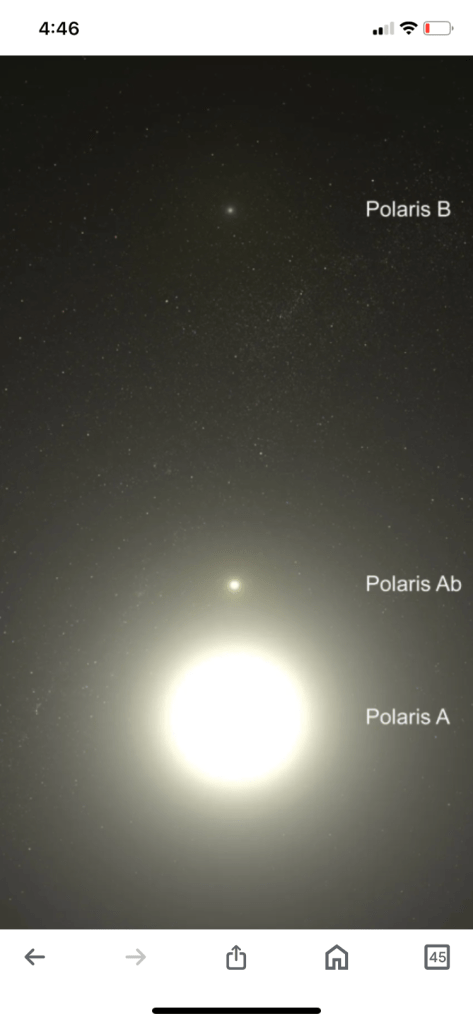
The Pole Star, also known as the North Star, is a bright star that appears to be stationary in the sky. It’s located nearly at the north celestial pole, which is the point around which the entire northern sky turns.
The Pole Star is nearly aligned with the axis of the Earth’s rotation. It’s directly above the Earth’s North pole in the sky.
The Pole Star is famous for:
- Holding nearly still in the sky while the entire northern sky moves around it
- Appearing to be stationary irrespective of the rotation of the Earth
- Marking the way due north
The Pole Star is also known as:
- Polaris
- The brightest star that appears nearest to either celestial pole at any particular time
- The North Star
Other potential or past pole stars include:
- Thuban (Alpha Draconis)
- Kochab (Beta Ursae Minori)
- Pherkad (Gamma Ursae Minoris)
- Errai (Gamma Cephei)
The next pole star will be Gamma Cephei, one of the leading lights of the constellation Cepheus.
The Pole Star is a useful fixed point for scientists to measure celestial navigation and astrometry. It’s also used by navigators to determine latitude and north-south direction in the Northern Hemisphere.
The Pole Star is easy to see in a dark country sky, even when the full moon obscures other stars. It’s a supergiant star with a diameter nearly 40 times larger than the sun and five times the mass. It’s about 2,500 times as luminous as our sun.
The Pole Star symbolizes:
- Direction
- Guidance
- Stability
- Purpose
- A guiding principle
- The center of attention or attraction
In Arabic mythology, the Pole Star is an evil star that killed the great warrior of the sky. The dead warrior now lies in the coffin of the ‘Funeral Bier’ constellation, which is the Arabic name for the Great Bear.
Here are some myths about the Pole Star:
- Norse mythology: The Pole Star is the jewel on the end of a spike that the gods stuck through the universe.
- Mongolian mythology: The Pole Star is a peg that holds the world together.
- Mandaean cosmology: The Pole Star is auspicious and associated with the World of Light.
- Indian mythology: The legend of Dhruva tells of a young boy who observed long penance to achieve the exalted position of the fixed North Star. Children in India still call it “Dhruv-tara” or “Dhruv-star
In Norse mythology, Njörðr is the god of the Pole Star. Njörðr is a Vanir god who is associated with the sea, wind, fishing, wealth, and crop fertility. He is the father of the deities Freyr and Freyja.
In Indian mythology, Dhruva is the god of the Pole Star. Dhruva is a devotee of Vishnu
Polaris is the pole star for Earth. It’s a bright star that’s almost aligned with the Earth’s axis of rotation. It’s the brightest star in the Ursa Minor constellation.
Other planets have stars that are close to their celestial poles, but Polaris is the only pole star for Earth
A pole star is a star that’s nearly aligned with the axis of rotation of an astronomical body. The Earth’s pole stars are Polaris and Polaris Australis. Polaris is a bright star that’s aligned with the Earth’s northern axis. Polaris Australis is a much dimmer star that’s aligned with the Earth’s southern axis.
The Pole Star is not a member of the solar system. The solar system is made up of the sun, its planets, satellites, asteroids, and meteors. The Pole Star is too far away from the solar system to be a member. The only star in the solar system is the sun
The next pole star will be Gamma Cephei, also known as Errai. Gamma Cephei is a binary star system that’s one of the leading lights of the constellation Cepheus. It’s also home to the first exoplanet ever discovered.
Gamma Cephei will become the pole star in 4200 CE. In 5200 CE, the pole will be between Iota Cephei and Beta.
The Earth’s axis wobbles, causing the north pole to aim at different stars over a cycle of about 26,000 years
Deneb will be the pole star in about 8,000 years. Deneb is located in the constellation Cygnus, which is also known as the Swan. It’s the “tail” of the swan.
In about 13,000 years, Vega will be the pole star. Vega is the fifth brightest star in the sky. It was the pole star about 12,000 BC and will be the pole star again in about 13,000 years
The Pole Star, or Polaris, is a multiple star system that consists of five stars. The three stars that are closest to each other orbit each other. The three stars are:
- Polaris A, a yellow supergiant
- Polaris Ab, a smaller star
- Polaris B, which orbits both Polaris A and Polaris Ab
The Pole Star is 46 times larger than the Sun and 4,000 times more luminous.
Earth has two pole stars: Polaris and Polaris Australis. Polaris is a bright star that’s aligned with the Earth’s northern axis. Polaris Australis is a much dimmer star that’s aligned with the Earth’s southern axis.
The Earth’s axis wobbles, causing the north pole to aim at different stars over a cycle of about 26,000 years. The North Star goes through a cycle of 12 stars, changing about every 2,200 years. The 12 stars are:
Polaris, Errai, Alfirk or Iota Cephei, Alderamin, Deneb, Fawaris, Vega, Iota Herculis
Glam and glitter on mobile accessories upto 80% off on Amazon
https://7bdf2eoe97z2hwlcyg1is71q98.hop.clickbank.net Universe discoveries
Very nice 🙂🌿
LikeLike
Interesting facts!
LikeLike