
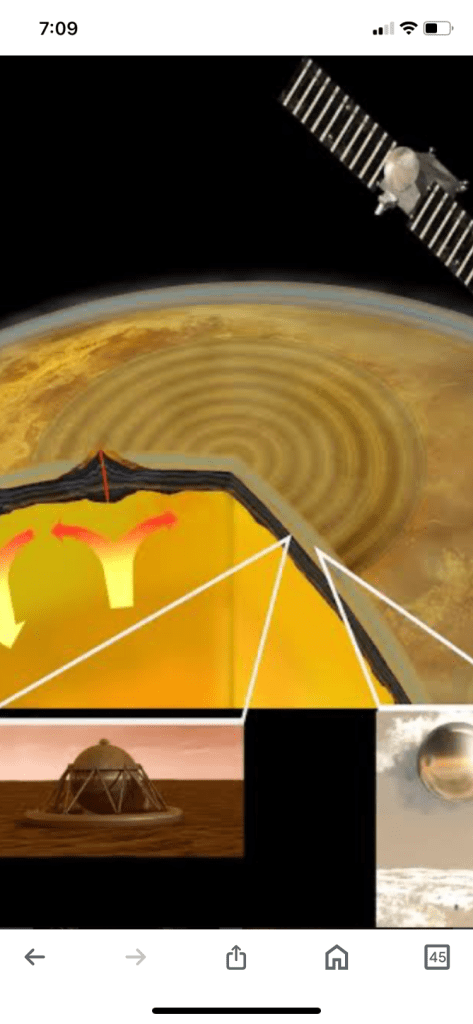
New research has revealed Venus may have had Earth-like plate tectonics billions of years ago. The finding opens up the possibility that the second planet from the sun, aka a scorching world, also once harbored life.
Venus doesn’t have global plate tectonics like Earth. However, the planet’s surface does show signs of local tectonic activity, such as: Faults, Folds, Volcanoes.
These features may be driven by processes in the mantle.
Venus is hot and dry, which is thought to be why it doesn’t have global plate tectonics. To have true plate tectonics, you need subduction zones so that one plate can ride over the other. This happens on Earth, but not on Venus.
However, Venus may have had Earth-like plate tectonics billions of years ago. Weller and colleagues think that Venus may have had shifting plate tectonics between 3.5 and 4.5 billion years ago.
The National Aeronautics and Space Administration’s upcoming mission to Venus, DAVINCI, may provide some clues and confirm the study’s findings( source google)
One of the takeaways from this study is that both planets very likely had plate tectonics operating roughly at the same period of time,” said Matthew B. Weller, a planetary scientist at the Lunar and Planetary Institute in Houston who led the research.
If true, that suggests Venus could have been much more like Earth in other ways. The geochemical reactions of plate tectonics could have buried much of the carbon dioxide that makes Venus so hellish today.(source google)
Plate tectonics is a theory in geology that states that Earth’s outer shell is divided into several plates that glide over the mantle. The plates act like a hard and rigid shell compared to Earth’s mantle. This strong outer layer is called the lithosphere.
The theory states that:
- The plates float on and travel independently over the mantle.
- Much of the earth’s seismic activity occurs at the boundaries of these plates.
- The plates move constantly to reshape the Earth’s landscape.
Tectonic plate boundaries can be the sites of:
- Mountain-building events
- Volcanoes
- Valley or rift creation
The Virunga chain is part of the East African Rift Valley system, which marks the boundary between two plates: the Nubian plate to the west and the Somalian plate to the east. The San Andreas Fault is another example of a tectonic plate boundary.
The term “plate tectonics” comes from the Late Latin word tectonicus, which comes from the Ancient Greek word tektonikós, which means “pertaining to building”. Tectonics refers to the processes that create the Earth’s crust and its evolution over time.
Plate tectonics is the modern version of continental drift. Continental drift was a theory proposed by Alfred Wegener in the early 20th century. The theory of continental drift has been replaced by the science of plate tectonics
Alfred Wegener is known as the “Father of Plate Tectonics”. He proposed the theory of continental drift in 1912. Wegener was a meteorologist who earned a PhD in astronomy in 1904. He was interested in geophysics and meteorology, and spent most of his academic career working in meteorology.
Wegener’s theory of continental drift stated that Earth’s continents had “drifted” across the planet over time. His fellow scientists ridiculed him, and it took another 50 years for the concept to be accepted.
There are three types of plate boundaries:
- Convergent: Plates move into each other. This can lead to the formation of volcanoes, deep-sea trenches, or mountains.
- Divergent: Plates move apart.
- Transform: Plates move sideways in relation to each other.
The movement of the plates is driven by convection currents in the mantle. There are two types of tectonic plates according to density:
- Continental/Granitic Plates: These are lighter.
- Oceanic/Basaltic Plates: These are heavier.
Tectonic plates are sometimes subdivided into three categories:
- Major (or primary) plates
- Minor (or secondary) plates
- Microplates (or tertiary plates)
Plate tectonics is driven by:
- Convection of magma in Earth’s interior
- The pull of heavy old pieces of crust into the mantle
- Minerals in lithospheric slabs restructuring as they descend into the mantle, releasing water and increasing the slabs’ densities
The heat source is thought to be the decay of radioactive elements. The plates move sometimes toward and sometimes away from each other
Best pet supplies on discount on Amazon
https://5ac90roi48sxj-hhlu4lz48u9i.hop.clickbank.net Universe discoveries
Nice information.
LikeLiked by 1 person
Thanks sir
LikeLike
So good 🌿✅
LikeLike