
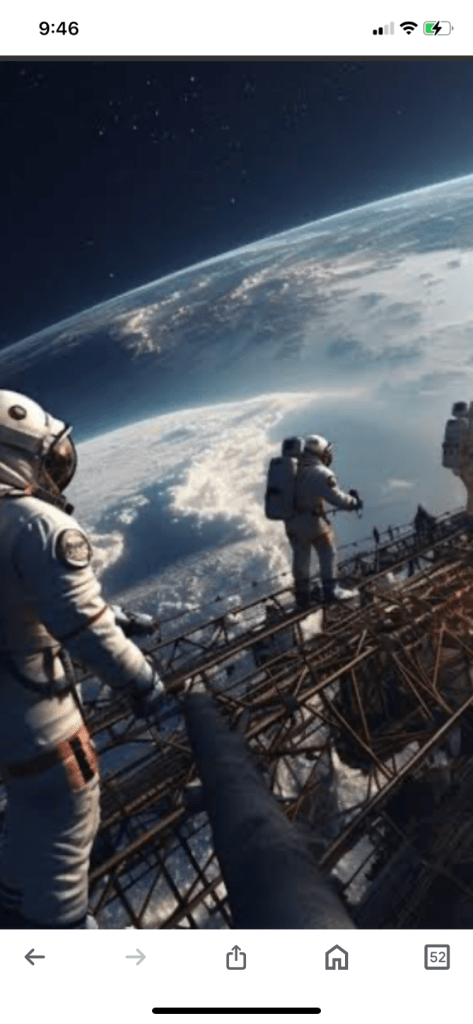
Yes, NASA is considering extending the International Space Station (ISS) operations beyond 2030. This would be dependent on the progress of commercial space stations.
In July 2022, Congress passed a bill that included authorization for NASA to keep the ISS running until 2030. NASA is hoping to transition from the ISS to private space stations in low-Earth orbit. The ISS is a unique laboratory that has returned enormous scientific, educational, and technological developments to benefit people on Earth.
The ISS has been continuously occupied since its first crew arrived in November 2000. However, the station’s hardware is aging, so in 2031 it will be de-orbited, brought back through Earth’s atmosphere, and crashed into the ocean.
A NASA official opened the door to keeping the International Space Station in operation beyond 2030 if commercial space stations are not yet ready to take over by the end of the decade.
NASA is working with commercial companies to develop new space stations. These stations will provide services to NASA and others, and ensure that the U.S. maintains a continuous human presence in low Earth orbit.
NASA also plans to build a new space station near the moon, known as the Lunar Gateway. Construction could begin later this decade. The Lunar Gateway is planned to launch in November 2024 and will be able to support a crew of 4 astronauts. NASA expects the Lunar Gateway to play a pivotal role in its plans to maintain a human presence on the moon and eventually send astronauts to Mars and beyond.
Other future space stations projects include:
- Lunar Orbital Station (LOS)
- Haven-1
- LIFE Habitat Pathfinder
Lunar Gateway
Instead of building another space station where the ISS is — about 250 miles up, in low Earth orbit (LEO) — NASA has teamed up with Canada, Europe, and Japan’s space agencies to build one near the moon, nearly 240,000 miles away.
NASA plans to begin assembling this space station, dubbed the Lunar Gateway, in 2024, and it expects it to play a pivotal role in its plans to maintain a human presence on the moon and eventually send astronauts to Mars and beyond.
“Through Gateway, NASA is extending more than 20 years of discovery, research, and international collaboration in low Earth orbit to deep space, starting at the moon,” said Dan Hartman, Gateway Program manager.( source google)
Going commercial
While NASA doesn’t plan to build another space station in LEO, it is helping several private companies develop their own space stations closer to home.
One of those companies, Axiom Space, received a NASA contract in 2020 to build up to four modules that could attach to the ISS as soon as 2025 and then detach to orbit freely once the ISS deorbits.
The following year, NASA announced that it was giving three companies — Nanoracks, Blue Origin, and Northrop Grumman — a total of $415 million to build their own commercial space stations in LEO. Those are all scheduled to be ready for habitation by 2030( source google)
NASA uses the International Space Station (ISS) for several reasons, including:
- Testing spacecraft systems The ISS is a safe location in low Earth orbit for testing spacecraft systems that will be needed for long-duration missions to the Moon and Mars.
- Long-term research The ISS is a platform for long-term research for human health, which NASA says is a key stepping stone to letting humans explore other solar system destinations.
- Research facilities The ISS has six state-of-the-art laboratories, four times larger and more capable than any previous space station.
- Preparing humans for deep space exploration NASA and its international partners conduct research aboard the ISS that helps prepare for human deep space exploration missions.
- Benefits for humanity The ISS has led to advances in telemedicine, disease models, psychological stress response systems, nutrition, cell behavior, and environmental health.
- Scientific benefits The ISS has evolved into a robust scientific laboratory with dozens of research facilities and an array of tools and observational instruments.
 Universe discoveries
Well done, Satyam😊🙏👏👏👏👏
LikeLike