
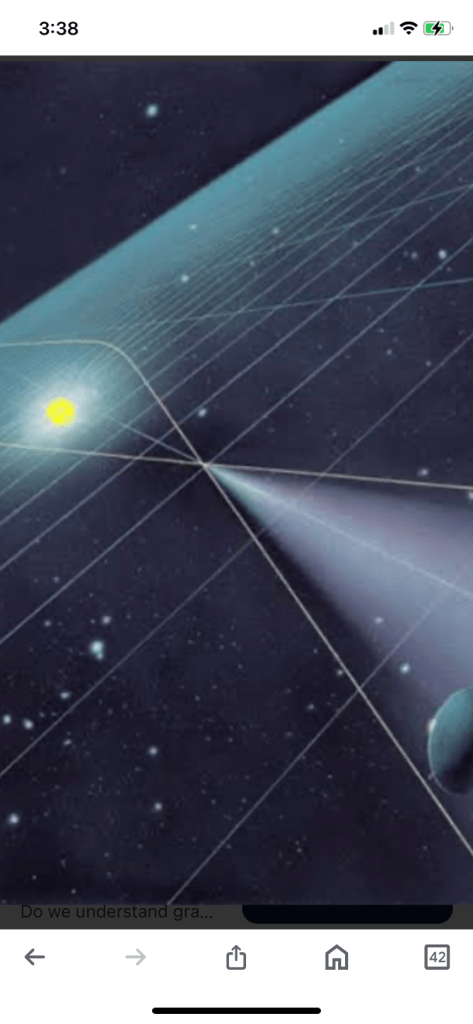
Gravitational lenses can be used to focus and beam energy from one star system to another. This could make interstellar power transmission possible.
In 1916, Albert Einstein finished his Theory of General Relativity, which describes how gravity alters the curvature of spacetime. In this theory, massive objects cause spacetime to curve, and gravity is the curvature of spacetime.
The body that causes light to curve is called a gravitational lens. Gravitational lensing is a phenomenon that can be observed when gravity bends and distorts light from more-distant objects.
Over the past forty years, various proposals have suggested using the gravitational lensing effect of a star like our Sun to focus outgoing or incoming transmissions. For example, you could use the Sun as a gravitational lens for a radio telescope.
Slava Turyshev, a research scientist with the Structure of the Universe Research Group at NASA’s Jet Propulsion Laboratory, has shown that it is possible to achieve a practically relevant Signal-to-noise ratio (SNR), making interstellar power transmission feasible
Civilizations Could Use Gravitational Lenses to Transmit Power From Star to Star. In 1916, famed theoretical physicist Albert Einstein put the finishing touches on his Theory of General Relativity, a geometric theory for how gravity alters the curvature of spacetime
Gravitational lensing has many applications in astronomy, including:
- Discovering exoplanets
- Studying the distribution of matter in galaxies and clusters of galaxies
- Observing the distant universe
- Detecting and characterizing dark matter
- Identifying the most distant galaxies
- Finding the sources of cosmic hydrogen reionization
- Magnifying images of galaxies and radio sources
Gravitational lensing became an observational science in 1979 when the double quasar Q0957+561 was discovered. This was the first example of a lensed object.
There are three main types of gravitational lensing: strong lensing, weak lensing, and microlensing. The distinction between these regimes depends on the positions of the source, lens, and observer, and the mass and shape of the lens.
Yes, gravitational lensing is real. It has been experimentally verified and first demonstrated for the Sun during a solar eclipse in 1919. In 1979, gravitational lensing became an observational science when the double quasar Q0957+561 was discovered.
Gravitational lensing occurs when a massive object, like a galaxy cluster, causes a sufficient curvature of spacetime for the path of light around it to be visibly bent, as if by a lens. The effect is like looking through a giant magnifying glass.
Gravitational lensing is usually only observed at cosmic scales. It takes a lot of mass to significantly deflect light away from its original path. This is why gravitational lensing is usually only observed at cosmic scales.
A solar gravitational lens uses the Sun’s gravity as a lens to magnify light from distant objects. The Sun’s mass distorts spacetime, which acts as a lens. Light from objects that are much further away bends around the Sun and becomes magnified.
To use the Sun as a gravitational lens, a spacecraft would be placed on the other side of the Sun from the target exoplanetary system. The light from the distant target reaching the focus must not intersect the surface of the sun. The focal point is in the region of about 550 AU to 850 AU, depending on how closely the exoplanet’s light passes by the sun.
The Sun’s gravitational field could be used to observe distant exoplanets in much greater detail than is currently possible.
Albert Einstein’s theory of general relativity predicted gravitational lensing. Einstein predicted that massive objects, such as stars, could bend light rays passing nearby. This prediction was verified by the observation of such bending of starlight near the Sun in 1919.
Einstein also predicted that a mass distribution, such as a galaxy, could act as a gravitational “lens,” not only bending light but also distorting images of objects lying beyond the gravitating mass.
Einstein’s general relativity predicted many phenomena years before they were observed, including:
- Black holes
- Gravitational waves
- Gravitational lensing
- The expansion of the universe
- The different rates clocks run in a gravitational field
 Universe discoveries
Thanks for sharing this idea star to star Anita
LikeLiked by 1 person
Thanks a lot
LikeLiked by 1 person
Nicely written article 🌿💯
LikeLike