
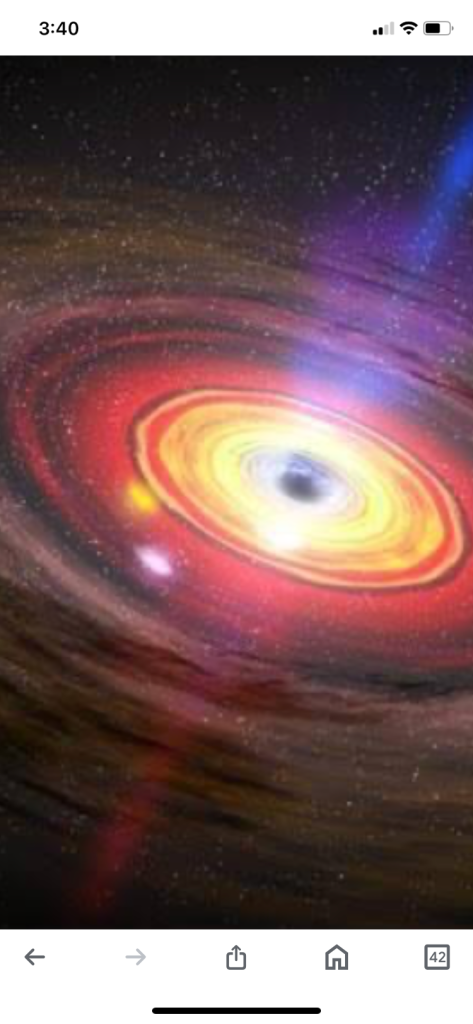
Primordial black holes (PBHs) are massive, invisible entities that could help explain dark matter, galaxy growth, and other strange observations. PBHs could also help us understand the Big Bang.
PBHs could have formed before fusion started during the Big Bang. The Big Bang was hot and dense, with fusion creating elements. The fractions of elements and isotopes in the oldest stars would be different if that matter had been around early on in the universe.
PBHs could also solve the problem of dark matter. If PBHs have a mass in the lower window, below that of the Moon, they would be less than one-tenth of a millimeter in diameter. That’s about the width of a human hair.
PBHs are scattered throughout the universe. The rate at which they would collide with Earth is less than one collision across the lifetime of our planet.
Then there is the fact that since PBH models depend critically on the conditions of the early Universe, if we discover primordial black holes of a certain number within a certain mass range, it will allow us to distinguish between early Universe models, giving us a better understanding of the Big Bang
Scientists haven’t found definitive proof that primordial black holes ever existed. However, some researchers proposed primordial black holes in September 2022 to explain the large early galaxies discovered by the James Webb Space Telescope.
Some people think there are hints of primordial black holes in detections of ripples in space-time called gravitational waves. The latest analysis of 47 collisions between black holes of all kinds of different masses suggests that more than a quarter of these collisions involved primordial black holes.
Harvard scientists suggest that Planet Nine might be a primordial black hole. With Planet Nine’s suspected super-Earth status, that black hole would only be roughly the size of a grapefruit.
According to a new model, dark matter could be composed of primordial black holes. Primordial black holes are non-baryonic, which makes them plausible candidates for dark matter. They could also be the seeds of supermassive black holes at the center of massive galaxies, as well as intermediate-mass black holes.
Primordial black holes created in the first instants after the Big Bang could account for all of the dark matter in the universe. These black holes could range in size from tiny ones smaller than the head of a pin to supermassive ones covering billions of miles.
However, it’s possible that primordial black holes could have evaporated as the cosmos aged due to quantum mechanical processes occurring at the edges of their event horizons.
Best car and vehicle electronics on discount on Amazon
