
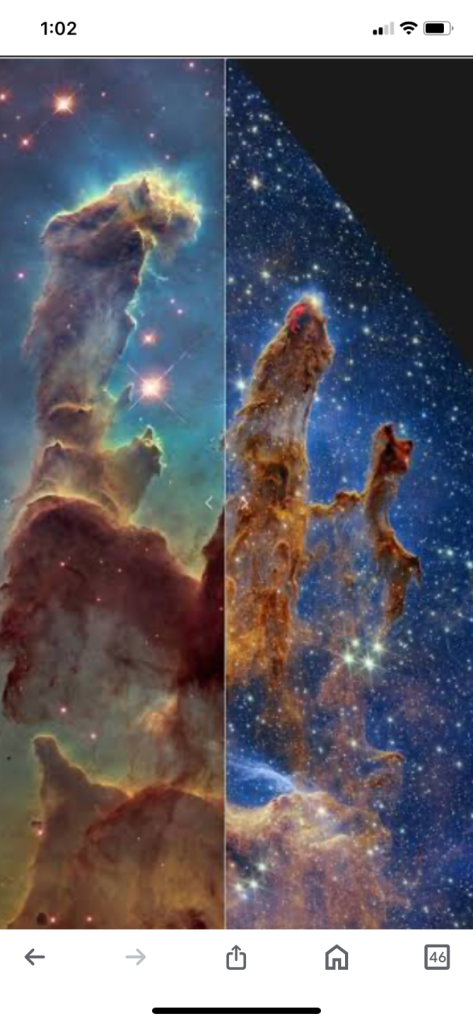
The James Webb Space Telescope (JWST) and the Hubble Space Telescope (HST) have collaborated on a number of projects:
- MACS0416 cluster The two telescopes studied the MACS0416 cluster, which is located about 4.3 billion light-years from Earth. The cluster contains multiple gravitational lenses that allow astronomers to look back in time and view galaxies as they appeared when the Universe was young.
- VV 191 Astronomers captured two galaxies (VV 191) that appear close to each other. They combined the infrared measurements taken by the JWST with the visible and ultraviolet light imaging done by the HST.
- Galaxy cluster The two telescopes studied an expansive galaxy cluster and revealed a colorful view of the universe.
The JWST will also look at exoplanets previously identified by the Kepler Space Telescope and follow up on real-time observations from ground space telescopes.
The JWST contains both a mid-infrared camera and an imaging spectrometer. Astronomers need sensitivity in the infrared part of the spectrum because the light from young stars in distant galaxies has been stretched by the expansion of the universe to appear to us as infrared light.
In 2012, as part of the MAssive Cluster Survey (MACS), the Hubble Space Telescope (HST) discovered a pair of colliding galaxy clusters (MACS0416) that will eventually combine to form an even bigger cluster
The James Webb Space Telescope (JWST) can gather about seven times as much light as the Hubble Space Telescope (HST). The JWST’s primary mirror is 6.5 meters in diameter, compared with Hubble’s, which is 2.4 meters. This gives Webb a light-collecting area of about 25 square meters, about six times that of Hubble.
The JWST was designed to be able to “see” the first stars and galaxies that ever formed in the early universe. It can detect objects 10 billion times fainter than the faintest stars visible with no telescope, or 10 to100 times fainter than what Hubble can observe.
The James Webb Space Telescope (JWST) has taught us many things, including:
- Distant galaxies The JWST has observed the four most distant galaxies known, which are also the oldest. The galaxies appeared about 13.4 billion years ago, when the universe was only 350 million years old.
- Exoplanets The JWST can tell us the composition of the atmospheres of exoplanets. For example, it detected carbon dioxide in the atmosphere of an exoplanet for the first time. It also discovered other compounds in the atmosphere of planet WASP-39b, including water vapor and sulfur dioxide.
- Building blocks The JWST revealed “the presence of many more building blocks than previously expected,” including stars and planets “in the form of clouds packed with dust and hydrogen”.
- Universe’s expansion rate The JWST data confirms the accuracy of 30 years of Hubble observations of Cepheids that were critical in establishing the bottom rung of the cosmic distance ladder for measuring the universe’s expansion rate.
- Signs of life Astronomers using the JWST say they have stumbled onto possible signs of life coming from a massive Earth-like exoplanet.
- Deepest image of space The JWST achieved the deepest image of space that had been achieved in visible light. It showed that even in the emptiest parts of the sky, there are thousands of galaxies, far too faint for our eyes, or even most telescopes, to see
 Universe discoveries
Beautiful post👌👌👌
LikeLiked by 1 person
Thanks 🙏
LikeLiked by 1 person
😊🙏🙏
LikeLike
In the mesmerizing journey through the cosmos, the James Webb Space Telescope (JWST) stands as a beacon of human ingenuity and exploration. The delicate dance it performs, studying the heart of our Milky Way for countless hours, reveals the majestic tapestry of our universe in unprecedented detail. The JWST’s ability to unveil every cosmic chapter, from the birth of galaxies to the formation of stars and planets, is a testament to its exceptional capabilities. With its high-resolution and high-sensitivity infrared instruments, the telescope has not only surpassed its predecessors like the Hubble but has also gifted us with a celestial ballet of discovery, showcasing the cosmic symphony in ways never before imagined. In essence, the JWST emerges as a poetic architect, crafting a narrative of the universe’s evolution that captivates our imaginations and leaves us in awe of the wonders it unveils. Nice post
LikeLiked by 1 person
Wow 🙏very well description of James Webb your writing skills are amazing freind
LikeLiked by 1 person
Thanks
LikeLiked by 1 person
Welcome 🙏 freinds
LikeLiked by 1 person
Nice article 🎭 happy colorful day 🔵
LikeLike