
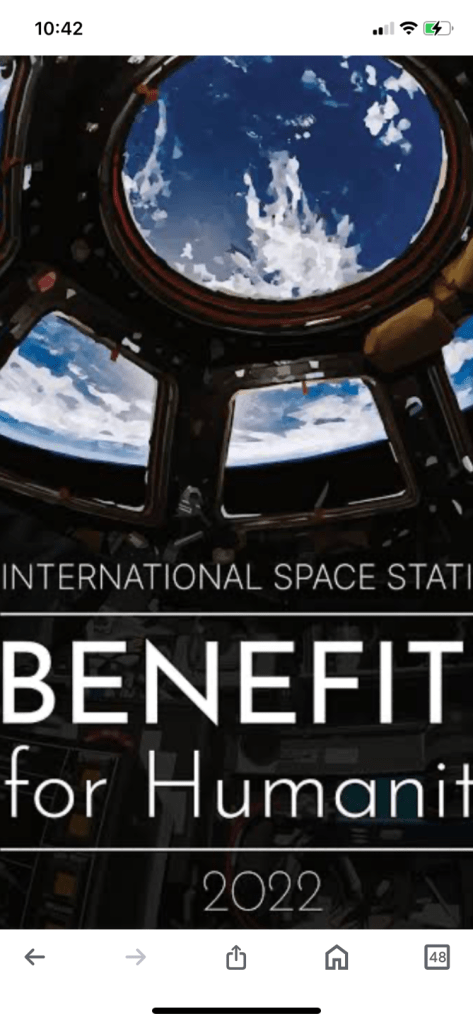
The International Space Station (ISS) turned 25 years old on November 20, 2023. The ISS has been continuously occupied for 23 years and 25 days, which is the longest continuous human presence in low Earth orbit. The ISS is set to be decommissioned by 2030
The ISS has been a hub for international collaboration in space. The owners of the ISS are the United States, Russia, the European Partner, Japan, and Canada. The ISS has contributed to advancements in technology in areas such as:Computing, Electronics, Robotics, Hardware prototyping.
Research conducted on the ISS includes:
Biology, Physiology, Fluid physics and combustion, Material sciences, Fundamental physics, Astrobiology
The International Space Station is a platform for scientific research that requires one or more of the unusual conditions present in low Earth orbit (for example microgravity, (cosmic) –radiation and extreme temperatures). The primary fields of research include human research, space medicine, life sciences, physical sciences, astronomy and meteorology.The 2005 NASA Authorization Act designated the American segment of the International Space Station as a national laboratory with the goal of increasing the use of the ISS by other federal agencies and the private sector.
Research on the ISS improves knowledge about the effects of long-term space exposure on the human body. Subjects currently under study include muscle atrophy, bone loss, and fluid shift. The data will be used to determine whether space colonization and lengthy human spaceflight are feasible. As of 2006, data on bone loss and muscular atrophy suggest that there would be a significant risk of fractures and movement problems if astronauts landed on a planet after a lengthy interplanetary cruise (such as the six-month journey time required to fly to Mars).Large scale medical studies are conducted aboard the ISS via the National Space Biomedical Research Institute(NSBRI). Prominent among these is the Advanced Diagnostic Ultrasound in Microgravity study in which astronauts (including former ISS Commanders Leroy Chiao and Gennady Padalka) perform ultrasound scans under the guidance of remote experts. The study considers the diagnosis and treatment of medical conditions in space. Usually, there is no physician on board the ISS, and diagnosis of medical conditions is a challenge. It is anticipated that remotely guided ultrasound scans will have application on Earth in emergency and rural care situations where access to a trained physician is difficult.
Here are some experiments on the ISS:
- Materials International Space Station Experiment (MISSE) Studies the effects of long-term exposure to space on materials, computer components, and electronics. The results help NASA design future spacecraft.
- Alpha Magnetic Spectrometer (AMS) A particle physics experiment that searches for dark matter, antimatter, and missing matter. It also measures cosmic rays.
- Fluids and Combustion Facility (FCF) Two research facilities that support physical and biological experiments. The Fluids Integrated Rack (FIR) studies space system fluids management.
Other experiments on the ISS include:
- Channeling Captain Kirk
- Combustion Integrated Rack Modal Model Correlation
Astronauts on the ISS have three main responsibilities:
- Research: Astronauts conduct experiments in two labs:
- U.S. Destiny Laboratory Module
- Zvezda Service Module
- Maintenance: Astronauts maintain the station. They also practice riding in space vehicles that deliver supplies.
- Exercise: Astronauts exercise for two hours a day to stay fit.
Astronauts also:
- Take part in medical experiments
- Learn to eat and exercise while floating
- Conduct experiments with the spacecraft
- Do household chores
- Spend leisure time reading, listening to music, and looking at Earth
Astronauts typically spend about six months on a mission.
Scientists on the ISS conduct experiments in a variety of fields, including:
Microbiology, Metallurgy, Biology, Biotechnology, Materials, Physical science, Technology.
The ISS’s unique location in low Earth orbit (LEO) allows scientists to conduct experiments that can’t be done anywhere else. The ISS provides:
- Long-duration microgravity
- Exposure to space
- A unique perspective on our planet
The data collected from these experiments can lead to new areas of scientific research. For example, growing protein crystals in space could lead to better treatments for diseases that currently have no cure.
The ISS has three main platforms for studying climate change:
- Earth-observing instruments: Mounted on the ISS’s exterior
- CubeSats: A platform for deploying Earth-observing CubeSats
- Windows: Astronauts use the ISS’s windows to take photos of the planet
Astronauts have taken over 4 million images of Earth from space, including over 3.5 million from the ISS. These images contribute to one of the longest running records of how Earth has changed over time.
Other data used to study climate change includes:
Aircraft, Ships, Buoys, Ground-based instruments, Satellites, Weather stations, Ice cores, Rocks, Tree rings.
NASA also uses satellites, aircraft, and boats to gather data on snowpack, hurricanes, wildfires, and ocean ecology.
Space exploration has helped us study Earth’s weather in a number of ways:
- Satellites Provide accurate measurements of the temperature of the atmosphere, land, and oceans. They also monitor the climate and provide weather reports.
- Earth-observation satellites Remotely sense land and ocean areas to improve resource management and understand climate change.
- Low Earth orbit satellites Can directly monitor the climate from their position within or just above the atmosphere.
Space exploration also provides information about the Earth, our solar system, and the role of gases in our atmosphere.
Scientists use a variety of tools to study Earth:
- Seismic waves Scientists use the energy from seismic waves to learn about the Earth’s interior. Seismic waves are generated by earthquakes and explosions. The rate at which these waves travel through Earth’s layers reveals information about the Earth’s structure.
- Rock samples Seismologists use rock samples to study the Earth’s interior. Geologists can also examine rocks and debris from volcanic eruptions.
- Fossils Scientists study fossils to learn about the Earth’s past.
- Satellites NASA uses satellites to take pictures and collect information about Earth. Satellites are especially good for observing clouds, oceans, land, and ice.
Earth scientists use tools from many different fields, including:
Geology, Chronology, Physics, Chemistry, Geography, Biology, Mathematics.
Earth scientists study a variety of topics, including:
- Natural hazards
- Environmental changes
- Bodies of water
- Earthquakes
- Volcanism
- Tectonic activity
- Rocks and minerals
- Fossils
- Soils
The ISS has provided many benefits to society, including:
- Health and medicine
- Transportation
- Public safety
- Consumer goods
- Energy and environment
- Information technology
- Industrial productivity
Some of the things we’ve learned from the ISS include:
- Fundamental disease research
- Cool flames
- Water purification systems
- Drug development
- Muscle atrophy and bone loss
- The 5th state of matter
- Stem cell regeneration
- Bone and muscle loss
The ISS has also provided insights into:
- Land use
- Geophysical changes
- Atmospheric changes
- Weather tracking and forecasting
The International Space Station (ISS) has four main purposes:
- Scientific research
- Space exploration
- Education and outreach
- International cooperation
The ISS is a research laboratory in space. It’s used to test the effects of space on humans and to test new technologies for future space exploration missions. The ISS is also a platform for advancing technologies for both space and ground applications. These technologies include:
- Robots
- Computers
- Health monitors
- Life support systems
The ISS is a collaborative project between multiple countries, including the United States, Russia, Europe, Japan, and Canada.
The International Space Station (ISS) has three main purposes:
- Scientific research
- Space exploration
- Education and outreach
The ISS’s research goals are focused on four areas:
- Human health and exploration
- Technology testing for future exploration
- Research in basic life and physical sciences
- Earth and space science
The ISS is also a location to test spacecraft systems for long-duration missions to the Moon and Mars. This provides experience in operations, maintenance, and repair and replacement activities on-orbit
The first long-duration mission to the International Space Station (ISS) was Expedition 1. The three-person crew, consisting of NASA astronaut William Shepherd and Russian cosmonauts Yuri P. Gidzenko and Sergei K Krikalev, stayed aboard the station for 136 days, from November 2000 to March 2001.
The first module to launch to the ISS was the Russia Zarya, which launched on November 20, 1998. Two weeks later, the NASA Unity/Node 1 module launched.
The ISS has allowed scientists to conduct experiments in space that have led to advances in:
Biotechnology, Medicinal technology, Alternative energy, Weather tracking and forecasting, Land use, Geophysical changes, Atmospheric changes.
The ISS has also provided information about how living things and machines behave in zero gravity. This information has been used to create technologies and devices for Earth
Some other discoveries made on the ISS include:
- Fundamental disease research
- Cool flames
- Water purification systems
- Drug development
- Methods to combat muscle atrophy and bone loss
- Exploring the 5th-state of matter
- Understanding how bodies change in microgravity
- Testing tissue chips ( full article source google)
 Universe discoveries
It has been a quarter of a century! Wow, time does go by.
LikeLike