
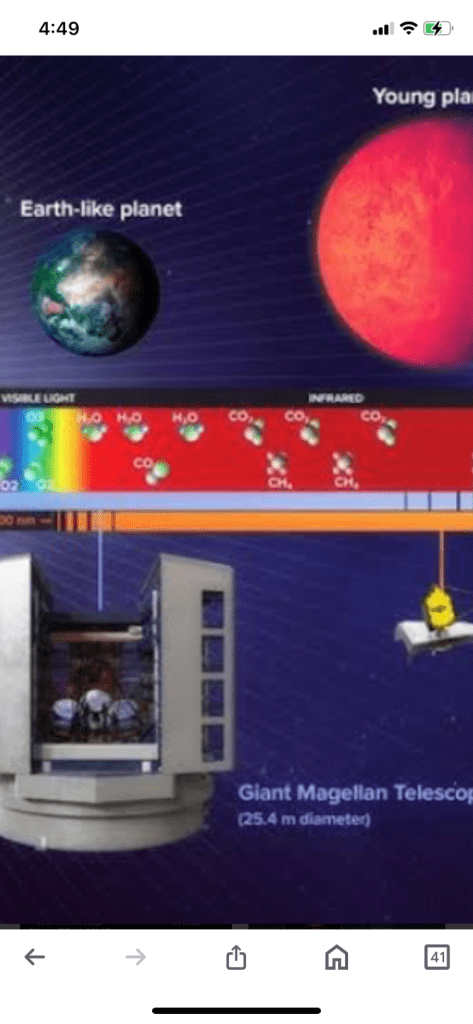
Deformable mirrors are a key technology for next generation space telescopes to directly image exoplanets. These mirrors correct imperfections and shape changes in space telescopes at subatomic scales. This technology is crucial for studying Earth-like planets orbiting neighboring stars and determining their potential habitability.
Deformable mirrors are used in conjunction with wavefront sensors and real-time control systems in adaptive optics. They are a key technology for future space telescopes using coronagraphic instruments for high-contrast imaging of exoplanets.
Several sounding rocket, space balloon, and CubeSat missions have flown or are flying in the near future to prepare this technology for space mission applications.
Deformable mirrors enable direct imaging of exoplanets by correcting imperfections or shape changes in a space telescope down to subatomic scales. Finding and studying Earth-like planets orbiting nearby stars is critical to understand whether we are alone in the universe.
Here are some next generation space telescopes:
- Nancy Grace Roman Space Telescope: Scheduled to launch in 2027, this telescope will use a coronagraph to image gaseous exoplanets.
- Habitable Worlds Observatory: This telescope will search for signs of life on habitable exoplanets.
- Lynx: This telescope will detect high-energy X-ray radiation to uncover the “invisible” universe.
- Next Generation Space Telescope (NGST): This telescope will be larger and more powerful than Hubble.
NASA is also planning a telescope called LUVEx, which will observe in infrared, optical, and ultraviolet light.
Telescopes are placed in space to get a clearer view of the universe. Earth’s atmosphere absorbs some light frequencies and blocks certain types of radiation. This blurs our view of the cosmos
Some telescopes are placed in Earth’s orbit to observe radiation that the atmosphere would normally absorb or scatter. This includes:
- UV
- X-ray
- Gamma ray
- Some types of infrared (IR) radiation
Most telescopes used by astronomers are on Earth. These are called ground-based telescopes. It’s cheaper and easier to build telescopes on Earth than in space. It’s also easier to fix them if something goes wrong.
Deformable mirrors (DMs) are mirrors with surfaces that can be deformed to correct optical aberrations and control wavefronts. They are used in adaptive optics with real-time control systems and wavefront sensors.
Some applications for DMs include:
- Femtosecond pulse shaping
- High power lasers
- Optical communications
- Ophthalmic imaging
- Microscopy
When choosing a DM, you can consider things like:
- Diameter
- Number of actuators
- Speed
- Active flat
- Reflectivity and damage threshold
- Dynamic range and linearity
- Control electronics, software, and API simplicity
Here are some types of DMs:
- ILAO Star: A mechanical DM developed for ultra high intensity lasers
- MEMS Grating Modulator: Has a fast response time and precision
- Mirao 52e: Has a large stroke, high optical quality, and low power consumption
- Piezoelectric Deformable Mirrors: Have a large stroke, high resonant frequency, and flexible actuator geometry
- Resistive Modal Deformable Mirror: Has an electrostatic membrane with actuators that distribute electrostatic pressure
In astronomical telescopes, deformable mirrors can correct wavefront errors. The wavefront correction can be measured directly with a wavefront sensor or estimated with sensorless AO techniques.
Here are some things to consider when buying a deformable mirror telescope: Energy, Power, Wavelength, Aperture.
Deformable mirrors use actuators behind the reflective surface to deform it into the desired shape. Actuators can include:
- Mechanical actuator posts
- Magnets
- Piezoelectric elements
Finding Earth-like planets is a key part of astronomy. These planets may have conditions that could support life, which could provide insights into the possibility of habitable habitats outside of Earth.
Earth-like planets are also known as Earth analogs, Earth twins, or second Earths. They are planets or moons with environmental conditions similar to those found on Earth.
Space missions are being built to detect Earth-like planets indirectly. These missions detect the effects of the planets on their parent stars. They also quantify factors such as:
- Terrestrial planet frequency
- Size distribution
- Mass distribution
Researchers have found about 5,000 confirmed exoplanets and thousands of other candidates. The Kepler satellite has confirmed over 2,000 planets.
Kepler-186fIn 2014, NASA’s KeplerSpace Telescope discovered the first Earth-sized world in the habitable zone of another star. The planet, dubbed Kepler-186f, is located within the Kepler-186 system about 500 light-years from Earth.(full article source google)
 Universe discoveries
Well done my friend 👏👏👏👍👍👍🌟✨
LikeLike