
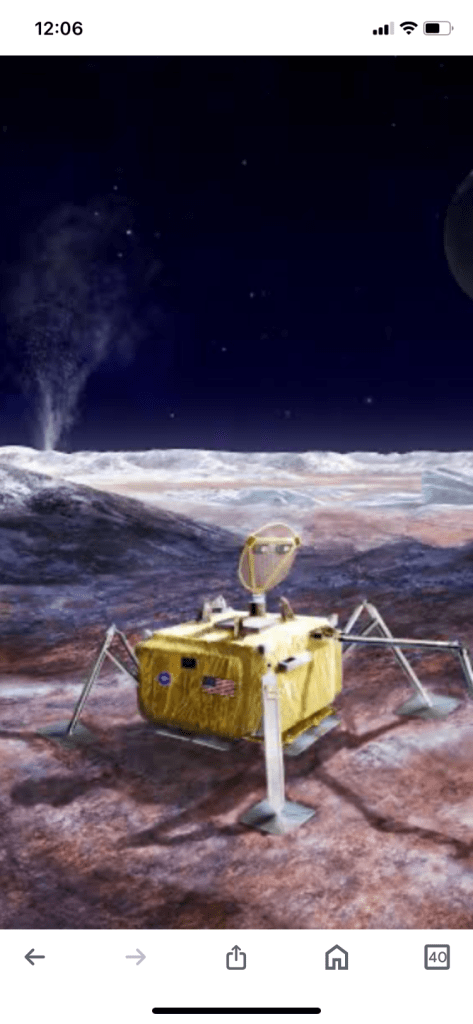
Even radiation-hardened spacecraft electronics have to be shielded inside a thick metal box in order to survive the Europa environment, so humans would be very unlikely to survive there for long enough to do anything useful
sending humans to Europa is a bad idea. Dr. Alyssa Rhoden, a Principal Scientist at the Southwest Research Institute, says that the radiation environment could kill a robotic lander in a few hours to days. Another Reddit user says that there’s no point in sending humans because they wouldn’t be able to walk on the surface without being killed by radiation.
Europa is one of Jupiter’s largest moons and the sixth-closest to the planet. It’s an icy moon with a heavily irradiated surface. However, it might have liquid water about 40 miles below its icy crust. NASA’s Europa Clipper mission will investigate whether Europa could have conditions suitable for life.
Sending humans to Europa might also violate Article IX of the Outer Space Treaty of 1967. This article mandates that the exploration of celestial bodies should avoid harmful contamination and adverse changes to Earth’s environment.
Jupiter’s moon Europa shows strong evidence for an ocean of liquid water beneath its icy crust. In fact, it could have all the ingredients needed for life as we know it. NASA’s Europa Clipper spacecraft will perform dozens of close flybys of Europa
Europa is one of the most promising places in our solar system to find life. Scientists believe that Europa has a saltwater ocean with twice as much water as Earth’s oceans. The ocean could contain some form of life.
Europa Clipper is NASA’s mission to explore Europa and determine if its ocean is habitable. The mission is scheduled to launch on October 6, 2024.
About the mission- mission will place a spacecraft in orbit around Jupiter in order to perform a detailed investigation of Europa — a world that shows strong evidence for an ocean of liquid water beneath its icy crust and which could host conditions favorable for life.
The Europa Clipper mission has three main objectives:
- Ice shell and ocean: Understand the nature of the ice shell and the ocean beneath it
- Composition and geology: Understand the moon’s composition and geology
- Astrobiological potential: Better understand the astrobiological potential for habitable worlds beyond Earth
The Europa Clipper mission will also help determine if Europa and similar worlds with global oceans could support life.
NASA is also developing a Europa Lander mission. This mission would send a lander to Europa to perform analyses on site. If funded and developed, it would launch in 2027.
NASA is developing a robot to explore Europa’s icy surface and ocean. The robot, called BRUIE (Buoyant Rover for Under-Ice Exploration), will be able to move around both above and below the surface. Researchers are testing the robot in Antarctica to see how it handles conditions similar to Europa
NASA is also developing a Europa Lander mission. This mission would send a lander to Europa to perform analyses on site. The objectives of the mission include:
- Searching for biosignatures
- Characterizing the composition of non-ice material
- Determining the proximity of liquid water
The Europa Lander is a space mission that would land a craft on Jupiter’s moon, Europa. The lander would follow up on the Europa Clipper mission, which will survey the moon. The lander’s main objectives are:
- Search for biosignatures
- Study Europa’s internal structure, surface, and environment
- Assess Europa’s habitability
- Characterize the surface and subsurface properties
The lander might also carry:
- A chemical analysis lab
- A microscope
- A camera
- A seismometer to detect geologic activity
The Europa Lander for Science Acquisition (ELSA) project will demonstrate the feasibility of collecting data from the surface of Europa. The project will use a spherical landing probe called the NeoPod.
Robots and probes are better suited for Europa missions than humans for a number of reasons:
- Distance: Europa is 17.5km/s from Earth’s orbit, which is three times farther than Mars.
- Environment: Europa has a low gravity, unknown ocean, and radiation environment.
- Challenge: Landing on Europa is very challenging.
Robots and probes are better suited for space exploration in general for the following reasons:
- Cost: Sending robots is cheaper than sending humans.
- Life support: Robots don’t need life support systems.
- Survival: Robots can survive in space for many years without food, water, or oxygen.
- Work: Robots can work for long periods without rest.
- Adaptability: Robots are more adaptable to hostile environments than humans.
Robots don’t need to eat or sleep or go to the bathroom. They can survive in space for many years and can be left out there—no need for a return trip! Plus, robots can do lots of things that humans can’t. Some can withstand harsh conditions, like extreme temperatures or high levels of radiation
Robotic and human exploration are mutually dependent and synergistic. Robotic exploration can set the context, provide critical information, and reduce risk to humans. Robots can also conduct experiments that would be too dangerous or difficult for humans. However, some say that human exploration is more effective for expanding knowledge of the universe(full article source google)
Best desktops on heavy discount on Amazon
https://19b9dnhp62u-irkj5jcy-8dhft.hop.clickbank.net Universe discoveries
Interesting.
LikeLike