
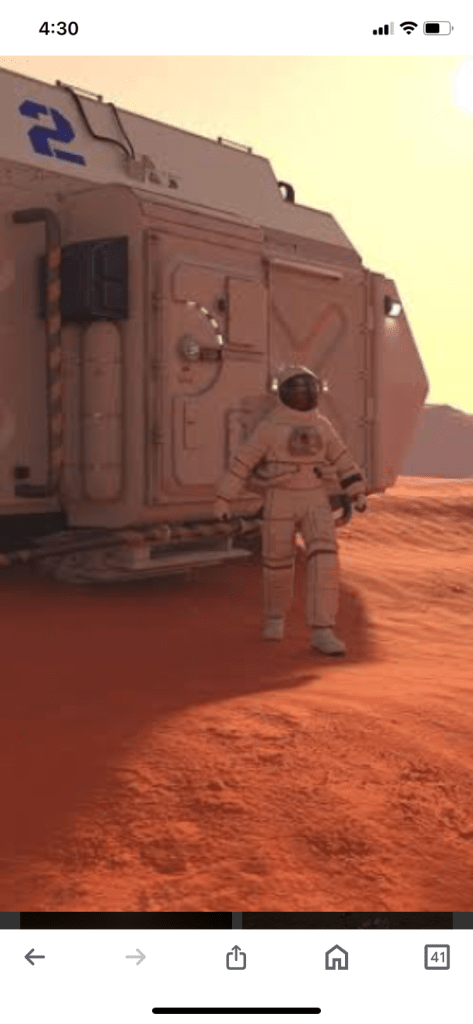
Questions Surround Settlements on Other Worlds. As ever-deepening turmoil engulfs Earth, daydreaming about moving to Mars might provide a pleasant break from our everyday predicaments. It is entirely understandable—and human—to grasp onto promises of a better life in a faraway place
Some questions about other worlds include:
- Why colonize Mars? Some reasons include curiosity, economic interest in its resources, and the possibility that settling other planets could decrease the probability of human extinction.
- Is the manned space mission to Mars a technological race? Some wonder if the manned mission to Mars in the 2030s will be a technological race between superpowers, like the manned mission to the Moon in the 1970s.
- Has enough attention been paid to ocean exploration? Some say that ocean research could cool the climate, heal illnesses, and provide drinking water.
Other questions about Mars include:
- Whether so many journeys to Mars are blocking other important science
- The ethical distinctions between utilizing AI to provide answers and embarking on a mission to reach Mars with the assistance of rockets
The reduced gravity well of Mars and its position in the Solar System may facilitate Mars–Earth trade and may provide an economic rationale for continued settlement of the planet. Given its size and resources, this might eventually be a place to grow food and produce equipment to mine the asteroid belt
Some reasons to live on Mars include:
- Scientific reasons:
- Search for life
- Understand the planet’s surface and evolution
- Prepare for future human exploration
- Economic reasons:
- Develop new technologies
- Space mining opportunities
- Space tourism
- Human survival:
- Safeguard the existence of humans
- If something happens to people on Earth, there will still be people who can carry on the species of humans somewhere else
Mars is the most habitable planet in our solar system after Earth. Some reasons include:
- Its soil contains water
- It isn’t too cold or too hot
- Gravity on Mars is 38% that of Earth’s
- Evidence of being warmer in the past and of having stable liquid surface water for potentially hundreds of thousands of years
The debate about space settlements has raised questions about whether it’s possible to settle other planets. Some questions include:
- Is it possible to settle other planets?
- If it’s possible, should humans do it?
- What makes a good location for a settlement?
- What are the different types of settlements?
As of 2022, there are no permanent space settlements other than temporary space habitats.
The first Martian shelters may be underground or made from 3D printed concrete. They may also be egg-shaped towers or artificial cave systems
Some other possibilities include: Ice igloos, Domes, Cylindrical structures.
Mars shelters will need to withstand:
Radiation, Temperature fluctuations, Low oxygen, Low pressure, High winds, Extreme cold.
They will also need to be:
- Sealed and pressurized
- Heavily insulated and heated
- Shielded against solar and cosmic radiation
NASA has developed a Mars Habitat Prototype that includes:
- Pressurized living quarters
- A greenhouse
- A laboratory
it’s understandable to daydream about moving to Mars as a break from everyday problems. It’s human to grasp onto the promise of a better life in a faraway place.
Exploring Mars can help us look for biosignatures, which may indicate if life was abundant in the past or still exists today. The more we learn about Mars, the better equipped we’ll be to try to make a living there in the future.
However, Mars is much colder than Earth because it’s further away from the sun. The climate at the Martian equator is similar to Earth’s polar regions, but colder.
No other planet in our solar system can currently support human life. However, there are plans to colonize Mars. Other planets that could be considered for colonization include:
- Venus
- The Moon
- Mercury
- Some of the larger moons of the giant planets
Some factors that make it difficult to colonize other planets include:
- Extreme weather conditions
- Atmospheric chemistry
- Amount of resources needed to support human life
The first step in establishing a successful Mars colony is water. Water can be extracted from ice and hydrated minerals.
Many planets within the Solar System have been considered for colonization and terraforming. The main candidates for colonization in the inner Solar System are Mars and Venus. Other possible candidates for colonization include the Moon and even Mercury.
Humans have not yet been able to travel to other planets. However, humans have sent rovers to Mars.
Humans may reach Mars within decades. China plans to send human crews to Mars in 2033, while NASA aims to send astronauts there by the late 2030s or early 2040s.
Humans do not yet have the technology to visit a habitable planet outside of our solar system. The closest known planet that could support life is around 36 light years away. The closest star to us is Proxima Centauri, at a distance of 40 trillion kilometers.
Humans can only survive on other planets if they have the essential elements of life. These include:
Oxygen, Water, Air, Breathable air, Stable gravity, Day and night cycles.
Other factors that make it difficult to colonize other planets include:
- Extreme weather conditions
- Atmospheric chemistry
- Amount of resources needed to support human life
Some say that it’s not the most optimal thing to do to colonize other planets. Instead, they say that it’s best to terraform Earth back to full habitability(full article source google)
Best men woman clothing on heavy discount on Amazon Universe discoveries
It all seems so far in the future for any sizable colonization. I think saving the earth should be a greater priority. Thank you Satyam for these interesting posts.
LikeLike