
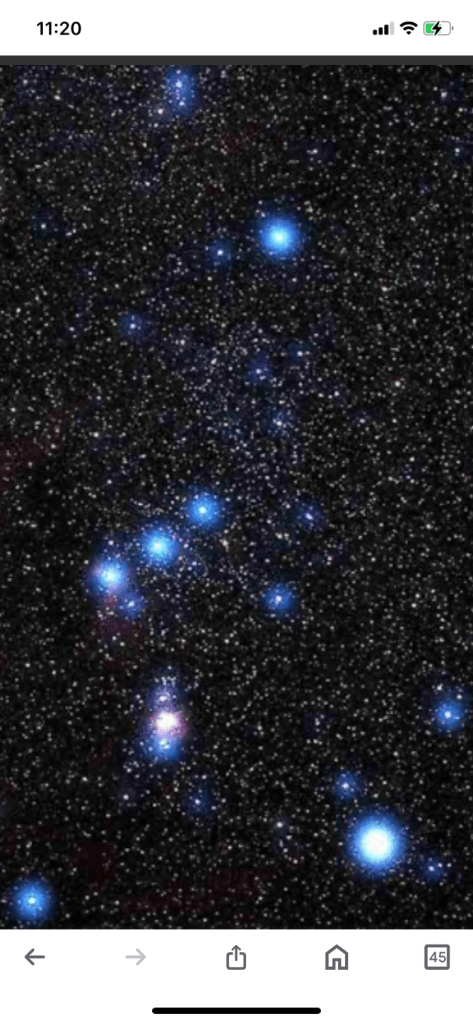
Over its 10 billion year life, S0-6 must have travelled more than 50,000 light-years from outside of the Milky Way to reach the vicinity of Sagittarius A*. Almost certainly S0-6 traveled much more than 50,000 light-years, slowly spiraling down to the center rather than making a straight shot
The star S0-6 traveled over 50,000 light-years from outside the Milky Way to reach the vicinity of Sagittarius A* in 10 billion years. S0-6 likely traveled much more than 50,000 light-years, spiraling down to the center instead of making a straight shot
S0-6 is now 0.04 light years from Sagittarius A*. This is the first time a star of extragalactic origin has been found in the vicinity of the supermassive black hole.
According to NASA, stellar black holes form when the center of a very massive star collapses in upon itself. This collapse also causes a supernova, or an exploding star, that blasts part of the star into space.
Scientists estimate that there are 40 quintillion black holes in the Universe.
Black holes can travel at speeds of up to 17,500 miles per second, which is one-tenth the speed of light. Some black holes may reach speeds of up to 5,000 kilometers per second
Here are some fast-moving black holes:
- GRO J1655-40 This stellar-mass black hole travels at 250,000 miles per hour, which is four times faster than the average speed of stars in its galactic neighborhood.
- S4716 This star orbits the supermassive black hole Sagittarius A* at 8,000 kilometers per second.
- Isolated black hole This black hole travels at 160,000 kilometers, which is faster than most of the stars in its region of the galaxy.
The star S0-6 is located 0.04 light-years away from Sagittarius A. The Subaru Telescope observed the star for eight years.
S0 indicates a star that is within one arc-second of Sgr A*, which is the galactic center.
S0-6/S10 is a star that has been observed spectroscopically. The star’s formation history is part of the Milky Way’s nuclear star cluster
The S2 star is about 7 million years old. It’s a B-type star that’s bluish and massive, weighing about as much as a dozen Suns. S2 is also known as S0–2.
S2 is a member of a star cluster near the supermassive black hole Sagittarius A* (Sgr A*). It orbits Sgr A* every 16.0518 years. S2 is 26,000 light-years from Earth, which is relatively distant compared to most Milky Way stars.
S2 has the fastest known ballistic orbit, reaching speeds of over 5,000 km/s. This is about 11,000,000 mph, or 1⁄60 the speed of light. At its closest approach, or periapse, S2 reaches speeds of 7650 km/s. This is about 3 percent of the speed of light.
S2’s acceleration is about 1.5 m/s2, which is almost one-sixth of Earth’s surface gravity.
S2’s 16-year orbit has a highly elliptical shape. At its closest approach, S2 comes within 18 billion kilometers of Sgr A*. This gravitational kick accelerates the star.
S2 is 5,000 times faster than the fastest fighter jet
Sagittarius A* (Sgr A*) is a supermassive black hole located in the center of the Milky Way galaxy. It’s located in the constellation Sagittarius, near the border of Sagittarius and Scorpius.
Here are some facts about Sagittarius A*:
- Mass: 4.6 million times the mass of the Sun
- Distance from Earth: 26,000 light-years
- Location: 5.6° south of the ecliptic, close to the Butterfly Cluster and Lambda Scorpii
- Activity: Mostly dormant, occasionally absorbs gas or dust
Sagittarius A* was discovered by Reinhard Genzel, Harry Clive Minnett, and Robert Brown. The name “Sagittarius A*” refers to the location of the black hole in the center of the Milky Way.
Astronomers identified Sagittarius A* about 50 years ago as the strongest region of radio emission in the constellation Sagittarius. The black hole is hidden from view by cosmic dust in the spiral arms of the Milky Way.
The most likely theory to explain the composition of S0-6 is that it was born in a now extinct small galaxy orbiting the Milky Way that was absorbed. This is the first observational evidence suggesting that some of the stars in the vicinity of Sagittaius A* formed outside of the galaxy
There are still many questions according to Nishiyama, “Did S0-6 really originate outside the Milky Way galaxy? Does it have any companions, or did it travel alone? With further investigation, we hope to unravel the mysteries of stars near the supermassive black hole.”(full article source google)
 Universe discoveries
Astonishing how the time lag of 50000 light year is estimated…hats of to these scientists or whatever name is given to people doing this study. Thanks for sharing.
LikeLiked by 1 person
Yes sir very astonishing, our space technology is incredible and it’s just starting of a very exiciting journey of cosmos, it just started
LikeLiked by 1 person