
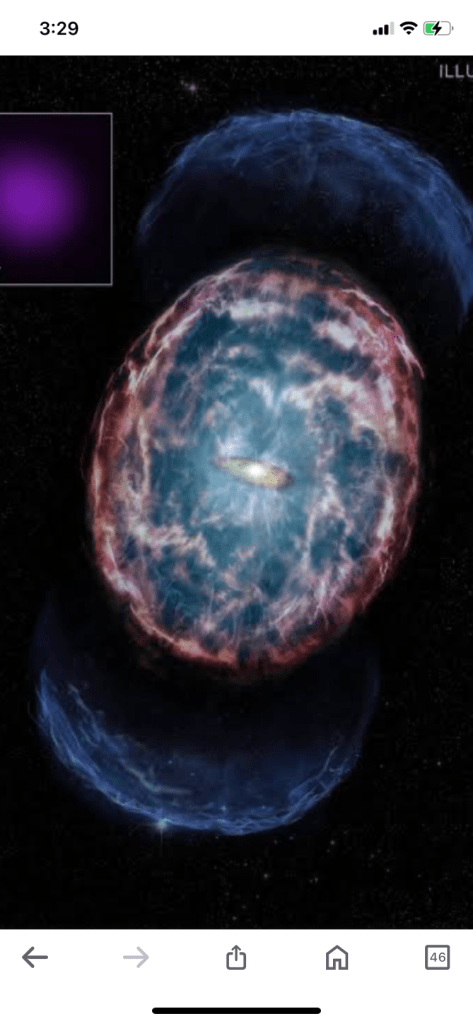
Scientists have found evidence of a kilonova that happened 3.5 million years ago. A kilonova is an explosion caused by two neutron stars colliding. The isotopes Fe-60 and Pu-244 were found in sediment that was created between 3 and 4 million years ago, which suggests that the kilonova happened then.
In 2022, astronomers observed what could be a kilonova afterglow that occurred around 3.5 years after the collision of two neutron stars. This was the first time a kilonova was observed with the James Webb space telescope. The telescope allowed astronomers to identify the elements produced in the collision by their infrared signatures.
A kilonova that occurs within 35 light years of Earth could bathe the planet in cosmic rays and exterminate life for thousands of years
It, therefore, seems that a single kilonova could explain the existence of Fe-60 and Pu-244 in our oceans. And since those isotopes showed up in sediment that was created between 3 and 4 million years ago, it seems likely that the kilonova happened then
The existence of Fe-60 and Pu-244 in the oceans could be explained by a single kilonova. These isotopes were found in sediment that was created between 3 and 4 million years ago.
The isotopes are evidence of violent cosmic events that occurred millions of years ago. These events formed many of the precious or radioactive elements.
The dating of the sample confirms two or more supernova explosions occurred near Earth
There are four main types of supernovae:
- Type I These supernovae have sharp maxima in their light curves, and then gradually die away. Type I supernovae do not contain hydrogen. Type Ia supernovae are also known as thermonuclear supernovae.
- Type II These supernovae contain hydrogen in their spectrum. Type II supernovae are produced by massive stars that collapse after their fusion processes end.
- Type III These supernovae are caused by electron-capture.
- Superluminous These supernovae are up to 100 times more powerful than any other stellar explosion. They are very rare and appear to detonate in galaxies that are different from our own.
The two main types of supernovae are Type I and Type II. Type I supernovae usually involve two stars, a white dwarf and a companion star. Type II supernovae involve a single star.
Isotopes of Iron-60 and Plutonium-244were found in ocean sediments that were created between 3 and 4 million years ago. These isotopes are indicative of cosmic events.
Some isotopes have half-lives of a few million to a few tens of millions of years. These isotopes can be used to constrain the timing of accretionary events in the early stages of the solar system.
Other isotopes used for dating igneous and metamorphic rocks and minerals include:
- Rb-Sr (rubidium-strontium)
- U-Pb (uranium-lead)
- U-Th (uranium-thorium)
- K-Ar (potassium-argon)
A kilonova is a rare and powerful cosmic event that occurs when two neutron stars or a neutron star and a black hole collide and merge. The collision produces a blast of electromagnetic radiation and gamma rays that lasts only a few second
Kilonovas are some of the biggest stellar blasts in space. They can release as much energy in a few seconds as our Sun will produce in its entire 10-billion-year lifetime. A kilonova explosion has the potential to eradicate life on Earth for thousands of years.
Kilonovas are also called macronovas. They occur in a compact binary system. Only a handful of telescopes on Earth, like the twin Gemini telescopes, are sensitive enough to detect kilonovas. (Full article source google)
 Universe discoveries
💕🥈
LikeLike