
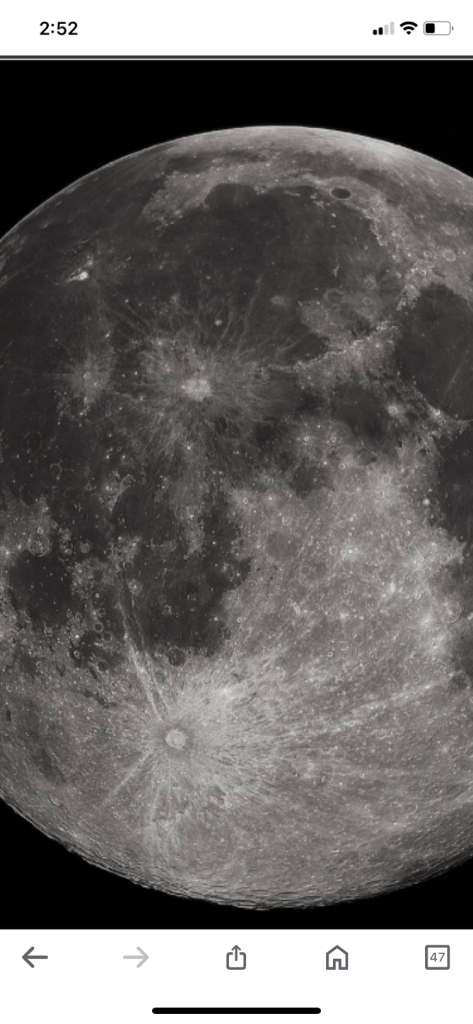
Story highlights. In a breakthrough investigation carried out in May, the scientists discovered that the inner core of the moon is a solid ball and has a density similar to that of iron
According to mathematical models, the Moon has a solid inner core and a fluid outer core, similar to Earth’s. The inner core is made of a metal with a density similar to iron, and is about 500 kilometers in diameter. The Moon’s core is also believed to contain a small amount of sulfur and nickel
The Moon’s core is solid iron with a temperature between 1,327°C and 1,427°C. This is hot enough to create a surrounding molten liquid iron outer core, but not hot enough to warm the surface. The mantle that surrounds the core is roughly 1,000 kilometers thick.
According to Earth.com, a team of scientists led by French astronomer Arthur Briaud concluded that the Moon’s core is likely a solid metal ball covered by a molten outer layer
Here are some other things we know about the Moon:
- Size: The Moon is about one-fourth the size of Earth and has about one-eighth of its mass.
- Gravity: The Moon has about one-sixth of Earth’s gravity.
- Shape: The Moon is asymmetrical, with a thicker crust on one side than the other.
- Surface: The Moon’s surface is covered with dirt, craters, and mountains.
- Water: The Moon has frozen water in craters near its poles. The water is in the form of ice caught within minerals and dust on and below the surface.
- Atmosphere: The Moon has almost no atmosphere. The Moon’s escape velocity is much less than the root mean square (RMS) velocity of gas molecules on the moon, so the molecules of gas escape from the moon’s surface.
- Shadows: Astronauts on the moon noticed that their shadows were much darker than on Earth. The atmosphere that scatters light to create shadows on Earth is absent on the moon.
- Formation: The Moon formed 4.51 billion years ago, not long after Earth’s formation, out of the debris from a giant impact between Earth and a hypothesized Mars-sized body called Theia.
- Humans: Twelve astronauts from the USA have walked on the Moon’s surface, starting with Neil Armstrong from the Apollo 11 mission in 1969.
Much of our knowledge of the structure of the lunar surface and the geology of the Moon comes from the landings of the Apollo series and the samples of lunar material brought back to Earth
Here are some reasons why we know so much about the Moon:
- Apollo missions Between 1969 and 1972, 12 astronauts landed on the Moon as part of NASA’s Apollo program. The Apollo missions provided valuable samples of lunar material and insights into the Moon’s formation, volcanism, and more.
- Lack of tectonic activity Unlike Earth and Venus, the Moon lacks tectonic activity, so its internal structure has been well preserved since its formation. This gives scientists an opportunity to understand how planets form.
- Meteorites Meteorites come from all over the Moon’s surface, while Apollo samples come from just one place near the equator. In some ways, meteorites can tell us more about the Moon than Apollo samples.
- Direct illumination The surface of the Moon is directly illuminated by light and radio waves.
One reason we know more about the Moon than the Earth’s oceans is that it’s easier to observe the surface of the Moon. The Moon, Earth, and Mars are all directly illuminated by light and radio waves. However, technological limitations make it difficult to directly observe the ocean floor.
Another reason is that it’s expensive and complicated to explore underwater.
Some say we feel like we know more about the Moon because it intrudes on our lives in a way that the deep sea doesn’t. We can see the Moon wax and wane and experience the tides.
A 1957 paper published in the Journal of the Royal Society of Arts states: “the deep oceans cover over two-thirds of the surface of the world, and yet more is known about the shape of the surface of the moon than is known about that of the bottom of the ocean
(Full article source google)
Best telescopes on discount on Amazon Universe discoveries
You know….I hadn’t even thought of the moon’s core! I had always assumed it to be a solid rock. But it makes sense that its core might be similar to Earth’s. One question: are you saying that meteorites literally break off of the moon and then hit the earth? Or do meteorites composition be similar to the moon?
LikeLiked by 1 person
Lunar meteorites are small pieces of the moon that occasionally reach Earth. They are identical in composition to the moon rocks brought back by astronauts, but they come from different locations
LikeLiked by 1 person
So these meteorites are NOT DIRECTLY from the moon, but come from elsewhere?
LikeLike
Thanks 🙏
LikeLike