
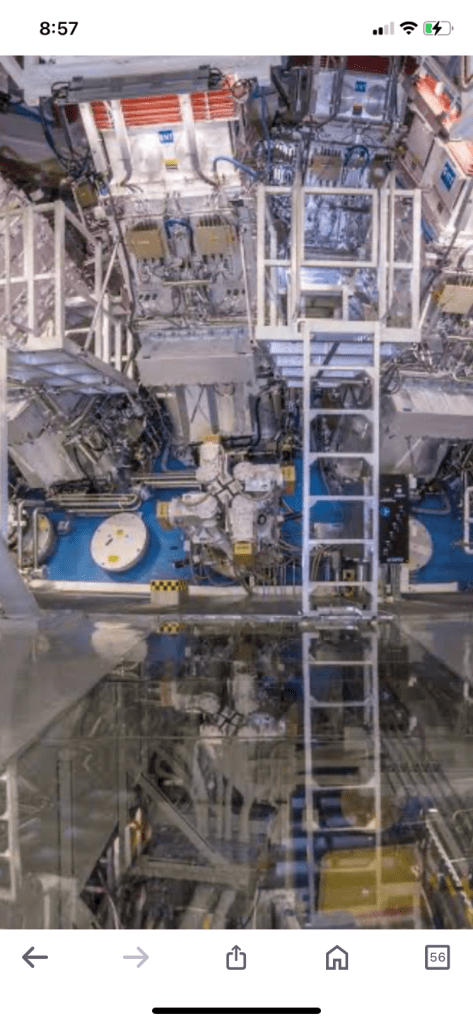
With 200 lasers and a peppercorn-sized fuel capsule, scientists inch closer to mastering fusion energy. The target chamber of the National Ignition Facility in California, where temperatures reach 100 million degrees Celsius and pressures are extreme enough to compress a substance to 100 times the density of lead.
According to CNN, scientists at the National Ignition Facility (NIF) in California have made progress towards mastering fusion energy by using 200 lasers on a peppercorn-sized fuel capsule. The NIF is part of the Lawrence Livermore National Laboratory.
The lasers are fired at a gold cylinder called a hohlraum, which heats the container to over 3 million degrees Celsius. The capsule inside is then bathed in X-rays. The intense energy and extreme pressures can compress a substance to 100 times the density of lead.
According to Jill Hruby, head of the National Nuclear Security Administration, the activity briefly simulated the “conditions of a star”.
If mastered, fusion energy could provide the world with a near-limitless source of clean power
Laser fusion, also known as inertial confinement fusion, uses lasers to heat and compress fuel pellets to initiate nuclear fusion reactions. The fuel pellets are made of deuterium and tritium, which are heavy hydrogen isotopes that react more easily than protium
Lasers can deliver high-intensity energy to heat and compress the fuel to high densities and temperatures. These conditions are necessary for the atoms to collide and fuse together, releasing significant energy.
The NIF uses an initial low-energy pulse that is amplified by more than a quadrillion times to create 192 highly energetic, tightly focused laser beams that converge in the center of the Target Chamber.
Some types of lasers that have been developed for fusion energy include:
- Argon fluoride (ArF) This laser system has deep ultraviolet light and a wider bandwidth than other laser drivers. This can improve laser target coupling efficiency and enable higher pressures for implosion.
- Krypton Fluoride (KrF) gas lasers These lasers have the potential to meet the fusion energy requirements for rep-rate, efficiency, durability, and cost.
- Diode Pumped Solid State Lasers (DPPSL) These lasers have the potential to meet the fusion energy requirements for rep-rate, efficiency, durability, and cost.
The principles of laser fusion are the implosion of fuel pellets and the inertial confinement of fusion plasma
The acronym “laser” stands for “light amplification by stimulated emission of radiation”. Lasers work through resonant effects, and their output is a coherent electromagnetic field.
In a fusion reaction, two light nuclei merge to form a single heavier nucleus. The process releases energy because the total mass of the resulting single nucleus is less than the mass of the two original nuclei. The leftover mass becomes energy.
Laser fusion was first suggested in 1962 by scientists at the Lawrence Livermore National Laboratory (LLNL). The initial concept was developed by LLNL employee John Nuckols in the late 1950s.
In the 1960s, theoretical physicist Keith Brueckner pioneered one type of laser fusion. In 2023, InnovationAus.com credited Australian theoretical physicist and HB11 Energy founder, Professor Heinrich Hora, with inventing laser fusion with boron.
Physicists John Emmett and John Nuckolls are also considered early pioneers in laser and inertial confinement fusion technology
(Full article source google)
https://9e9f8fli49wql29k9be-nhp65z.hop.clickbank.net Universe discoveries
Thank you for sharing it, Satyam👏👏👏💯
LikeLike