
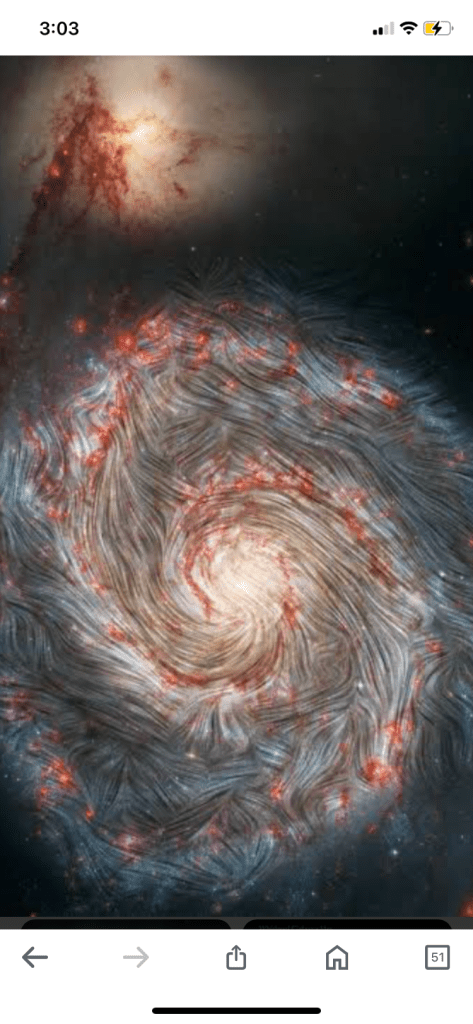
Astronomers have identified the birthplaces of stars in the Whirlpool Galaxy, also known as Messier 51. The research was led by the Max Planck Institute for Astronomy and published in Astronomy & Astrophysics.
The research team used molecular maps and optical images of the galaxy to identify regions rich in diazenylium. These regions line up with dark zones in the galaxy’s spiral arms, which are likely areas for new stars to form.
The research also found that hot stars form in some of the coldest regions of the universe. These regions are thick clouds of gas and dust that can span entire galaxies.
Astronomers track star formation by monitoring these cold clouds of gas and dust. They use two types of molecules to do this: hydrogen cyanide (HCN) and diazenylium (N2H+).
The Whirlpool Galaxy is a grand design spiral galaxy located in the constellation of Canes Venatici. It’s one of the most famous galaxies in the sky, appearing face-on when viewed from Earth. Astronomers estimate that the Whirlpool Galaxy has about 100 billion stars
Now, a team of researchers from the Max Planck Institute for Astronomy has completed a survey of molecules throughout the galaxy and developed a map of potential star-forming regions. Tracking star formation from far away is best done by monitoring cold clouds of gas and dust formed as part of the creation process
Molecular clouds are the birthplaces of most stars in our galaxy. These clouds are made of cool gas and dust, and can range in mass from a thousand times the mass of the sun to about 3 million solar masses.
The majority of star formation in the Milky Way occurs in the cold, dense interiors of these massive molecular clouds, especially in the galaxy’s spiral arms.
Stars are born in the following way:
- Turbulence deep within the clouds creates knots with enough mass for the gas and dust to begin to collapse under its own gravitational attraction.
- As the cloud collapses, the material at the center begins to heat up.
- This hot core at the heart of the collapsing cloud is known as a protostar, and will one day become a star.
The most well-studied molecular cloud is Orion, where star formation is currently taking place
The Max Planck Institute for Astronomy (MPIA) is a research institute in Heidelberg, Germany that uses high-tech instruments to study the universe. The institute was founded in 1967 and is one of about 80 institutes in the Max Planck Society
The journal Astronomy & Astrophysics is published by EDP Sciences and is operated by an editorial team. The journal has a board of directors that represents 27 sponsoring countries and a representative of the European Southern Observatory
Here is some information about star formation and a map of potential star-forming regions from Max Planck Institute for Astronomy.
Stars form in dense regions within molecular clouds in interstellar space. These regions are sometimes called “stellar nurseries” or “star-forming regions”.
Molecular clouds are perfect star-forming regions because the combination of these atoms into molecules is much more likely in very dense regions.
The Max Planck Institute for Astronomy (MPIA) has developed a map of potential star-forming regions in the Whirlpool Galaxy. The map was created by an international research team led by astronomers from the MPIA.
The map shows areas where there is a high concentration of gas and dust. These are the conditions that are necessary for star formation to occur.
The MPIA’s map is a valuable tool for astronomers who are studying star formation. It will help them to better understand the process of star formation and how stars evolve.
Here are some pieces of evidence that support the star formation theory:
- Stellar evolution theory
- Expanding OB associations
- The interstellar medium
- Stellar mass
- Interstellar dusts and gasses
The discovery that much of a galaxy’s interstellar medium is in giant molecular clouds (GMCs) has changed our understanding of star formation. These clouds are the precursors to star formation
Protoplanetary disks are also an important part of the star and planet formation process. They form when prestellar cloud cores contract gravitationally and disperse after millions of years
Star formation is difficult to observe because the dust in molecular clouds blocks visible light. However, astronomers can observe these dark stellar nurseries using radio waves. Radio waves travel freely down to radio telescopes.
Astronomers also observe star formation by:
- Using spectroscopy This is the most common method astronomers use to determine the composition of stars and other objects.
- Observing active galactic nuclei These regions can be observed using infrared through X-rays.
- Observing atomic and molecular gas Scientists can trace star formation in interstellar clouds by observing atomic and molecular gas.
- Using data from satellites Satellites can acquire data about the radiation emitted by astronomical objects. Most young stars shine their light in ultraviolet wavelengths, making it easy to differentiate between young and old stars in a galaxy.
Some indicators of star formation include:
- Ultraviolet light: Young massive stars emit ultraviolet light, which can be used to trace star formation.
- Far infrared (FIR) light: Dust can absorb and be heated by young stars, then radiate in the far infrared.
- Nebular H α recombination line: This line is a widely used indicator of star formation.
- Far-ultraviolet (FUV) continuum: This continuum is another widely used indicator of star formation.
- 4000 Å break and Balmer lines: These are also indicators of star formation.
Star formation can be triggered by compression from wind or supernova-driven shock waves that sweep over molecular clouds
(Full article source google)
Best bags and bag packs on heavy discount on Amazon Universe discoveries
Great discovery
LikeLiked by 1 person
Yes it is we are going through a spectacular change and findings in astronomy and after James Webb is there we are rocking in astronomy 🙏
LikeLiked by 1 person
Good written 🥉
LikeLiked by 1 person
Thanks 🙏
LikeLiked by 1 person