
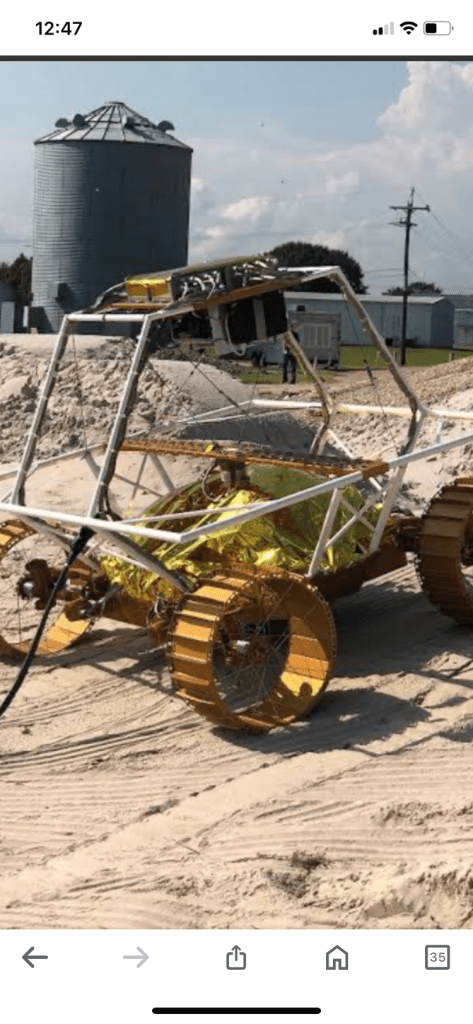
Beyond navigation, VIPER will employ temporal constraint planning, an AI subfield, to manage its activities within the mission’s timeframe. This technique is critical for balancing scientific goals with the practicalities of lunar operations
NASA’s VIPER (Volatiles Investigating Polar Exploration Rover) rover will use AI to navigate the Moon’s south pole. The rover will use AI to make decisions, such as choosing safe areas to avoid extreme cold and dark shadows. It will also use AI to assess risk and make optimized decisions, from selecting a landing site to planning out the rover’s path
The rover will also use temporal constraint planning, an AI subfield, to manage its activities within the mission’s timeframe. This technique is critical for balancing scientific goals with the practicalities of lunar operations.
The rover’s AI is geared to navigate the mission’s challenges by being adaptable, flexible, resilient, and efficient. NASA sees AI as a tool to handle the unpredictability and harsh terrain of the moon.
The rover will get a close-up view of the location and concentration of ice and other resources at the Moon’s South Pole. This will bring NASA closer to its ultimate goal of a long-term presence on the Moon.
Throughout the 100-day mission, the rover will make many stops in scientifically significant places. The AI system will help the rover make informed decisions, such as choosing safe areas between scientific sites to avoid extreme cold and dark shadows.
The information gathered from these sites will give NASA scientists a wide range of scientific data on surface characteristics, chemistry, and accessible resources.
The AI system’s capabilities include evaluating massive volumes of data while taking into account the harsh lunar surface and the rover’s physical constraints. It will also be able to evaluate the probability of discovering resources at the designated site.
Finally, SHERPA provides its human controllers with various mission options for collaborative decision-making.
“It can assess the various risks of different routes by running thousands of mission simulations, and even provide contingency branches for where to go if something changes or doesn’t go according to plan,” described NASA.
Central to VIPER’s AI capabilities is the System Health Enabled Real-time Planning Advisor (SHERPA). This tool will aid NASA scientists in decision-making by providing route options and assessing risks through extensive simulations
The System Health Enabled Real-time Planning Advisor (SHERPA) is an AI system that helps NASA scientists make decisions for the VIPER rover. SHERPA provides route options and assesses risks through simulations. It also informs the team about important aspects of navigation.
SHERPA has been crucial in planning the rover’s 100-day mission around the moon’s south pole. SHERPA doesn’t control the mission, but it helps the team navigate the dangerous environment.
SHERPA uses advanced algorithms and machine learning to analyze data in real-time, evaluate the environment, and make decisions
Yes, NASA’s Volatiles Investigating Polar Exploration Rover (VIPER) will use an AI system called SHERPA to navigate the Moon’s south pole. SHERPA will help the rover plan its path and traverse the lunar surface.
SHERPA will help NASA scientists make decisions by providing route options and assessing risks through simulations. SHERPA’s contributions have been especially vital in planning the rover’s 100-day mission around the moon’s south pole.
VIPER is a square golf-cart-sized vehicle about 5 feet long and wide, and about 8 feet high. Unlike all of NASA’s Mars rovers, VIPER has four wheels, not six. VIPER can also lift its wheels independently and drive sideways, with a top speed of 0.8 kilometers per hour.
The Volatiles Investigating Polar Exploration Rover (VIPER) is NASA’s Artemis lunar rover that will explore the Moon’s south pole in 2024. VIPER will search for ice and other resources, and will map water on the Moon’s surface
VIPER’s findings will help NASA learn more about the history of water in the solar system, and will help NASA plan for future lunar habitats. VIPER’s findings will also help NASA achieve its goal of establishing a long-term presence on the Moon, which will eventually allow NASA to explore Mars and beyond.
VIPER will land near the western edge of the Nobile Crater at the Moon’s South Pole. VIPER will drive into some of these PSRs, which can have temperatures below -200°C (-390°F), and will use its headlights to explore their secrets.
The south pole of the moon is a top destination for exploration because scientists believe it contains significant amounts of ice. This ice could be used for drinking water, fuel, and oxygen for future missions to the moon. Water is also essential for life and can be used as a coolant for equipment.
The south pole is also challenging due to its craters and deep trenches. Some craters only receive a small amount of sunlight due to the angle of the light, and scientists believe they may contain frozen water. If so, it could be a good location for a testing base or colony
The moon’s south pole is a challenging landing site for several reasons:
- Terrain The south pole has a rugged landscape with craters, boulders, and uneven surfaces. The terrain is also dangerous and mountainous, with craters and scarps that have been in perpetual darkness for billions of years.
- Lighting The south pole is dark during spacecraft descent, making it difficult to find a suitable landing site.
- Temperature Some areas of the south pole are shrouded in darkness and have never received sunlight. Temperatures can plummet to as low as -230°C.
- Distance The south pole is far from the equatorial region explored by previous lunar missions.
- Flight plan It requires a more complex flight plan and more fuel to get into an orbit that passes over the South Pole.
- Communication The Pole is so close to the edge of the Moon that dropping into a deep crater could easily cut the communication link.
The moon’s south pole has more craters than the north pole, which may be due to meteorite impacts. The south pole also has craters that are unique because sunlight can’t reach their interiors
Scientists are interested in the south pole because it may contain valuable resources, such as water ice in permanently shadowed areas. The south pole also provides a unique opportunity to study the lunar surface’s interaction with the Earth’s magnetic field and cosmic radiation.
Scientists are also interested in ancient water ice because it could provide a record of lunar volcanoes, material that comets and asteroids delivered to Earth, and the origin of oceans.
The presence of water on the moon is seen as crucial for future moon colonies, lunar mining, and potential missions to Mars
(Full article source google)
https://2a72alfh59s0huexs0xbc0sc7b.hop.clickbank.net Universe discoveries
Very nice topic about universe , but south pole of moon having _२३० degrees Celsius it was not in my knowledge, _ thanks
LikeLike
I don’t know how Viper rover will work.
LikeLike