
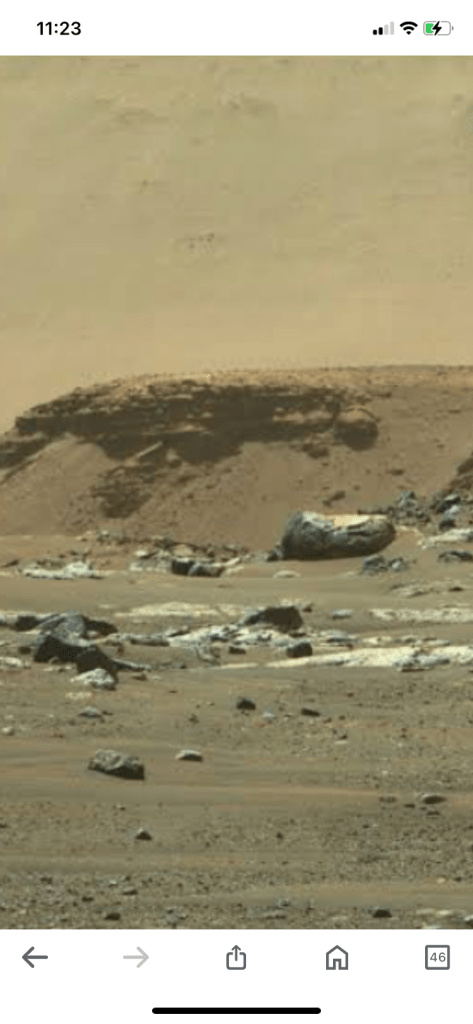
NASA’s Perseverance rover has been exploring an ancient river delta on Mars that once fed into a lake billions of years ago. The rover landed in Jezero Crater on February 18, 2021, to search for signs of ancient life
The rover has found evidence of flowing water on Mars, which supports the idea that the planet once had oceans and rivers. The rover is also studying rocks that show different eras in the history of the river delta. Scientists are looking for evidence of ancient life in the rocks.
Perseverance is also testing new technologies that could help future human missions to Mars
NASA’s Perseverance rover has been exploring the Jezero Crater delta on Mars, which scientists believe was once a lake fed by a river. The delta is thought to be one of the best places on the Red Planet to search for signs of ancient life
The rover landed in Jezero Crater in February 2021. The crater is now a dry depression, but images taken by the rover confirm that it was once a lake fed by a river about 3.7 billion years ago. The delta is older than any on Earth and dates back to a time when Mars was warm and wet. The basin may have preserved organic molecules and signs of microbial life.
The rover has been studying rocks that show different eras in the history of the delta. Scientists are looking for evidence of ancient life recorded in the rocks
NASA’s Perseverance rover has been exploring the Jezero Crater delta on Mars, which scientists believe was once a lake fed by a river. The rover landed in the crater on February 18, 2021
The Jezero Crater is a dry, wind-eroded depression that was once a lake fed by a small river about 3.7 billion years ago. The delta is an area where scientists believe a river once flowed into a lake and deposited sediments in a fan shape. The delta is considered one of the best places on Mars to search for potential signs of ancient life.
The rover has used the Planetary Instrument for X-Ray Lithochemistry (PIXL) to determine the elemental composition of Martian surface materials. The rover has found carbon-based matter in every rock it has abraded, as well as carbonates, sulfates, and unexpected salts.
Scientists chose the Jezero Crater as a landing site for Perseverancebecause:
- Potential habitability The crater floor contains clays and minerals that can preserve organic materials.
- Evidence of a lake Orbital imagery showed a delta, which is clear evidence of a large lake that once filled the crater.
- Delta rocks Delta rocks are a great environment for preserving signs of ancient life as fossils in the geologic record.
- Sediment layers Geologists hope to examine places where water once ponded and sediment layers.
- River systems On Earth, sprawling river systems like that found in the Martian crater build up enormous deposits of sediments.
The delta rises about 40 meters above the crater floor. The freshly abraded patch is made in a sandstone in one of the lowest rock layers in the delta. This means it is one of the oldest rocks formed by Jezero’s ancient river and thus an excellent place to hunt for signs of ancient life.
Scientists are searching for signs of ancient microbial life in Jezero Crater. The rover’s prime destination is the 3.5-billion-year-old river delta, where sediments have turned into rock
The crater is a great place to study a potentially habitable environment that may still preserve signs of past life. On Earth, scientists have found microbial life embedded in the rock of the Mississippi river delta.
The rover has found signs of organic molecules in Jezero Crater
Perseverance and its helicopter companion, Ingenuity, landed in Jezero Crater on February 18, 2021, to search for signs of ancient microbial life. As part of the search, the robotic explorer just completed its investigation of a river delta that once fed into a lake that filled Jezero Crater billions of years ago
Jezero Crater was a good target for Perseverance because it offered multiple diverse environments to probe for signs of past life. The crater’s lake-delta system offered a variety of environments, including a large, fan-shaped pile of sediments that could preserve signs of ancient Martian life-forms.
The crater’s geologically rich terrain also offers landforms that could potentially answer important questions in planetary evolution and astrobiology
NASA chose Jezero Crater as the landing site for the Perseverance rover. Scientists believe the area was once flooded with water and was home to an ancient river delta
The Perseverance rover uses several scientific instruments to study the Jezero Crater, including:
PIXL Uses an X-ray beam to identify the composition of samples.
SHERLOC A Raman spectrometer on the rover’s robotic arm that can detect organic compounds.
- SuperCam Contains a laser that can zap rocks up to several meters away. It also contains a Raman spectrometer that can detect organic compounds.
RIMFAX A ground-penetrating radar instrument that can map layers of rock, water, and ice up to 33 feet (10 m) deep.
MEDA Collects atmospheric measurements and provides weather reports from the crater.
The rover also has seven science cameras and nine engineering cameras that have taken more than 166,000 images.
Scientists believe that Jezero Crater was formed by an asteroid impact almost 4 billion years ago. The crater is located in the Isidis Planitia region of Mars, where a large crater was left behind by the impact
Scientists think the Red Planet dried out about 3.5 billion years ago. They believe the crater was once a quiet lake, fed by a small river, and that the crater endured flash floods. The crater floor is made of igneous rock formed from magma underground or from volcanic activity at the surface
Scientists believe the Red Planet dried out about 3.5 billion years ago. This happened after the planet’s magnetic field died and its atmosphere became susceptible to stripping by charged particles from the sun.
The wind then stripped away much of the planet’s atmosphere, and surface water boiled away in the low pressure or seeped down into the surface.
Over billions of years, wind eroded the landscape, leaving the crater we see today
Yes, there was water in Jezero Crater. The crater is 28 miles in diameter and geological evidence suggests that it once filled with water and spilled onto the surrounding land
Scientists believe that river channels spilled over the crater wall more than 3.5 billion years ago, creating a lake. They also believe that water carried clay minerals from the surrounding area into the crater lake.
The Perseverance rover has collected samples that reveal the history of water within Jezero Crater. The rover’s exploration of the crater floor and the delta have led to scientists developing a detailed timeline for the crater’s formation
This animated artist’s concept depicts a scene of water breaking through the rim of Mars’ Jezero Crater, which NASA’s Perseverance rover is now exploring. Water entered the crater billions of years ago, depositing sediments that built up into a delta
Scientists also theorize that Mars had other ancient lakes, including:
- Eridania Lake This ancient lake may have been larger than the Caspian Sea and contained more water than all other Martian lakes combined.
- Lake Vostok This underground lake is about the size of Lake Ontario and is buried beneath 3 kilometers of ice. Some scientists believe that microorganisms may be living in these lakes.
- Gale Crater NASA’s Curiosity Rover has found evidence that this 150 kilometer wide crater once held a lake and stream system.
Scientists also believe that Mars may have once had a large ocean around 4 billion years ago
(Full article source google)
<!– /wp:paragraph https://923b8jfj00zw8za6quztya9w5q.hop.clickbank.netBest kitchen and home appliances on discount on Amazon
https://923b8jfj00zw8za6quztya9w5q.hop.clickbank.net Best woman clothes on heavy discount on Amazon Universe discoveries
Beautiful 👏👏👏👏💯
LikeLike