
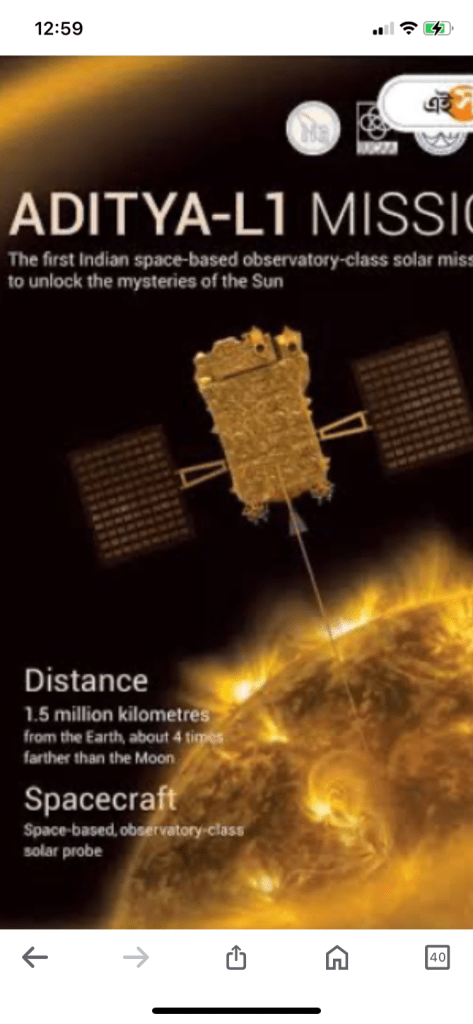
The Parker Solar Probe and Aditya-L1 are both spacecraft with different instruments that study the Sun. The Parker Solar Probe studies the Sun’s atmosphere, while Aditya-L1 studies the Sun’s magnetic field and solar wind.
Here are some other differences between the two spacecraft:
- Proximity to the Sun: The Parker Solar Probe gets much closer to the Sun than Aditya-L1, coming within 3.9 million miles of the Sun’s surface. Aditya-L1 orbits the Sun-Earth Lagrange Point L1, about 1.5 million kilometers from Earth.
- Technological approach: The two spacecraft have different approaches and technologies.
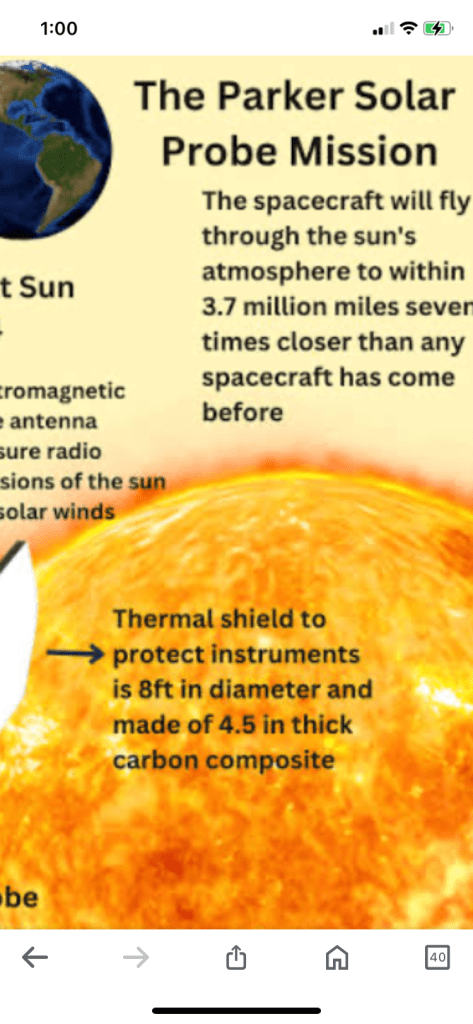
- Instruments: The Parker Solar Probe has a hexagonal solar shield that’s 2.3 meters in diameter and 11.4 centimeters thick. Aditya-L1 has a Visible Emission Line Coronagraph (VELC) that observes the solar corona in visible light.
Aditya-L1 mission spacecraft will settle in a big orbit around the Sun-Earth Lagrange Point L1, about 1.5 million kilometres from Earth. This point has balanced gravitational forces between the Sun and Earth. Parker Solar Probe gets much, much, closer to the Sun at just about 3.9 million miles away
The Parker Solar Probe and Aditya-L1 spacecraft have different purposes and different approaches to studying the Sun
The Parker Solar Probe gets much closer to the Sun than Aditya-L1, coming within 3.9 million miles of the Sun’s surface. Aditya-L1 orbits the Sun-Earth Lagrange Point L1, about 1.5 million kilometers from Earth
Aditya-L1 is positioned strategically at the L1 Lagrange point, offering continuous observation from a distance. The Parker Solar Probe is unprecedentedly close to the Sun’s surface, within the corona, enduring extreme heat and radiation for direct data collection.
Aditya-L1 has seven instruments:
- Visible Emission Line Coronagraph (VELC): Studies the solar corona and Coronal Mass Ejections
- Solar Ultraviolet Imaging Telescope (SUIT): Images the Solar Photosphere and Chromosphere
- Solar Low Energy X-ray Spectrometer (SoLEXS): Studies X-ray flares from the Sun
- ASPEX: Includes two tools to study the sun: the Solar Wind Ion Spectrometer (SWIS) and the Suprathermal and Energetic Particle Spectrometer (STEPS)
The Parker Solar Probe has four main instruments:
- FIELDS (Electromagnetic Fields Investigation):
- IS☉IS (Integrated Science Investigation of the Sun):
- WISPR (Wide-field Imager for Solar Probe):
- SWEAP (Solar Wind Electrons Alphas and Protons):
Yes, the Parker Solar Probe is the fastest human-made object ever built. In 2018, the probe became the fastest human-made object soon after its launch. By 2025, the probe will travel at a speed of 430,000 mph, which is 0.064% the speed of light
The Parker Solar Probe launched in 2018 and has been spiraling around the Sun ever since. The probe’s goal is to study the Sun up close during the first half of solar cycle 25, leading up to solar maximum in 2025
The Parker Solar Probe and the Solar Orbiter work together to study the Sun. The Parker Solar Probe travels closer to the Sun, while the Solar Orbiter observes the Sun from a distance:
- Parker Solar Probe Travels within 4 million miles of the Sun’s surface, enduring the Sun’s plasma. The Parker Solar Probe has a smaller payload than the Solar Orbiter, but it goes closer to the Sun.
- Solar Orbiter Studies the Sun’s corona from about 26 million miles away. The Solar Orbiter uses gravity assists from Earth and Venus to move its orbit closer to the Sun.
The Parker Solar Probe and the Solar Orbiter use gravitational assist maneuvers to move closer to the Sun. The Parker Solar Probe’s mission is scheduled to end in 2025.
The Parker Solar Probe’s primary science goal is to determine the structure and dynamics of the Sun’s coronal magnetic field. It also aims to:
- Trace the flow of energy that heats and accelerates the solar corona and solar wind
- Determine the structure and dynamics of the plasma and magnetic fields at the sources of the solar wind
- Explore mechanisms that accelerate and transport energetic particles
- Understand how the solar corona and wind are heated and accelerated
- Determine what processes accelerate energetic particles
The Parker Solar Probe’s mission is to amass crucial data on key solar processes by executing repeated, progressively closer passes of the Sun.
The Parker Solar Probe’s achievements include:
- Becoming the first spacecraft to “touch the Sun”
- Collecting vital data on the Sun’s upper atmosphere and solar wind
- Breaking speed and distance records
- Revolutionizing our understanding of the Sun
The Parker Solar Probe and Aditya-L1 spacecraft have different approaches to studying the Sun. While their objectives are similar, they differ in their technology, approach, and proximity to the Sun
The Parker Solar Probe is expected to revolutionize our understanding of the Sun by providing new data on solar activity and helping us forecast space weather events
The Parker Solar Probe is the first spacecraft to fly into the Sun’s corona. It will provide humanity with the closest-ever observations of a star. Scientists hope the data will help them understand how heat and energy move through the corona and drive the solar wind.
The Sun is the only star we can study closely. Studying the Sun can help us learn more about stars throughout the universe and how life evolved on Earth.
The Parker Solar Probe’s primary scientific goal is to understand how the Sun’s corona is heated and how the solar wind is accelerated
The Sun’s corona is hotter than the surface, with temperatures reaching over 2 million degrees Fahrenheit. This is one of the biggest unanswered questions in astrophysics.
The Parker Solar Probe also aims to answer the question of why the corona gets hotter as you move further away from the surface
The Parker Solar Probe has made several discoveries, including:
- Magnetic field flips The probe found that the Sun’s magnetic field flips as the spacecraft approaches the Sun. These flips align with magnetic funnels in the Sun’s surface.
- Solar wind origins Scientists believe they have discovered the processes that create solar wind, which are streams of charged particles released from the Sun’s corona.
- Critical surface The probe detected that the Sun’s critical surface is made up of spikes and valleys, rather than a perfect sphere.
- Sun’s atmosphere The probe determined the end of the Sun’s atmosphere is about 13 million kilometers from the surface.
The probe also found that magnetic reconnection within funnel structures is the energy source of the fast solar wind.
The Parker Solar Probe is unique in that it is the first spacecraft to fly into the Sun’s corona, or outer atmosphere. The probe is also designed to withstand the extreme heat and radiation of the corona. It has a heat shield that reflects sunlight and a cooling system that keeps its instruments from overheating.
The Parker Solar Probe is also unique in that it uses Venus flybys to gradually shrink its orbit around the Sun. This allows it to come as close as 3.83 million miles to the Sun, which is about seven times closer than any other spacecraft
Aditya-L1 is a spacecraft designed to study the Sun’s atmosphere. It is India’s first solar mission and was launched on September 2, 2023. The spacecraft will orbit the Sun-Earth system’s Lagrange Point 1 (L1), which is about 1.5 million kilometers from Earth
Aditya-L1’s objectives include:
- Studying the solar atmosphere and solar magnetic storms
- Studying the Sun’s corona, chromosphere, and photosphere
- Monitoring space weather
- Providing data to understand the Sun’s impact on Earth’s climate and space environment
- Studying the physics of the partially ionized plasma
- Studying the initiation of coronal mass ejections and flares
- Studying the particle and plasma environment
Yes, Aditya-L1 is India’s first solar mission. It’s also ISRO’s second space-based astronomy mission, after AstroSat
The Polar Satellite Launch Vehicle (PSLV-C57) successfully launched the Aditya-L1 spacecraft on September 2, 2023. The launch took place at 11:50 IST, ten days after the successful landing of ISRO’s Moon mission, Chandrayaan-3.
The PSLV is ISRO’s reliable Polar Satellite Launch Vehicle. The PSLV deployed Aditya-L1 into low-Earth orbit around 63 minutes after launch. After this, it underwent a Trans-Lagrangian1 insertion maneuver
Aditya-L1 has several sensors and instruments, including:
- PAPA An instrument that studies the temperature, distribution, and velocity of solar winds. It has two sensors: the Solar Wind Electron Energy Probe (SWEEP) and the Solar Wind lon Composition Analyser (SWICAR).
- SWIS A low-energy spectrometer that measures the proton and alpha particles of the solar wind. It has two sensors with a 360-degree field view, positioned perpendicularly to obtain a comprehensive view of Aditya’s surroundings.
- STEPS An instrument with six sensors that observe in various directions. It measures supra-thermal and energetic ions ranging from 20 (kiloelectronvolt) keV/nucleon to 5 (mega electron volt) MeV/nucleon, as well as electrons exceeding 1 MeV.
- SoLEXS A soft X-ray spectrometer that measures the solar soft X-ray flux to study solar flares.
Aditya-L1 also has a solar ultraviolet imaging telescope, a high-energy X-ray spectrometer, and a magnetometer. These sensors and instruments gather critical data concerning the Sun’s atmosphere, magnetic field, and solar wind.
The Aditya-L1 mission will observe the Sun’s corona and chromosphere, including:
- Coronal mass ejections (CMEs) Massive eruptions of solar material and magnetic fields. Understanding CMEs is important for predicting and preparing for space weather events.
- Coronal magnetic fields VELC will measure coronal magnetic fields and detect CMEs and coronal loops.
- Solar plasma Aditya-L1 will detect waves in solar plasma at L1.
- Space weather Aditya-L1 will observe and study drivers for space weather, such as the origin, composition, and dynamics of solar wind. The data from the spacecraft will aid in making models and predicting storms in advance.
- Solar winds, flares, and storms The five-year-long mission aims to get insights into how solar winds, flares, and storms generate and evolve.
Aditya-L1 will also study:
- Chromospheric and coronal heating
- The physics of partially ionized plasma
- The coronal magnetic field and heat transfer mechanisms
- Flare exchanges
- Magnetic field topology and magnetic field measurements in the solar corona
The Aditya-L1 mission aims to understand the Sun’s corona and its extreme heat. The Sun’s corona is its outermost layer, with temperatures reaching 2 million degrees Celsius
The mission’s scientific payloads must be placed outside the Earth’s magnetic field to be useful. The Aditya-L1 mission will also:
- Study coronal mass ejections (CMEs): These are large expulsions of plasma and magnetic fields from the Sun’s corona.
- Monitor solar activity: This includes sunspots and solar flares.
- Provide data for studying particle dynamics: This will help study the propagation of particles and fields in the interplanetary medium
(Full article source google)
 Universe discoveries
Beautifully written post👏👏👏👏
LikeLike