
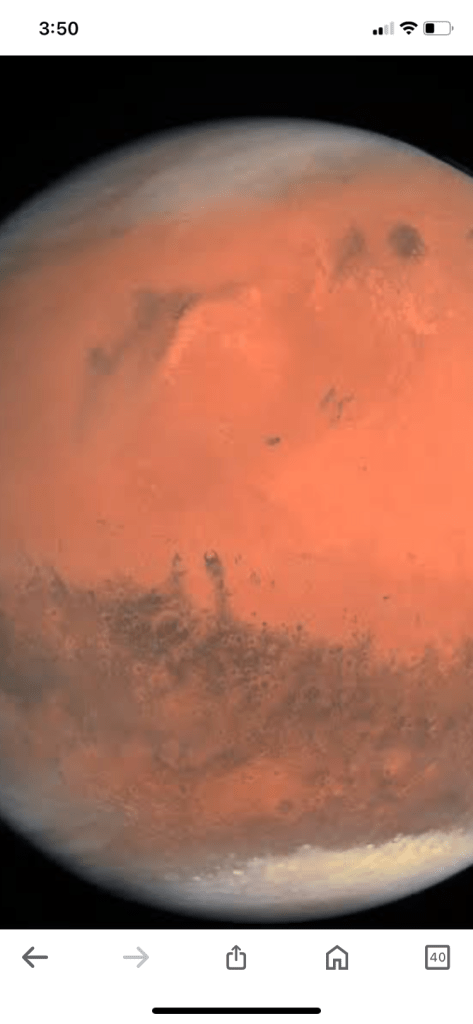
Some posts about Mars by NASA and ESA that have left people stunned include:
- “Solar rays” on Mars
- A Martian hourglass
- Mars in a never-before-seen view
- A Martian valley and chain
- An “unusual view” of Mars
NASA has also discovered other things about Mars, including:
- Crossbeds: These are centimeter-scale rock layers that overlap and cut into each other. The shapes and sizes of these layers indicate that water once flowed on the surface of Mars.
- Organic chemistry: NASA rovers have found active and ancient organic chemistry on Mars.
- Bench-and-nose features: These landforms are found within small craters and indicate that most of the planet once had the right conditions for life.
NASA has also discovered other things about Mars, including:
- Ancient water waves NASA’s Curiosity rover found rippled rocks in the foothills of a Martian mountain in 2023. The ripples are the clearest evidence yet of ancient water waves on Mars. The rocks formed when waves stirred up sediment on the bottom of an ancient Martian lake.
- Nitrogen NASA’s Curiosity rover found evidence that biologically and chemically usable nitrogen was present on Mars 3.5 billion years ago.
- Meteorite NASA’s Curiosity rover captured an image of an iron-nickel meteorite nicknamed “Cacao” in 2023. The meteorite is estimated to be about 1 foot (30 centimeters) across.
- Bedrock NASA’s Perseverance Mars rover discovered that the bedrock it has been driving on since landing in February likely formed from red-hot magma.
In March 2023, NASA’s Curiosity rover captured the first clear images of “sun rays” on Mars. These rays are also known as crepuscular rays, which comes from the Latin word for “twilight”. The images also show clouds at a higher altitude, which NASA suggests could be made of dry ice
The Sun appears to be 5/8 the angular diameter on Mars as it does on Earth, and it sends about 40% of the light. The maximum solar irradiance on Mars is about 590 W/m2, compared to 1000 W/m2 at the Earth’s surface.
Solar radiation on Mars is made up of two components: the direct beam and the diffuse component. The direct beam is affected by scattering and absorption as it travels from the top of the Martian atmosphere to the surface.
While Mars is less suitable for generating solar energy than Earth, solar power is still a good option for Mars exploration. However, more efficient solar technologies are needed to meet energy requirements
The unusual ‘hourglass’-shaped structure is located in the southern-hemisphere highland terrain of Promethei Terra at the eastern rim of the Hellas Basin, at about latitude 38º South and longitude 104º East.
Most likely the surface morphology is formed by the ‘creep’ of ice and debris, similar to either terrestrial rock glacier landforms or debris covered glaciers which are commonly found in high latitudes and alpine regions
The uncommon view of Mars shared by NASA has left people stunned. Many reacted to the post with heart emoticons
NASA took to Instagram to share a series of pictures of Mars. These never-seen-before images show the Red Planet in a whole new light. Captured by the space agency’s specialised instrument Thermal Emission Imaging System (THEMIS), the pictures show ‘Mars’ thin atmosphere, hazy clouds, craters, and dust
Be kind, but don’t rewind. This isn’t VHS. It’s from space,” NASA joked. “The horizon of the fourth planet from the Sun is seen from our Odyssey orbiter, now in its 23rd year around the Red Planet. This uncommon view of Mars, taken using an instrument called the Thermal Emission Imaging System (THEMIS), captures Mars’ thin atmosphere, hazy clouds, craters, and dust 250 miles (425 km) above the surface—the same POV orbiting astronauts would have,” they added
The space agency also added a description of the image. “Split over four images, Mars’ surface appears gray, with many craters and hills. The atmosphere shows a haze of clouds and dust in white and gray. The image is slightly grainy.,” it reads
A post on Instagram by the European Space Agency on December 18, 2023, featured a Martian valley and chain
Here’s some related information about Martian valleys and chains:
- Valles Marineris: This chain is named after the Mariner 9 Mars orbiter from 1971–1972.
- Ruell Valles: This Martian valley is also known as a fretted channel.
- Rift valley: The largest and deepest rift valley ever discovered is on Mars.
- Groundwater sapping: Most small valleys in the ancient highlands of Mars are likely the result of erosion by groundwater sapping.
- Nonimpact pit crater chains: Most valleys that formed after a certain time are related to nonimpact pit crater chains associated with volcanic processes
The Odyssey orbiter took the images from an altitude of about 400 kilometers, which is roughly the same height at which the ISS orbits Earth
In Short
- It showcases the planet’s curving horizon
- It offers valuable data for understanding the Martian atmosphere.
- The team had to rotate the orbiter nearly 90 degrees
In a remarkable feat of space photography, Nasa’s 2001 Mars Odyssey orbiter has captured a series of panoramic images that reveal the Red Planet in unprecedented detail.
The Odyssey orbiter took the images from an altitude of about 400 kilometers, which is roughly the same height at which the ISS orbits Earth. The resulting photographs stitch together to form a breathtaking panorama of Mars, showcasing the planet’s curving horizon beneath delicate layers of clouds and dust. This new vantage point is not just visually stunning but also offers valuable data for understanding the Martian atmosphere
Cross-bedding is a phenomenon that can be seen in the layers of Martian rocks. It is evidence of water movement, recorded by waves or ripples in the loose sediment that the water passed over
Cross-bedding appears as layers at angles to each other. It reflects the formation and passage of waves of sand, one on top of the other.
Cross-bedding can be seen in many places on Mars, including Gale crater. Gale crater is a 154 km diameter crater that contains a 5 km tall mountain of layered rock called Aeolis Mons, also known as Mount Sharp.
The geometry of cross-bedded sedimentary deposits can provide information about the depositional setting and post-depositional history of the rocks
NASA’s Perseverance rover has found a variety of organic molecules in a Martian crater. Organic compounds are molecules that contain carbon and often include other elements like hydrogen, oxygen, nitrogen, phosphorus, and sulfur
According to a study of a Martian meteorite, these compounds were produced by water interacting with volcanic rocks. The study also found signals consistent with molecules linked to aqueous processes, suggesting that water may have played a key role in the diverse range of organic matter on Mars.
The large diversity of organic molecules detected on Mars is a hint that life once existed there. The key building blocks necessary for life may have persisted on Mars for a far more extended period than previously thought.
NASA’s Mars Curiosity rover has also detected other organic molecules in a rock-powder sample collected by the robotic laboratory’s drill. The rover measured a tenfold spike in methane, an organic chemical, in the atmosphere around it.
NASA’s Curiosity rover and Perseverance rover have found evidence that Mars may have once supported life:
- Curiosity rover In 2013, NASA announced that the Curiosity rover found evidence that ancient Mars had the right chemistry to support microbes. The rover found sulfur, nitrogen, oxygen, phosphorus, and carbon in a powder sample from the “Sheepbed” mudstone in Yellowknife Bay. The rover also found well-preserved mud cracks that form a hexagonal pattern, which could indicate wet-dry cycles that may have been key to the assembly of complex chemical building blocks for microbial life.
- Perseverance rover In 2022, the Perseverance rover found the strongest signs yet of ancient life on Mars. The rover collected samples from an ancient river delta in the Jezero Crater, which scientists believe was full of life billions of years ago. The rover found two rocks that are full of carbon-based molecules that could be remnants of ancient life. The rocks formed several billion years ago when the crater was a lake, an environment where life could have existed.
However, as of 2023, there is still no proof of past or present life on Mars.
Please like subscribe comment your precious thoughts on my blogs on universe discoveries ( a perfect destination for universe new discoveries and science)
(Full article source google)
https://66567ljfz81wbshny7cnm-kodp.hop.clickbank.net
Best electronics toys on discount on Amazon Universe discoveries
simply amazing and great text. thanks
LikeLiked by 1 person
Thanks a lot freind 🌹
LikeLike
amazing!
LikeLike