
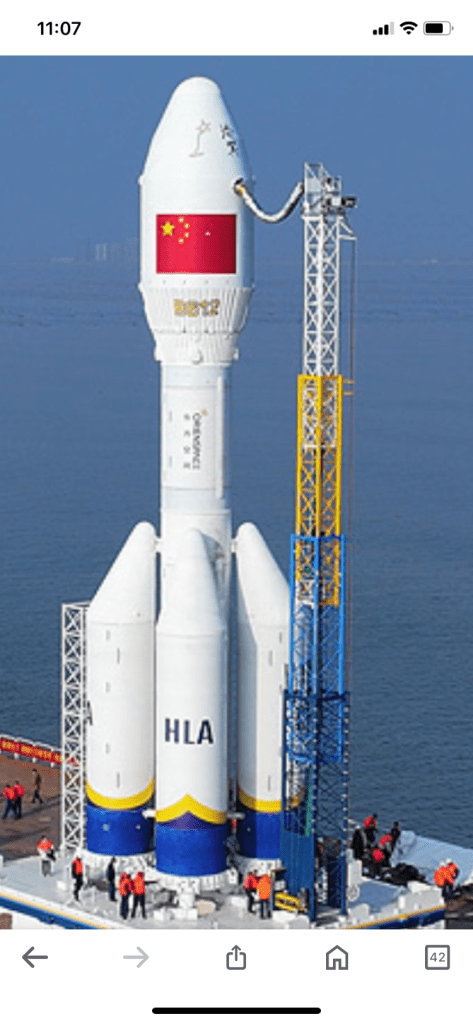
The Chinese aerospace company Orienspace has just launched Gravity-1 a solid fuel propelled rocket. The launch, from a modified cargo ship in the Yellow Sea, just off the coast of Haiyang City has sent three Yunuao-1 meteorology satellites into orbit
Gravity-1 is a solid-fuelled rocket designed by OrienSpace to launch payloads to low-Earth orbit (LEO) and sun-synchronous orbit (SSO). It’s the most powerful commercial rocket developed by a Chinese firm to date. The rocket has three stages and four boosters, and can carry a payload of up to 6.5 tons to LEO or 4.2 tons to SSO
Gravity-1 consists of three stages and four boosters. It boasts the capability to lift around 6,500 kilograms of payload to low Earth orbit, or 3,700 kilograms to 700-kilometer sun-synchronous orbit, when using a kerosene-liquid oxygen third stage
Orienspace is based in Shandong and has facilities in the province. The Haiyang sea launch facilities for today’s launch are also in Shandong. It secured a number of rounds of funding totalling more than $150 million
Orienspace CEO Yao Song, who first rose to fame in the semiconductor industry, stated previously that the firm has already securedorders for the launch of hundreds of satellites and been shortlisted in plans for a number of satellite constellations. Orienspace plans two further Gravity-1 launches for 2024
The launch success is a notable moment in the Chinese commercial space sector. Gravity-1 is now the largest in the sector in terms of launch capacity. It is also the first to use boosters, one of a handful to reach orbit on the first attempt, and the first to have a debut launch from the sea.
Many commercial firms have opted to first develop light-lift solid rockets and move on to reusable liquid propellant rockets. Orienspace opted to proceed with a much more capable launcher as well as working on a larger kerosene-liquid oxygen launcher
Gravity-1 is capable of carrying more than twice that of the previous largest Chinese solid rockets, CAS Space’s Kinetica-1 and China Rocket’s Jielong-3 (1,500 to 500-km SSO). Both are spinoffs from state-owned enterprises. It is also more powerful than Europe’s Vega-C
The Gravity-1 rocket is a solid-fueled rocket developed by OrienSpace, a commercial aerospace company in Beijing. It has three core stages and four boosters, all powered by solid-propellant motors. The Gravity-1 is 30 meters tall and has a liftoff weight of 400 metric tons
The Gravity-1 can lift around 6,500 kilograms of payload to low Earth orbit, or 3,700 kilograms to 700-kilometer sun-synchronous orbit. It has flexible swinging nozzles to help with flight control.
The Gravity-1’s second stage uses the same booster as the first stage, but with a nozzle optimized for lower pressure. The third stage has a shorter version of the motor, and the fourth stage has an even smaller solid motor
The Gravity-2 is a heavy-lift launch vehicle that is expected to debut in 2025. It will be 60 meters tall and have a liquid-fueled core stage and solid rocket boosters. Gravity-2 is designed to carry 25.6 tons to low Earth orbit
Orienspace is also working on larger, heavier liquid-fuel rockets with bigger payloads
The Gravity-1 rocket is a solid-propellant rocket. It has a thrust of 600 tonnes and can lift 6.5 tonnes of cargo into near Earth orbit.
Most liquid chemical rockets use two separate propellants: a fuel and an oxidizer. Typical fuels include kerosene, alcohol, hydrazine and its derivatives, and liquid hydrogen
The first liquid-fueled rocket was launched on March 16, 1926 by American physicist and scientist Robert H. Goddard. The rocket was launched on a farm in Auburn, Massachusetts and burned for 20 seconds before lifting off the launch rack. The rocket was powered by gasoline and liquid oxygen
Goddard was a pioneer of controlled, liquid-fueled rocketry. Between 1930 and 1935, he launched rockets that reached speeds of up to 885 kilometers per hour (550 miles per hour).
The history of Chinese rocketry dates back to the Song dynasty (960-1279). In 1232, the Chinese used rockets against Mongol invaders during the battle of Kai-Keng. The rockets were a simple form of solid-propellant rocket, made by filling a paper tube with gunpowder and attaching it to an arrow. Reports from the battle describe the rockets as “fire arrows” and “iron pots” that could be heard for 15 miles and caused devastation for 2,000 feet
Rockets are now used for many purposes, including fireworks, missiles, ejection seats, and space exploration
China’s first rocket launch was on July 19, 1964, when it launched a biological rocket carrying white mice.
On April 24, 1970, China launched its first artificial satellite, Dong Fang Hong 1, into low Earth orbit. The satellite was launched using the Long March 1 rocket from the Jiuquan Satellite Launch Center. China became the fifth nation to independently launch a satellite.
In September 2020, China successfully launched its first reusable spacecraft. The spacecraft flew in orbit for two days.
In May 2020, China launched the Long March 5B rocket, which deployed a prototype of China’s new-generation manned spacecraft, an experimental cargo retrieval craft, and more than 10 experimental payloads into low-Earth orbit.
In 2020, China launched its first independent interplanetary mission, Tianwen-1, for Mars. Tianwen-2 is in development and will launch in 2025 to target a near-Earth asteroid and a main belt comet.
Please like subscribe comment your precious thoughts on my blogs on universe discoveries ( a destination for latest universe discoveries and science discoveries)
Full article source google
Best pet supplies on heavy discount on Amazon Universe discoveries
They slavishly copied the Russian design.
LikeLiked by 1 person