
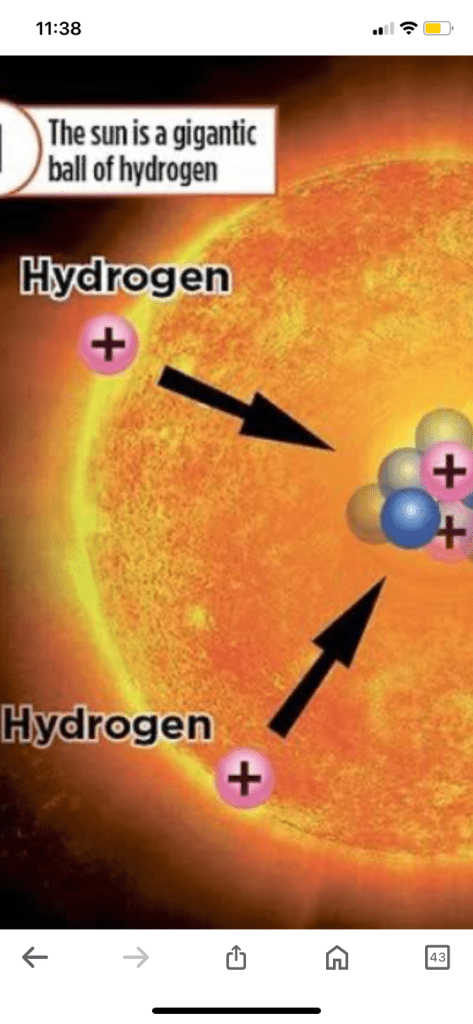
The sun is not on fire in the same way as a fire on Earth. The sun’s energy comes from nuclear fusion, where hydrogen atoms are converted into helium in its core. This process does not require oxygen.
Nuclear fusion is not a chemical reaction and therefore no oxygen is needed. In the nuclear fusion, the nuclei of the atoms fused with each other to form a larger nuclei. This process creates a ton of energy or thermal radiation which is why the sun glows.
The sun is a huge ball of hydrogen and helium held together by its own gravity. The sun has several regions, including the core, the radiative zone, and the convection zone.
But the burning of the sun is not a chemical combustion, it is a nuclear fusion. The sun is considered as the giant hydrogen bomb. In the nuclear fusion, the nuclei of the atoms fused with each other to form a larger nuclei. The nuclear fusion does not involve oxygen
Stars are made of plasma, a state of matter that’s mostly hydrogen and helium. They don’t burn like a fire on Earth, but instead undergo nuclear fusion to release energy.
Nuclear fusion is a nuclear process that doesn’t require oxygen. It happens under very high temperatures and pressures, and involves converting a small amount of mass into a large amount of energy.

In the core of a star, hydrogen atoms fuse together to form helium, releasing a huge amount of energy. This energy is what makes stars shine brightly.
The outflow of energy from the central regions of the star provides the pressure necessary to keep the star from collapsing under its own weight.
Stars die when they exhaust their nuclear fuel. The events at the end of a star’s life depend on its mass
So, the Sun can “burn” hydrogen to helium without the need for oxygen. It should be noted that in the presence of carbon, nitrogen and oxygen, stars heavier than theSun may burn hydrogen to helium by using the C, N and O as catalysts. Even in these stars, however, an absence of oxygen does not prevent nuclearburning
Fire can’t start in space because there’s no oxygen. However, flames can burn in space without oxygen because the combustion process involves the release of energy from fuel and an oxidizer.
In space, flames burn at cooler temperatures, in unfamiliar shapes, and are powered by unusual chemistry. They are also dome-shaped or spherical, and sluggish, thanks to meager oxygen flow.
Rockets work in space by using a fuel and oxidizer to create a combustion reaction. The combustion reaction creates high-pressure gases that are released from the rear of the rocket, which propels the rocket forward.
The sun is not on fire in the same way as a fire on Earth. The sun is a huge ball of gas, and the nuclear fusion process in its core causes it to glow. The sun also has its own supply of oxygen, which is produced by a process called photodissociation
The sun’s immense pressure and heat cause a nuclear reaction that generates heat and light. The sun’s core burns millions of tons of hydrogen every second, turning hydrogen into helium and releasing incredible amounts of energy. This energy heats up the sun, which produces radiation in various spectrums including visible light
The sun has been radiating heat for a long time because of the efficiency of thermonuclear fusion. The energy released from turning one kilogram of hydrogen into helium is the same as burning 20,000 metric tons of coal
The sun’s core’s immense gravitational force keeps the nuclear fusion process stable and prevents the sun from burning up. As the sun’s core becomes saturated with helium, it shrinks, causing nuclear fusion reactions to speed up. This means that the sun spits out more energy.
The sun is a relatively small and common star that uses up its energy at a relatively slow rate. It also constantly receives more energy from celestial objects, such as dust, asteroids, and comets. Some say that the sun will never burn out.
The sun is self-sustaining because it’s a nuclear power plant that’s been producing energy for about 11 billion years. It has enough mass to continue for another 5–6 billion years
The sun’s core is about 27 million degrees Fahrenheit, which is hot enough to sustain nuclear fusion. This creates outward pressure that supports the sun’s mass and keeps it from collapsing.
The sun’s gravity keeps all the planets and moons in the solar system orbiting around it
The sun generates energy from a process called nuclear fusion. During nuclear fusion, the high pressure and temperature in the sun’s core cause nuclei to separate from their electrons. Hydrogen nuclei fuse to form one helium atom. During the fusion process, radiant energy is released
The sun’s energy comes from a process called nuclear fusion. In this process, the sun’s core’s high pressure and temperature cause nuclei to separate from their electrons. Hydrogen nuclei then fuse to form one helium atom, releasing radiant energy.
The sun uses a fusion reaction, which is the fusing or combining of two atoms together. This is different from the fission reaction, which is the splitting of an atomic core, that an earthly nuclear reactor uses to produce energy.
Scientists believe that the sun’s energy production began when a huge cloud of gas and particles (a nebula) collapsed under the force of its own gravity
According to NASA, the sun will become a white dwarf in about 6 billion years.
Here’s what will happen to the sun before it becomes a white dwarf:
- 1. Red giant The sun will expand to become a red giant in about 5 billion years. It will remain in this stage for about 2 billion years.
- 2. White dwarf The sun will shed its outer gas layers and become a white dwarf in about 4 billion years.
- 3. Cooling The white dwarf will continue to cool for 100 trillion to 1 quadrillion years. It will eventually fade out of the visible spectrum and cool down to a few degrees above absolute zero.
A white dwarf is a small, dense remnant of a star that glows from leftover heat. It’s made of carbon and oxygen, and no longer produces nuclear energy
Yes, a white dwarf is hotter than the sun:
- White dwarfs According to NASA, white dwarfs can reach temperatures of over 100,000 Kelvin (179,500 degrees Fahrenheit). The surface temperature of a white dwarf can range from 8,000 to 100,000 degrees Celsius.
- Sun The sun’s surface temperature is about 10,000 degrees Fahrenheit (5,600 Celsius). The sun’s core is about 27,000,000 degrees Fahrenheit (15,000,000 Celsius).
Despite their high temperatures, white dwarfs have low luminosity because they are so small. White dwarfs are extremely dense, have high mass, and are made up of mostly carbon and oxygen.
Here are some ways the sun and white dwarfs compare:
- Size White dwarfs are about the same mass as the sun, but only slightly larger than Earth. A white dwarf is about a million times smaller than the sun, but has a density that is 1,000,000 times greater.
- Temperature The sun’s surface is about 10,000°F (5,600°C), while its core is about 27,000,000°F (15,000,000°C). White dwarfs can reach temperatures of over 100,000°F (179,500°C).
- Density White dwarfs are one of the densest forms of matter, surpassed only by neutron stars and black holes.
- Composition White dwarfs are made up of mostly carbon and oxygen.
The Sun is a yellow dwarf star, not a white dwarf
Yellow dwarf stars are medium-sized stars that are about 1.4 million kilometers in diameter. They are also known as G dwarf stars and G-type main-sequence stars. The Sun is a G2 Yellow dwarf main sequence star, and it is one of the smaller stellar classes
The Sun is classified as a yellow dwarf because it emits light primarily in the yellow range. It is also a main sequence star, which means it fuses hydrogen into helium.
Yellow dwarf stars make up about 7% of stars in the Milky Way Galaxy
Please like subscribe comment on my blogs on universe discoveries (a perfect destination for universe new discoveries and science discoveries)
Full article source google
Best pet supplies on heavy discount on Amazon Universe discoveries
Very inspiring and science related phenomenon nuclear fusion about sun energy described by you topic , it’s very important to know about energy of sun *how it’s originated?* _thanks
LikeLike
Intresting post with information about useful sun energy 🌴
LikeLike