
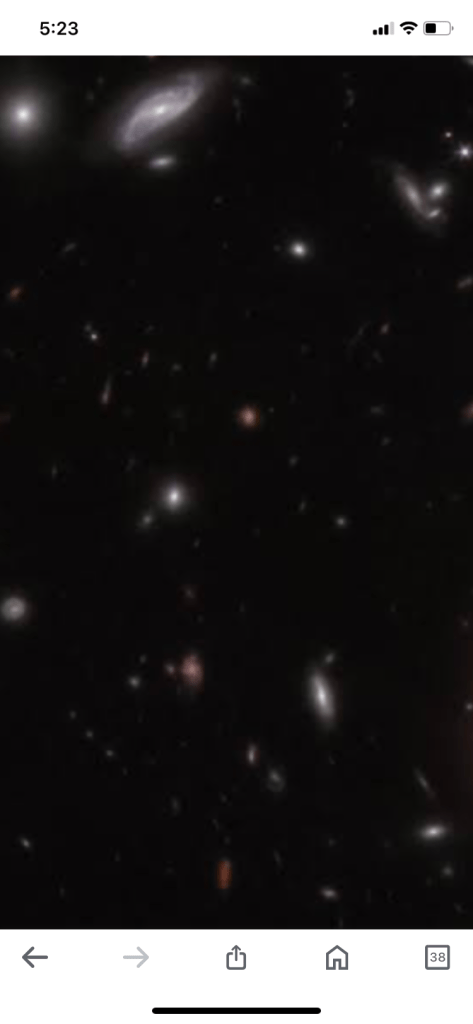
The James Webb Space Telescope (JWST) has solved the mystery of ancient light. One of the most puzzling issues that previous observations presented was the detection of light from hydrogen atoms in the very early Universe.
The very early Universe was a dark place. It was packed with light-blocking hydrogen and not much else. Only when the first stars switched on and began illuminating their surroundings with UV radiation did light begin its reign. That occurred during the Epoch of Reionization.
But before the Universe became well-lit, a specific and mysterious type of light pierced the darkness: Lyman-alpha emissions.
The JWST’s infrared viewing helps astronomers see closer back to the beginning of time and observe the formation of ancient suns and galaxies. The telescope has also discovered several black holes dating back to 800 million years after the Big Bang
One of the most puzzling issues that previous observations presented was the detection of light from hydrogen atoms in the very early Universe, which should have been entirely blocked by the pristine neutral gas that was formed after the Big Bang,” said lead author Callum Witten from Cambridge’s Institute of Astronomy
According to Callum Witten, a lead author from Cambridge’s Institute of Astronomy, one of the most puzzling issues in astronomy is how light from hydrogen atoms was detected in the early universe.
The neutral gas formed after the Big Bang should have blocked the light. However, a team of astronomers has solved this mystery by discovering that violent events, such as galactic mergers, created pathways through the neutral hydrogen. These events also caused a surge in star formation, which released Lyman-α light.
These findings were published in Nature Astronomy.
According to theory, the neutral hydrogen gas that surrounded areas of active star formation should have absorbed or scattered the Lyman-α emission released in the earliest galaxies. However, observations have detected light from hydrogen atoms in the early universe.
Callum Witten, lead author from Cambridge’s Institute of Astronomy, says that this is one of the most puzzling issues that previous observations have presented.
Neutral atoms blocked the brightest light produced by the earliest stars and galaxies for less than half-a-million years after the Big Bang. For 550 million years, neutral atoms blocked the light made in stars from traveling freely through the universe
About one billion years after the Big Bang, the densest regions of the universe became massive enough to form the first galaxies. These galaxies then collided and merged to form larger galaxies
The first stars and galaxies began forming a few hundred million years after the Big Bang. By the time the universe was one billion years old, stars and galaxies had transformed nearly all the gas, making the universe transparent to light
According to theory, the Lyman-α emission released in the earliest galaxies should not be observable today. However, observations have detected light from hydrogen atoms in the early universe.
Here are some possible explanations:
- Resonant scattering A Lyα photon is not just absorbed by a hydrogen atom, it is re-emitted almost immediately, but in another direction. This process is called resonant scattering.
- Ionized hydrogen The Lyman-alpha absorption process occurs when an electron in an atom moves from one energy level to another, and cannot occur in the case where electrons can move freely. Observations show that the hydrogen has not remained neutral, but was largely ionized by the UV radiation emitted by the galaxies.
- Galaxy mergers Galaxy mergers may have solved the mystery of early Universe light emission.
The “epoch of reionization” is a period in the universe’s history that lasted from the end of the dark ages to when the universe was around a billion years old. It refers to the point when most of the neutral hydrogen was reionized by the increasing radiation from the first massive stars
The era of reionization likely arose as a result of the arrival of the first stars and galaxies. Before this, the universe was dark, suffused with a dense, obscuring fog of primordial gas.
The gas between galaxies was largely opaque to energetic light, making it difficult to observe young galaxies. As stars and young galaxies continued to form and evolve, they began to change the gas around them.
Reionization is the second of two major phase transitions of gas in the universe (the first is recombination).
The reionization of the universe was caused by radiation from the first luminous sources, such as galaxies, stars, and supermassive black holes
The first stars and black holes that formed turned much of the hydrogen gas in the universe into plasma. The energy from the early massive stars ionized cold interstellar hydrogen from the Big Bang.
As galaxies grew in the first billion years, light from their hot stars spread into the surrounding intergalactic gas, producing bubbles of ionized gas around them. As galaxies continued to grow, so did the ionized bubbles, reionizing all hydrogen.
The primary source of ionizing photons during the epoch of reionization are dwarf galaxies. Other energy sources include quasars and Population III stars.
The reionization epoch made the universe “transparent”. The universe was “opaque” (since it was filled with ionized gas). Then the universe cooled enough for neutral hydrogen to form again.
For the first 550 million years of the Universe, neutral, light-blocking atoms persist in the space between galaxies, continuing what’s known as the cosmic dark ages. Once the last of that neutral matter becomes reionized, starlight can propagate freely through the Universe, marking the end of the reionization epoch
Please like subscribe comment your precious thoughts on my blogs on universe discoveries ( a perfect destination for universe new discoveries and science discoveries)
Full article source google
https://df109rhpaxw2k3ickh3mwc1ub9.hop.clickbank.net Universe discoveries
👌👌👌👌Nice one my friend
LikeLiked by 1 person
Thanks a lot 🌹
LikeLiked by 1 person
😊🙏🙏🙏🙏🙏🌺
LikeLike
So interesting!
I always read & follow James Webb’s amazing news & pics.
Warmly, ❦❦❦
Gol
LikeLiked by 1 person
It’s great 👍 James Webb is really a marvel of our science
LikeLiked by 1 person
Great article. Thanks for sharing. Have a wonderful day!
LikeLiked by 1 person
Thanks a lot freind 🌹
LikeLiked by 1 person