
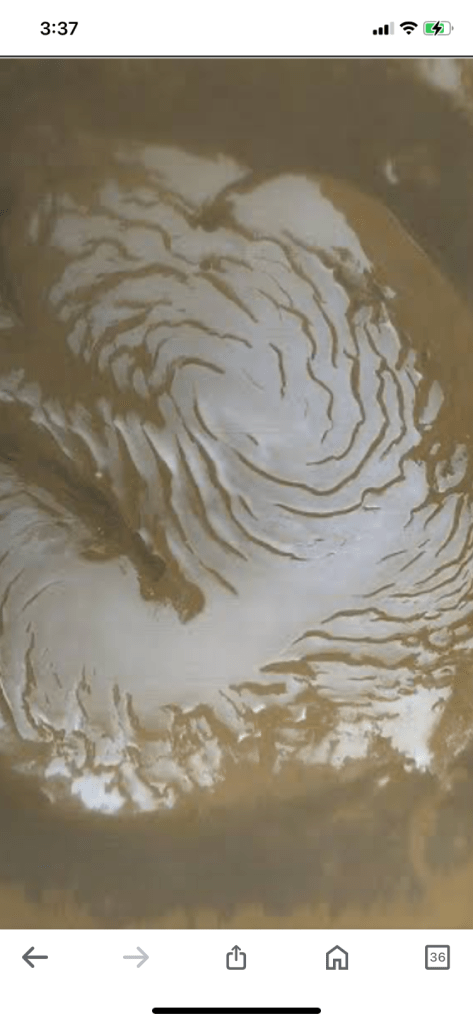
According to a January 19, 2024 press release from the European Space Agency (ESA), Mars’ ice sheets are up to 2.3 miles (3.7 km) thick. This is thicker than previously believed.
The ice sheets are covered by a protective layer of dry dust that is hundreds of meters thick. The radar signals match what would be expected from layered ice and are similar to the signals from Mars’ polar caps.
Mars has extensive polar ice caps that are made mostly of water ice. The polar caps contain a combined volume of water ice similar to the Greenland Ice Sheet on Earth.
We’ve explored the MFF again using newer data from Mars Express’s MARSIS radar, and found the deposits to be even thicker than we thought: up to 3.7 km thick,” says Thomas Watters of the Smithsonian Institution, lead author of the new research and the 2007 study
Mars’ ice sheets are made of water ice and dust. The ice sheets are called Planum Boreum (north) and Planum Australe (south). They are laid down like pages in a book during climate changes
The polar caps have a permanent cap that is visible year-round, and a temporary cap that appears in winter and disappears in summer. The north has a permanent cap of water ice, while the south has a permanent cap of mostly carbon dioxide ice.
The seasonal polar caps are made of dry ice (carbon dioxide). In the spring, the sun turns the dry ice from solid to gas, which causes surface erosion. Dry ice goes directly from solid to vapor, unlike water ice which melts into liquid when it gets warm.
The poles grow and shrink with the changing seasons on the planet. During a pole’s winter, it lies in continuous darkness, chilling the surface and causing the deposition of 25–30% of the atmosphere into slabs of CO2 ice (dry ice). When the poles are again exposed to sunlight, the frozen CO2 sublimes
Yes, Mars has two ice caps, one at each pole:
- North polar cap This cap is about 1,100 kilometers (680 miles) across. In the northern winter, a thin layer of frozen carbon dioxide builds up on the north cap, about one meter thick.
- South polar cap This cap has a permanent dry ice cover about 8 meters thick. The south pole is so cold that carbon dioxide, which makes up 95% of Mars’ atmosphere, can remain frozen on the surface all year. Both polar caps contain the same four geological units stacked like pancakes. However, the two polar regions have different details.
There is a slim chance that microbial life exists on Mars today, perhaps under the planet’s ice caps or in subsurface lakes detected by spacecraft like the European Space Agency’s Mars Express. Locations like these could protect life from the harsh conditions on the planet’s surface
Scientists using the Mars Express’s MARSIS radar have discovered water ice deposits at the Medusae Fossae Formation (MFF) on Mars that are up to 3.7 km thick. This is equivalent to twice the thickness of the ice deposits at the planet’s poles. The discovery suggests that Mars may have been much more habitable in the past than it is today.
The MFF is a large region of chaotic terrain located in the southern hemisphere of Mars. It is thought to have been formed by a series of volcanic eruptions that occurred billions of years ago. The new radar data shows that the MFF is covered in a thick layer of ice, which is thought to have been deposited by glaciers.
The discovery of the ice deposits at the MFF is significant because it suggests that Mars may have been much more habitable in the past. The ice would have provided a source of water for plants and animals, and the warmer climate would have made it possible for liquid water to exist on the surface of the planet. This could have supported a thriving ecosystem.
The discovery of the ice deposits at the MFF also raises the possibility that Mars may still be habitable today. The ice could be used to support human life on Mars, and it could also be used as a source of fuel for rockets. The discovery is a major step forward in our understanding of Mars, and it could have a significant impact on our plans to explore the planet in the future.
Yes, Mars has polar ice caps that are mostly made of water ice and have a combined volume similar to the Greenland Ice Sheet. The Martian ice caps are called Planum Boreum (northern) and Planum Australe (southern
The northern polar cap is about 1,000 kilometers in diameter and contains about 1.6 million cubic kilometers of ice. The ice caps are up to 3.7 kilometers thick and have a combined volume similar to the Greenland Ice Sheet.
The south polar cap also has a thin, permanent layer of carbon dioxide ice on top.
Earth’s polar ice caps are made of mostly water ice, while Mars’ polar ice caps are a combination of water ice and solid carbon dioxide
In the Martian winter, carbon dioxide freezes out of the atmosphere to form a seasonal layer of dry ice on top of the permanent water ice cap. During the Martian spring, the sun shines on the ice, causing it to turn from solid to gas and erode the surface. This process is called sublimation.
NMars’ rotation axis tilts about 25° to its orbit around the Sun, giving Mars four distinct seasons. However, polar winters on Mars are much colder (–153° Celsius or –243° Fahrenheit) than the coldest winters on Earth.
Earth and Mars are the only planets with permanent polar ice caps. Pluto also has polar ice caps, which are made of methane and nitrogen ice
Polar ice caps are high-latitude regions of a planet or moon that are covered in ice. They form because high-latitude regions receive less solar radiation from the sun than equatorial regions, resulting in lower surface temperatures
The average temperature on Mars is about -60°C (-76°F). However, in winter, temperatures near the poles can drop to -195°F (-125°C). At the poles, surface temperatures can reach a low of about -153°C (120 K; -243°F).
In late summer, the black areas in the infrared image of the Martian south polar cap are at a temperature near -125°C (-193°F) and correspond to solid carbon dioxide ice.
In spring, the CO2 ice cap sublimates, changing directly from a solid into a gas as temperatures warm above –130° C (–202° F).
If the polar ice caps on Mars melted, the carbon dioxide would be released into the atmosphere. This would create a greenhouse effect, trapping heat from the sun and causing the planet to warm
The ice caps contain enough water to cover the entire surface of Mars by several meters. However, this is much less than Earth’s water, which could cover the planet by 2,000 meters. Even with the ice caps melted, Mars would still be much drier than Earth.
The melting ice caps could also erode the ground, creating channels and canyons. This could provide information about the geology of Mars.
Some estimate that it would cost $2–$3 trillion and take 100–200 years to melt the ice caps and create seas on Mars. This would involve making the atmosphere denser and the planet’s temperature hotter.
Mars’ frost point temperature is much lower than the melting point of pure ice. This means that water ice diffuses into the atmosphere before it can melt
Mars’ freezing point for water is about -63°C (-81.4°F). This is because Mars has a much lower atmospheric pressure than Earth, which is about 1% of Earth’s normal pressure.
Most of Mars’ ice is underground because it can’t survive long if it’s exposed at the surface. The sun’s warmth and Mars’ thin atmosphere cause exposed ice to sublimate, which is when it goes directly from a solid to a gas without melting. Only the poles are cold enough to allow exposed water ice to remain year-round.
However, some researchers have found that dusty ice on Mars might melt just a few centimeters below the surface. The liquid water produced could potentially support microscopic life.
Please like subscribe comment your precious thoughts on my blogs on universe discoveries ( a perfect destination for universe new discoveries and science discoveries)
Full article source google
Best pet supplies on discount on Amazon Universe discoveries
Very good information about mars .
LikeLiked by 1 person