
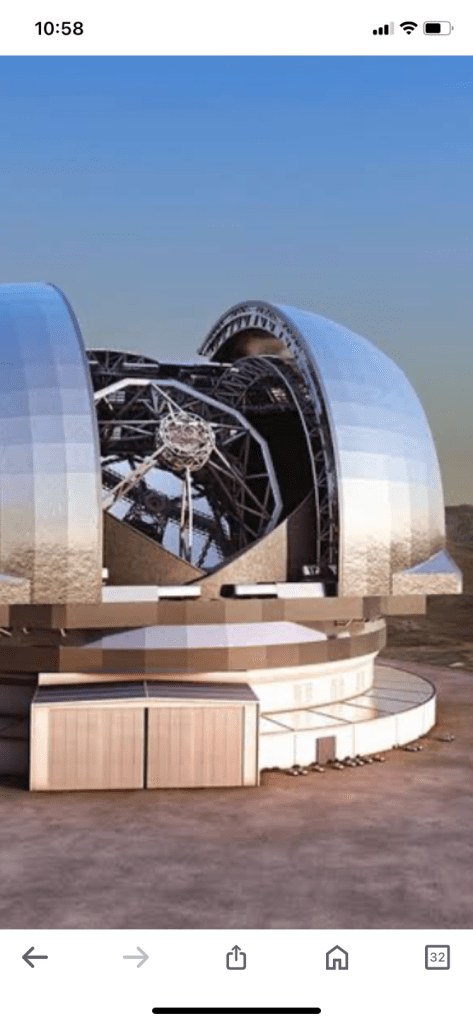
The Extremely Large Telescope (ELT) will be able to see Earth-like planets around other stars and study the evolution of giant planets around young stars. It will also be able to study the behavior and evolution of distant galaxies and visualize the first galaxies that emerged in the universe.
The ELT will have a 39.3-meter main mirror and advanced adaptive optics, allowing it to collect more light and achieve sharper images than any other ground-based telescope. It will be able to probe the furthest reaches of the cosmos, revealing the properties of the very earliest galaxies and the nature of the dark Universe
The ELT’s mirror is too large to be made from a single piece of glass. Instead, the ELT will have 798 hexagonal segments, each measuring 1.4 meters across and 5 centimeters thick. These segments will work together as a single mirror to collect tens of millions of times more light than the human eye.
The ELT’s design also includes adaptive optics systems to compensate for atmospheric turbulence. The ELT will have more than 5,000 actuators that can change the shape of its mirrors a thousand times per second.
Astronomers study exoplanets, which are planets that orbit stars other than our Sun. They use ground-based and space-based observatories to study gas-giant, ice-giant, and rocky planets.
As of 2023, more than 5,000 exoplanets have been discovered. Astronomers can detect a planet’s presence and determine its mass, distance from its parent star, and the length of its year.
Astronomers are also investigating models for planet formation and evolution. They want to understand why these systems are common in the galaxy, and why our Solar System doesn’t look like that.
The study of young systems can provide clues about what happened during the infancy of our solar system. For example, it seems likely that gas giants develop farther from their parent star, past a boundary called the snow line. The snow line is where it’s cool enough for ice and other solid materials to form
The study of exoplanets is called exoplanetary science. It’s a branch of astrophysics that’s growing quickly.
The study of planets and their planetary systems is called planetary science. This includes moons, ring systems, gas clouds, and magnetospheres.
Astrobiology is a field that studies the potential for life to exist on other planets. Astrobiologists study the atmospheres of exoplanets to determine their chemical compounds and elements
The Extremely Large Telescope (ELT) can detect biosignatures in nearby rocky exoplanets using high-contrast imaging and medium-resolution spectroscopy.
Proxima Centauri b is the closest known exoplanet to Earth, located four light-years away. It’s a super Earth exoplanet that orbits a red dwarf star. The planet is tidally locked to its star, meaning it rotates once every time it orbits the star. This means that the same side of the planet is always facing the star, in constant daylight
Future large ground-based telescopes and space-based observatories, such as the James Webb Space Telescope and the Nancy Grace Roman Space Telescope, could directly observe Proxima Centauri b. However, disentangling the planet from its star would be difficult
Proxima Centauri b is too faint to see with the naked eye, but it can be found with a small telescope. However, it’s not currently possible to see the surface of Proxima Centauri b through a telescope
Proxima Centauri has an apparent visual magnitude of 11, so a telescope with an aperture of at least 8 cm (3.1 in) is needed to observe it. Proxima Centauri may not look like much through a telescope, especially compared to the much brighter A and B stars.
The James Webb Telescope provides the clearest image of Proxima b. However, to even marginally resolve Proxima Centauri, we’d need a telescope with a mirror 100 times larger than JWST’s.
Most exoplanets are discovered through the transit method, where a planet regularly passes in front of its star from our point of view. We see the recurring dip in a star’s brightness, and we know the planet is there. For transiting exoplanets, we can look for changes in the spectrum of the star as the planet transits. Some of the starlight passes through an exoplanet’s atmosphere, and some wavelengths get absorbed by the atmosphere. By looking at the pattern of absorption, we can fingerprint different molecules. This is how we’ve detected the presence of water, carbon dioxide, and other molecules in exoplanet atmospheres
But Proxima Centauri B isn’t a transiting planet. It was discovered by a different method known as Doppler spectroscopy.When we look at the light from Proxima Centauri, we can see its spectrum redshift and blueshift slightly over time. The gravitational pull of Proxima Centauri B makes the star wobble slightly. So we know the exoplanet is there, and have a good idea of its size and mass, but since it doesn’t transit its star we can’t observe its atmospheric absorption spectrum
In this work, the authors look at the potential for the Extremely Large Telescope (ELT), currently under construction in Northern Chile. Specifically, they consider the High Angular Resolution Monolithic Optical and Near-infrared Integral field spectrograph (HARMONI), which will be able to capture high-resolution spectra on the ELT. The team simulated observations of Proxima Centauri using the masking effect to capture the light of its exoplanet. Is it possible for HARMONI to capture enough high-resolution data to discover biogenic molecules?
What will the extremely large telescope be able to see?
By probing the most distant objects the ELT will provide clues to understanding the formation of the first objects that formed: primordial stars, primordial galaxies and black holes and their relationships
How big of a telescope do you need to see Proxima Centauri?
Even from Alpha Centauri A or B, Proxima would only be seen as a fifth magnitude star. It has apparent visual magnitude 11, so a telescope with an aperture of at least 8 cm (3.1 in) is needed to observe it, even under ideal viewing conditions—under clear, dark skies with Proxima Centauri well above the horizon
The telescope will have several science instruments and will be able to switch from one instrument to another within minutes. The telescope and dome will also be able to change positions on the sky and start a new observation in a short time.
Four of its instruments, the first generation, will be available at or shortly after first light, while two others will begin operations later. Throughout its operation other instruments can be installed.
The first generation includes four instruments: MICADO, HARMONI and METIS, along with the adaptive optics system MORFEO.
- HARMONI: The High Angular Resolution Monolithic Optical and Near-infrared Integral field spectrograph (HARMONI) will function as the telescope’s workhorse instrument for spectroscopy.[61]
- METIS: The Mid-infrared ELT Imager and Spectrograph (METIS) will be a mid-infrared imager and spectrograph.
- MICADO: The Multi-AO (adaptive optics) Imaging Camera for Deep Observations (MICADO) will be the first dedicated imaging camera for the ELT and will work with the Multiconjugate adaptive Optics Relay For ELT Observations, (MORFEO, formerly MAORY).
- MOSAIC: A proposed multi-object spectrograph which will allow astronomers to trace the growth of galaxies and the distribution of matter from shortly after the Big Bang to the present day.
- ANDES (formerly HIRES): The ArmazoNes high Dispersion Echelle Spectrograph will be used to search for indications of life on Earth-like exoplanets, find the first-born stars of the universe, test for possible variations of the fundamental constants of physics, and measure the acceleration of the Universe’s expansion
The ELT will search for extrasolar planets—planets orbiting other stars. This will include not only the discovery of planets down to Earth-like masses through indirect measurements of the wobbling motion of stars perturbed by the planets that orbit them, but also the direct imaging of larger planets and possibly even the characterisation of their atmospheres. The telescope will attempt to image Earthlike exoplanets
Please like subscribe comment your precious thoughts on universe discoveries (a perfect destination for universe new discoveries and science discoveries)
Full article source google
https://7731arfkz8o2h3ae3fbonbrq08.hop.clickbank.net Universe discoveries
Very informative
LikeLike