
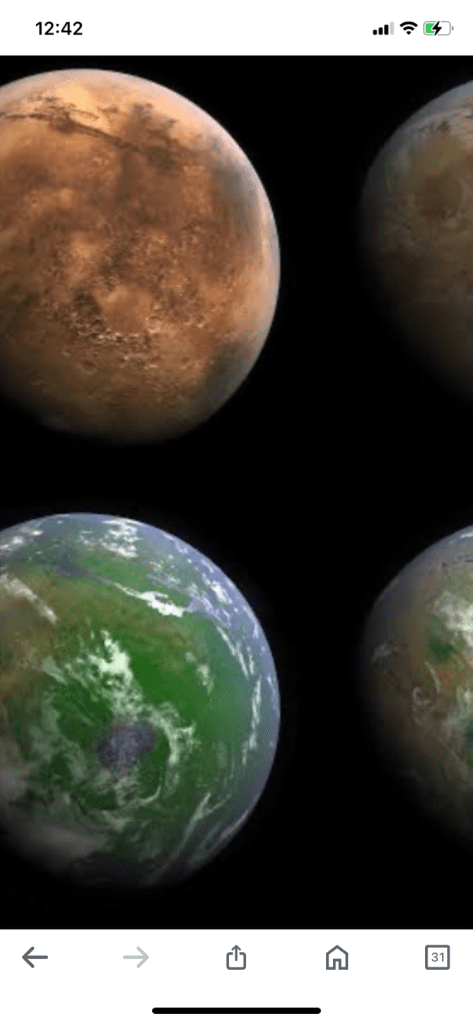
Mars is believed to have died due to its small size and lack of a strong magnetic field.
Mars is about half the diameter of Earth and has less than one-ninth the mass. Because of this, it doesn’t have the gravitational strength to hold onto its atmosphere and water.
Mars’ core cooled and solidified within a billion years of its formation, weakening its magnetic field. Without this protection, Mars lost its atmosphere. The solar wind also strips away Mars’ atmosphere and causes its water to boil away.
Mars is believed to have had a denser atmosphere, higher temperatures, and large oceans about 3.8 billion years ago.
Born too small, within a billion years its core cooled and solidified, its magnetic field becoming feeble.Without that protection, Mars lost its atmosphere
Without that protective magnetic field, we would lose our air like dandelion seeds in the breeze. And this was Mars’ flaw. Born too small, within a billion years its core cooled and solidified, its magnetic field becoming feeble. Without that protection, Mars lost its atmosphere
Scientists believe that Mars’ smaller size and rapid cooling caused it to lose its magnetic field, which led to the planet’s atmosphere being stripped away by solar wind
Here’s some more information about Mars’ magnetic field:
- Earth’s magnetic field Earth’s magnetic field is generated by the motions of liquid material under the surface, especially the outer core.
- Mars’ magnetic field Mars’ magnetic field died when the planet’s interior cooled more rapidly than Earth’s, causing the planet’s core to solidify. The magnetic field died with it, except for weak local patches that remain to this day.
- Mars’ atmosphere Without a magnetic field, Mars’ atmosphere was slowly stripped away by solar wind for billions of years. The planet’s atmosphere became extremely thin, and the planet became a cold, barren desert with few signs of liquid water.
But 4 billion years ago, the Martian core cooled, shutting down the dynamo that sustained its magnetic field. That left the planet vulnerable to the solar wind, which clawed away the atmosphere, and allowed the Martian water to sputter into space. Before long—in geological terms—the planet was a desert
Before it died, Mars was a watery planet, covered in oceans up to 1,000 feet deep. It had river valley networks, deltas, and lakebeds, and rocks and minerals that could only have formed in liquid water. Some features suggest that Mars experienced huge floods about 3.5 billion years ago
Mars may have also had wet and dry seasons, like Earth, that were conducive to life. Researchers have discovered fossil evidence suggesting the red planet had a cyclical climate more than three billion years ago.
Mars may have resembled Earth and may have been inhabited by life forms. It may have offered a comfortable climate for any emerging microbes, much like Earth did.
However, about three billion years ago, the rivers, streams, and lakes all dried up, and no one knows why
Some scientists believe that Mars may have been a good environment for life to start, perhaps even before Earth. Mars formed before Earth, and early in its history, it would have had a “hospitable” environment. However, there’s no proof of past or present life on Mars.
According to a study that simulated the conditions on a young Mars, early in its history, the red planet likely would have been habitable to methanogens, microbes that make a living in extreme habitats on Earth. However, the authors are clear that they’re not saying that life definitely existed on the planet.
Some say that the idea that life existed on Mars is still just a theory. Others say that Mars lost its water when it lost its magnetic field around 4 billion years ago. Without an atmosphere, there was nothing to prevent Mars’ water from evaporating and then being lost to space. This radiation also made the existence of life at the surface of Mars unfeasible
According to a NASA scientist, Mars and Earth formed from the same material when the solar system first formed over four billion years ago. However, the two planets have diverged and are very different today
NASA’s Curiosity rover has detected high concentrations of manganese oxide minerals in Martian rocks. This suggests that the Martian atmosphere contained more oxygen billions of years ago than it does today.
A study of meteorites suggests that Mars was once a blue planet, like Earth, covered in water as deep as 1,000 feet.
Mars is of particular interest for the study of the origins of life because of its similarity to the early Earth. Mars has a cold climate and lacks plate tectonics or continental drift, so it has remained almost unchanged since the end of the Hesperian period.
Please like subscribe comment your precious thoughts on universe discoveries (a perfect destination for universe new discoveries and science discoveries)
Full article source google
https://4562erlm06s3gxe9wifapei7fk.hop.clickbank.net Universe discoveries
Interesting post, thank you
LikeLiked by 1 person
Welcome 🙏 freinds
LikeLiked by 1 person
Nice and well researched post.
LikeLike