
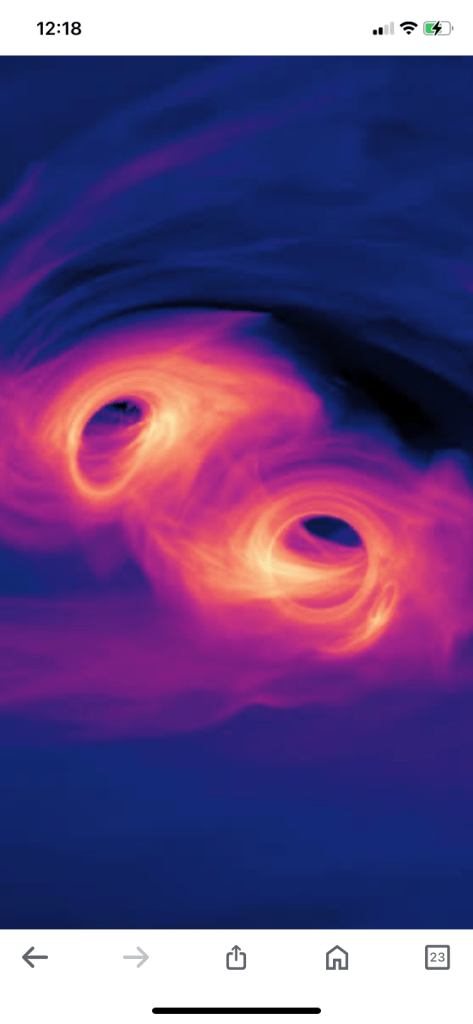
Dark matter may play a role in the mergers of supermassive black holes.
Dark matter is usually studied in relation to the rotational curves in the outskirts of galaxies. However, its role may be different in the galactic bulges and centers where supermassive black holes dominate the gravitational interaction.
Dark matter outweighs everything else, so it guides the growth of the central black hole and molds the newly formed elliptical galaxy. The act of merging creates a gravitational blueprint that the galaxy, the stars, and the black hole will follow in order to build themselves.
Black holes can increase in size by accreting matter, such as by swallowing stars that get too close, or by merging with other black holes.
Because the dark matter outweighs everything else, it molds the newly formed elliptical galaxy and guides the growth of the central black hole. “In effect, the act of merging creates a gravitational blueprint that the galaxy, the stars and the black hole will follow in order to build themselves,” explains Bogdan
Two black holes can merge when they get close enough to each other that they can’t escape the other’s gravity. This event is extremely violent
Here are some mechanisms that can bring two black holes together:
- Gravitational ejection If enough stars pass close to an orbiting pair of black holes, their gravitational ejection can bring the black holes together.
- Third supermassive black hole A third supermassive black hole from a second galactic collision can also bring two black holes together. When two supermassive black holes merge, they create gravitational waves, which are fluctuations in the fabric of spacetime. The merger also releases a massive amount of energy in the form of jets. For example, the Milky Way and Andromeda each contain a central supermassive black hole. These black holes will eventually spiral into one another and converge near the center of the newly formed galaxy over a period that may take millions of years.
Yes, almost all merging black holes produce gravitational waves. However, the black holes must orbit each other for a while to produce detectable waves. A head-on collision between two black holes would produce almost no waves
Gravitational waves are ripples in space and time caused by some of the most energetic processes in the universe. Albert Einstein predicted the existence of gravitational waves in 1916.
Binary black hole mergers are one of the strongest known sources of gravitational waves in the universe. As the orbiting black holes give off these waves, the orbit decays, and the orbital period decreases.
The strongest gravitational waves are produced by cataclysmic events such as colliding black holes, supernovae, and colliding neutron stars
On September 14, 2015, the LIGO and Virgo collaborations detected gravitational waves from the merger of two black holes. The signal was named GW150914. This was the first direct observation of a binary black hole merger
The gravitational waves were emitted during the final moments of the merger of two black holes that were located about 1.8 billion light-years away. The black holes had masses of about 31 and 25 times the mass of the sun.
The gravitational-wave power radiated during the final moments of the black hole merger was more than ten times greater than the combined light power from all the stars and galaxies in the observable Universe.
The detection of gravitational waves confirms a major prediction of Albert Einstein’s 1915 general theory of relativity
cold dark matter is likely to play a role in the mergers of supermassive black holes. However, simulations using cold dark matter have the same final parsec problem as general relativity alone.
Dark matter is usually studied in connection with rotational curves in the outskirts of galaxies. However, the role of dark matter might be different in the galactic bulges and centers where supermassive black holes dominate the gravitational interaction.
Dark matter guides the growth of supermassive black holes. When smaller galaxies merge, their stars and dark matter mix together to form an elliptical galaxy. Because the dark matter outweighs everything else, it molds the newly formed elliptical galaxy and guides the growth of the central black hole
This is known as the final parsecproblem. One idea to solve the problem is to introduce dark matter into the mix. After all, cold dark matter is nearly everywhere according to the standard cosmological model, so it likely plays a role in the mergers of supermassive black holes
Some astrophysicists believe that primordial black holes are the source of all dark matter in the universe
Dark matter is a theoretical substance that can’t be seen or directly observed. The most popular explanation for dark matter is that it’s an undiscovered subatomic particle, like axions or weakly interacting massive particles (WIMPs). Another possibility is that dark matter is made up of primordial black holes, which formed in the first second of the universe.
Some theorists have proposed that black holes are dark matter. However, others say that it’s normal matter, not dark matter, that’s responsible for the black holes we observe.
In March 2023, scientists may have discovered indirect evidence that large amounts of dark matter surround black holes. If confirmed, this discovery could be a major breakthrough in dark matter research.
Gravitational wave detectors have seen the fusion of objects in this category in recent years. Our hypothesis is not that black holes are dark matter, but that dark matter would consist of substances from black holes, including sterile neutrinos associated with a magnetic charge
According to a Quora post, dark energy can be absorbed by black holes, but the effect is negligible. Dark energy has a density of only four proton rest masses per cubic meter. For a black hole with a mass of five solar masses, this amounts to about 90 picograms of rest mass energy within the 15 kilometer Schwarschild radius.
Black holes can consume anything that comes too close, including moons, planets, and stars. However, dark matter can only be accreted if its orbit directly intersects the black hole. This happens very rarely because the geometric size of the black hole is very small on the scale of the galactic orbits that particles of dark matter follow
According to the standard cosmological model, cold dark matter is nearly everywhere, so it likely plays a role in the mergers of supermassive black holes.
Cold dark matter is a hypothetical type of dark matter. It is a dominant matter species in the universe, and it interacts very weakly with ordinary matter and electromagnetic radiation.
Dark matter outweighs everything else, so it guides the growth of the central black hole and molds the newly formed elliptical galaxy. The act of merging creates a gravitational blueprint that the galaxy, the stars, and the black hole will follow in order to build themselves.
Dark matter models with a subdominant self-interacting component are able to produce early seeds for supermassive black holes.
Please like subscribe comment your precious thoughts on universe discoveries
Full article source google
https://0e199emp280saulpxenot7tx76.hop.clickbank.net Universe discoveries
Nice Post
LikeLike