
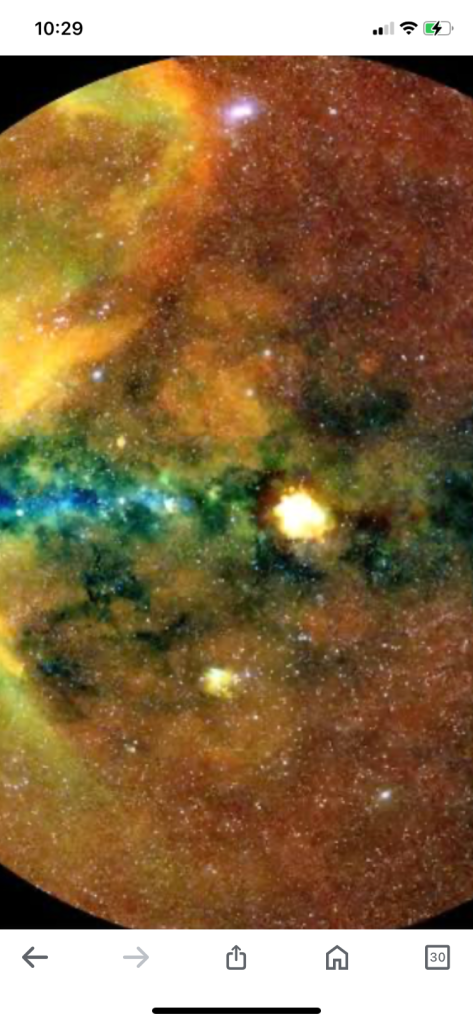
Recently, astronomers in the eROSITA consortium at the Max Planck Institute for Extraterrestrial Physics announced the latest trove of X-ray data from the eROSITA survey. It covers half the X-ray sky and reveals information about 900,000 distinct X-ray sources
The eROSITA survey is a recent X-ray data collection that covers half of the X-ray sky. It reveals information about 900,000 distinct X-ray sources. The eROSITA All-Sky Survey (eRASS1) is the first all-sky survey by the soft X-ray imaging telescope. It has yielded the largest X-ray catalog ever published.
The 900,000 sources include:
- Around 710,000 supermassive black holes in distant galaxies
- 180,000 X-ray emitting stars in our own Milky Way
- 12,000 clusters of galaxies
- A small number of other exotic classes of sources like X-ray emitting binary stars, supernova remnants, pulsars, and more X-rays are high-energy electromagnetic radiation. They have wavelengths shorter than UV rays and longer than gamma rays. X-rays are widely used in medical diagnostics and material science
X-rays come from objects that are millions of degrees Celsius, such as:
- Pulsars
- Galactic supernova remnants
- The accretion disk of black holes The brightest X-ray sources in our galaxy are the remnants of massive stars that have undergone a catastrophic collapse: Neutron stars, Black holes. Other powerful sources of X-rays are supernova remnants:
- Giant bubbles of hot gas produced by exploding stars The Sun is also a source of X-rays, but it is an intrinsically weak X-ray source. The X-rays we detect from the Sun do not come from the Sun’s surface, but from the solar corona, which is the upper layer of the Sun’s atmosphere. Scientists can use these X-rays to take pictures of our universe using X-ray telescopes.
The eROSITA survey is an imaging all-sky survey in the medium energy X-ray range up to 10 keV. It is the main instrument on the Russian spacecraft Spektrum-Roentgen-Gamma (SRG).
eROSITA stands for extended ROentgen Survey with an Imaging Telescope Array. It is made up of seven identical X-ray telescope modules, each with 54 individual mirrors that have a common focus. The eROSITA survey is designed to be about 25 times more sensitive than the ROSAT all-sky survey in the soft X-ray band (0.2–2.3 keV). In the hard band (2.3–8 keV), it will provide the first ever true imaging survey of the sky at those energies.
eROSITA achieved first light on October 17, 2019 and completed its first all-sky survey on June 11, 2020. The operations of eROSITA were suspended on February 26, 2022 after the Russian attack into Ukraine.
The main goal of the eROSITA mission is to measure dark energy through the structure and history of the universe traced by galaxy clusters. Dark energy is one of the most exciting questions facing astronomy and physics today
The primary science goal is to measure dark energy through the structure and history of the Universe traced by galaxy clusters. eROSITA was launched on 13 July 2019 by Roscosmos from Baikonur. It achieved first light on 17 October 2019 and completed its first all-sky survey on 11 June 2020.

As of July 2023, eROSITA’s all-sky survey has a greater depth than its predecessor, ROSAT. It has also produced large samples of all types of cosmic X-rays
The eROSITA bubbles are giant lobes of hot gas that extend far out from the center of the Milky Way. They were discovered in 2020 by the joint Russian–German eROSITA X-ray telescope
The eROSITA bubbles are part of the Galactic bubbles, which also include the Fermi bubbles. The Fermi bubbles are two large structures in gamma-rays above and below the Galactic center. The eROSITA and Fermi bubbles are named after the satellites that discovered them. They are thought to have similar origins.
The eROSITA bubbles are probably produced by shocks that have been driven into the northern and the southern Galactic halo. The bubbles are thought to inject energy and momentum into the MW circum-galactic medium (CGM) or halo
According to research, the eROSITA and Fermi bubbles may have originated from a single 100,000-year-long explosion2.6 million years ago.
According to a simulation, a single jet activity from the GC black hole around 2.6 million years ago could be the common origin for the eRosita bubbles, the Fermi bubbles, and the microwave haze.
In 2010, astronomers at NASA’s Fermi gamma-ray telescope discovered the Fermi bubbles by processing data from the Fermi’s Large Area Telescope (LAT). The LAT is the most sensitive and highest-resolution gamma-ray detector ever launched
In 2014, Tracy Slatyer, Douglas Finkeiner, and Meng Su won a prize for their discovery of the Fermi bubbles. Slatyer is an MIT physicist who was looking for hints of dark matter’s signature in the gamma rays emanating from the center of the Milky Way
The eROSITA consists of seven Wolter-I telescope modules, each of which is equipped with 54 mirror shells with an outer diameter of 36 cm. It scans the entire sky eight times over four years, using an array of seven aligned mirror modules, operating in the 0.2–10 keV energy range
Please like subscribe comment your precious thoughts on universe discoveries
Full article source google
Best men and women wear on heavy discount on Amazon Universe discoveries
That’s awesome
LikeLiked by 1 person
Thanks 🌹
LikeLiked by 1 person