
Helium-3 (He-3) is a rare isotope of helium that could be used as a fuel in nuclear fusion power plants. It’s one of the most abundant elements in the universe, but it’s extremely scarce on Earth. However, there are thought to be significant supplies on the Moon.
Helium-3 is considered a potentially valuable fuel for nuclear fusion reactions due to its unique properties. Experts believe that 40 grams of Helium-3 could replace 5,000 tons of coal. And just eight tons of Helium-3 in fusion reactors would provide the equivalent energy of one billion tons of coal.
One tonne of He-3 can produce 10,000 MWe-y of electrical energy.
He + 3He fusion is feasible as demonstrated in the laboratory and has immense advantages, but commercial viability is many years in the future. The amounts of helium-3 needed as a replacement for conventional fuels are substantial by comparison to amounts currently available
Helium has many uses, including:
- Energy and transport systems: Helium can be used as a heat transfer medium, cryogen, and lift gas.
- Quantum computing: Liquid helium is being considered for use in quantum computing.
- Nuclear energy: Helium is used in both fission and fusion nuclear energy.
- Medical field: Helium is used in MRIs and helium-neon lasers are used in eye surgery.
- National defense: Helium is used in rocket engine testing, scientific balloons, surveillance craft, and air-to-air missile guidance systems.
- Rocket propulsion systems: Helium’s low boiling point and light weight make it an ideal fuel for rocket propulsion systems.
- Leak detection: Helium can be used for leak detection.
- Welding technologies: Helium can be used in some welding technologies.
- Breathing mixture: Helium can be used as a breathing mixture with oxygen.
- Safe lift gas: Helium can be used as a safe lift gas for blimps and balloons. The global helium gas market is projected to reach multimillion figures by 2030. The global liquid helium market is also expected to rise at a considerable rate between 2023 and 2030.
Helium’s cooling properties are indispensable to scientific research and medical diagnostic equipment including magnetic resonance imaging (MRI) machines, NMR spectrometers and even the Large Hadron Collider. Helium is used to cool nuclear reactors and keeps rocket fuel cool during lift-off
Helium-3 (He-3) is a rare isotope of helium that could be used as a fuel in nuclear fusion power plants.
Helium-3 is a non-radioactive isotope that can be fused with deuterium to create a fusion reactor. The process of fusing helium-3 with deuterium creates normal helium and a proton, which is easier to contain and wastes less energy. Nuclear fusion reactors using helium-3 could provide a highly efficient form of nuclear power with virtually no waste and no radiation.
Helium-3 is a light, stable isotope of helium with two protons and one neutron. It is primarily found on Earth in very small amounts, but it is more abundant on the moon’s surface.
Helium-3 has also been used to “breed” Tritium, which is used in current fusion experiments, thermonuclear weapons, and boosted atomic bombs
Helium-3 is a valuable resource because it has a wide range of applications, including:
- Nuclear fusion: Helium-3 is a potentially valuable fuel for nuclear fusion reactions because it produces no neutrons when fused with deuterium. This is unlike conventional deuterium-tritium (D-T) fusion reactions.
- Neutron detection: Helium-3 is an important isotope in neutron detection instruments because it has a large absorption cross-section for thermal neutron beams.
- Dilution refrigerators: Helium-3 is an essential molecule for dilution refrigerators.
- Ultra low temperature physics research: Helium-3 is used in ultra low temperature physics research. Helium-3 is also rare on Earth and is sought after for use in nuclear fusion research. It’s rare because it hasn’t been produced in or added to the planet in significant quantities and it’s lost to space. Helium-3 is worth $1400 per gram, and one hundred kilograms (220 pounds) of helium-3 would be worth about $140 million. One hundred kilograms is more than enough fuel to potentially power a 1000 megawatt electric plant for a year when fused with deuterium
Here are some more interesting facts about helium-3:
- Helium-3 is a fermion: This means that the atoms in liquid helium-3 must occupy different quantum states. This allows helium-3 to become superfluid at a much lower temperature, around 3 mK. This discovery led to the 1996 Nobel Prize in Physics for Lee, Osheroff, and Richardson.
- Helium-3 boils at 3.2 Kelvin: This is one degree colder than the boiling point of helium-4.
- Helium-3 is colorless, tasteless, and odorless: It is also nontoxic and nonflammable.
- Helium-3 is the only stable isotope of any element with more protons than neutrons
- Helium-3 is obtained from the transformation of tritium 3H into 3He after β (beta) emission
- Helium-3 is lighter than air: In fact, it is seven times lighter than air, making it more buoyant.
- Helium-3 is the second-most abundant element in the universe: However, it is much less common on Earth
Helium-3 is expensive because it’s rare on Earth and in high demand.
Helium-3 is a non-renewable resource, and it’s a tiny fraction of naturally-occurring helium. Physicists believe that most of the helium-3 on Earth is primordial, meaning it was created by nuclear fusion in ancient stars and incorporated into the Earth as it formed 4.5 billion years ago.
Helium-3 is produced as a by-product of the maintenance of nuclear weapons, which could net a supply of around 15Kg a year.
Virtually all helium-3 used in industry today is produced from the radioactive decay of tritium.
Some small users, such as academic researchers, have seen the price of helium-3 increase dramatically because of its scarcity.
According to a Reddit user, the world needs 334,263,157.895 kilograms of helium-3 to power itself for a year.
However, there isn’t enough helium-3 on Earth to power a nuclear power plant. Scientists estimate that one million tons of moon soil would be needed to produce 70 tons of helium-3, which is too much to transport to Earth.
According to The Hill, the moon has about 1.1 million metric tons of helium-3 within several meters of the surface. 25 metric tons of helium-3, which is about a quarter of the cargo capacity of a SpaceX Starship, would be enough to power the United States for a year.
One kilogram of helium-3 combined with 0.67 kilograms of deuterium can produce 19 megawatt-years of energy. One ton of helium-3 can produce 10,000 MWe-y of electrical energy.
Some estimates suggest that the moon’s surface has at least 1.1 million metric tons of helium-3, which is enough to power human energy needs for up to 10,000 years.
One ton of helium-3 can produce 10,000 MWe-y of electrical energy. 40 tons of helium-3 can provide for the entire U.S. electricity consumption in 2000.
The total energy yield from helium-3 depends on how much helium-3 is fused. The fusion of D-3He produces a high-energy proton and an alpha particle for a total kinetic energy of 18.4 MeV.
However, the main disadvantage of fusion using helium-3 is that it would take a far greater amount of energy to achieve it than the conventional deuterium and tritium variety
Helium-3 is considered a valuable fuel source for nuclear fusion reactions because it produces no neutrons when fused with deuterium. This is different from conventional deuterium-tritium (D-T) fusion reactions
Helium-3 is also non-radioactive, and its only byproduct, a proton, can be contained by electric and magnetic fields. The momentum energy of the proton interacts with the containing electromagnetic field, resulting in direct net electricity generation.
Helium-3 is also proposed as a power source for spacecraft because of its abundance on the moon. The energy release from fusing helium-3 with deuterium in a reactor could expel propellant out the back of a spacecraft
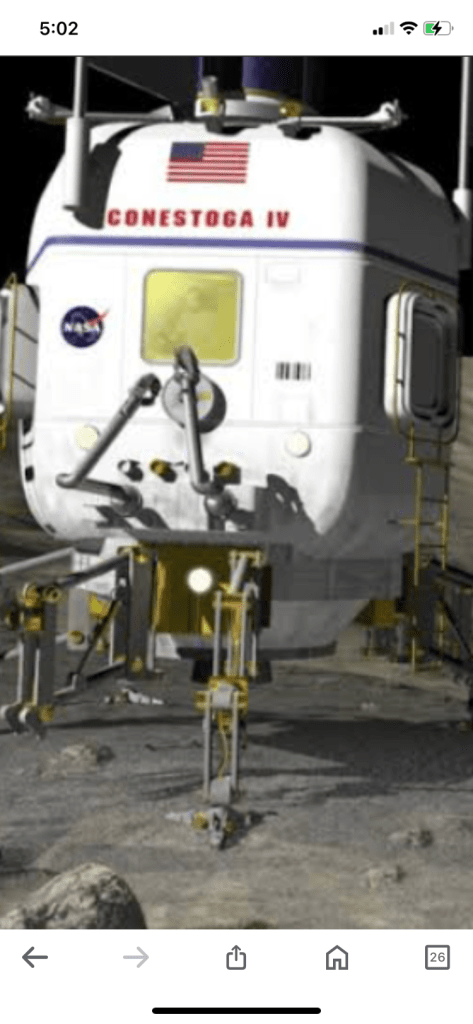
Helium-3 is a rare isotope on Earth, but the moon’s surface is believed to contain significant deposits. This has led to the concept of lunar mining, where robotic spacecraft would be sent to the moon to extract Helium-3 and bring it back to Earth.
Helium-3’s potential as an energy source has led to discussions about mining it from the moon. Scientists estimate that 25 tons of Helium-3 could power the United States for an entire year.
The extraction of He3 from the Moon’s surface has profound implications for energy, manufacturing, and habitation on both the Moon and Earth. However, the temperatures required to achieve helium-3 fusion reactions are much higher than in traditional fusion reactions
Please like subscribe comment your precious thoughts on universe discoveries
Full article source google
Apple vision pro on heavy discount on Amazon Universe discoveries
Amazing 👏👏👏💯
LikeLike
Nice article 🆗
LikeLiked by 1 person
Thanks a lot dear friend 🌹
LikeLike