
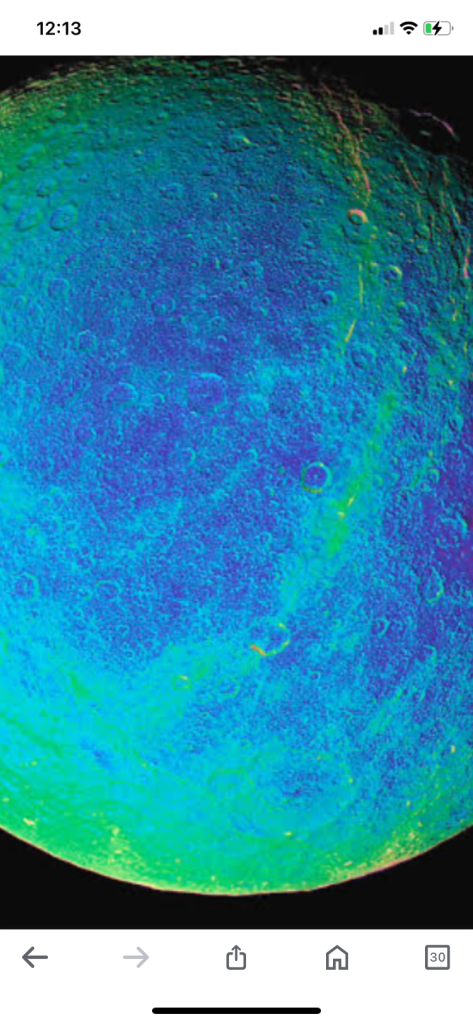
In February 2024, researchers concluded that Saturn’s moon Mimas probably has an ocean 12 to 18 miles (20 to 30 kilometers) beneath its icy surface. The ocean is thought to have formed around 25 million years ago when Saturn’s tidal forces warmed Mimas’s core. The ocean would account for more than half of Mimas’s volume and have an overall temperature of around freezing.
The discovery suggests that the conditions under which oceans can exist may be more varied than previously thought. Mimas is the smallest of five moons in our solar system that show evidence of subsurface oceans.
After analyzing data from NASA’s Cassini, the researchers concluded that an internal ocean exists on the heavily cratered Mimas approximately 20-30 kilometers (12-18 miles) beneath its surface, forming less than 25 million years ago, which is young in geologic terms.
According to a February 2024 study, researchers have concluded that Mimas, one of Saturn’s moons, may have an internal ocean:
- The ocean is about 12–18 miles (20–30 kilometers) beneath Mimas’ surface
- The ocean formed between 2 million and 25 million years ago
- The ocean is encased within a 12–19 mile thick icy shell
- The ocean is a liquid water ocean The research was published in Nature by French astronomer Valéry Lainey and a team of researchers from Observatoire de Paris
Mimas’ thick, icy exterior, however, has never indicated the existence of an ocean. Researchers suggest this is because Mimas’ ocean dwells 12 to 18 miles (20 to 30 kilometers) below the moon’s 15-mile-thick frozen shell. An image from the Cassini spacecraft of Saturn’s moon Mimas.
NASA’s Cassini spacecraft has mapped many moons, including:
- Enceladus: A small, icy moon that Cassini discovered has an ocean world. Cassini revealed that jets spew water vapor and ice particles from an underground ocean beneath the icy crust.
- Titan: Cassini mapped Titan’s surface, studied its atmospheric reactions, and discovered liquid seas there. Cassini also sent a probe to the moon’s surface.
- Dione: Cassini has a digital map of Dione in 3 colors (IR, Green, UV).
- Mimas: Cassini has provided detailed images of Mimas.
The Cassini-Huygens mission was a joint effort between NASA, the European Space Agency (ESA), and the Italian Space Agency (ASI). The mission’s objectives were to:
- Analyze Saturn’s composition and atmosphere
- Investigate Saturn’s rings and moons
- Study Saturn’s magnetosphere The Cassini spacecraft orbited Saturn from 2004 to 2017, circling the planet 294 times. The spacecraft was equipped with powerful instruments and cameras that could take accurate measurements and detailed images in a variety of atmospheric conditions and light spectra. The Cassini mission’s length allowed scientists to observe weather and seasonal changes, which improved our understanding of similar processes on Earth and potentially on planets around other stars
A joint endeavor of NASA, ESA (the European Space Agency), and the Italian space agency (ASI), Cassini was a sophisticated robotic spacecraft sent to study Saturn and its complex system of rings and moons in unprecedented detail
NASA describes the Cassini mission as one of the most ambitious planetary exploration efforts ever. The mission was a joint effort between NASA, the European Space Agency (ESA), and the Italian Space Agency (ASI).
The Cassini spacecraft was equipped with 12 instruments that could perform sophisticated scientific studies of Saturn. These instruments could collect data from multiple regions of the electromagnetic spectrum, study dust particles, and characterize Saturn’s plasma environment and magnetosphere. The instruments also provided the probe’s senses for studying the dust, gas, and magnetic fields around Saturn and its moons.
The Cassini mission’s findings changed the course of future planetary exploration. The mission’s discoveries at Saturn’s moons Enceladus and Titan made exploring “ocean worlds” a major focus of planetary science
Cassini’s remote sensing instruments include:
- Optical and microwave sensing instruments
- Cameras
- Spectrometers
- Radar
- Radio
- Radio and Plasma Wave Science (RPWS)
- Plasma spectrometer
- Ultraviolet imaging spectrograph Cassini’s electrical power source is Radio-isotope Thermoelectric Generators (RTGs
Yes, Mimas, one of Saturn’s moons, may have an internal ocean. According to a February 2024 study published in Nature, Mimas’ ocean is likely less than 25 million years old. The ocean is estimated to be located 12-19 miles (20-30 km) below the surface, encased in a 12-19 mile thick icy shell.
Mimas is Saturn’s smallest known astronomical body that is roughly rounded in shape. It has a mean diameter of 396.4 kilometers (246.3 miles) and a low density of 1.15 g/cm³. Mimas’s surface is heavily cratered and shows little signs of recent geological activity.
The study suggests that Mimas is a prime target for studying the origin of life in our solar system.
Please like subscribe comment your precious thoughts on universe discoveries
Full article source google
Best pet supplies on discount on Amazon Universe discoveries
water
LikeLiked by 1 person