
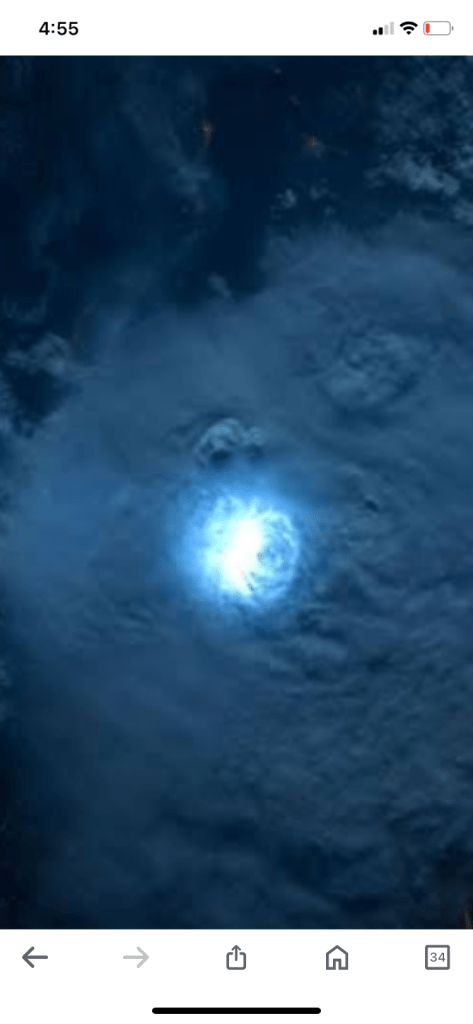
lightning on exoplanets can complicate the search for life by masking some biosignatures and amplifying others.
Lightning can mask the presence of ozone, which is an indication that complex life could exist on a planet. It can also amplify the presence of compounds like methane, which is considered to be a promising biosignature.
Lightning can also break molecules into smaller pieces. These fragments of molecules can then combine in new ways, changing the chemistry of a planet’s atmosphere and potentially its ability to support life.
Lightning on exoplanets and brown dwarfs may be more energetic and release more radio power than what has been observed from the Solar System. Such energies would increase the probability of detecting lightning-related radio emission from an extrasolar body.
According to a recent study, lightning can complicate the search for life on exoplanets by masking some biosignatures and amplifying others
A biosignature is a substance that provides scientific evidence of past or present life on a planet. Lightning can mask the presence of things like ozone, which is an indication that complex life could exist on a planet. Lightning can also amplify the presence of compounds like methane, which is considered to be a promising biosignature.
Lightning at a flash rate slightly higher than on modern Earth can mask the ozone features of an oxygen-rich, biotic atmosphere, making it harder to detect the biosphere
Astronomers look for signs of life on exoplanets by searching for:
- Evidence of an atmosphere
- Liquid water
- Biological activity
Astronomers also use sophisticated space telescopes to detect biosignature gases. These gases are produced by life and can accumulate to detectable levels in an exoplanet’s atmosphere.
Astronomers use a method called transit spectroscopy to detect life on exoplanets. This method involves splitting light from the atmospheres of exoplanets into a rainbow spectrum that can be read like a bar code. This provides a menu of gases and chemicals in the skies of these worlds, including those linked to life.
Simply put, we need to take pictures of potentially habitable exoplanets. Astronomers call this direct imaging. To maximize our chances for finding life beyond the Solar System, we must develop the capability to directly image exoplanets around as many nearby stars as possible.
According to NASA, a habitable planet is one that can sustain life for a significant period of time. Based on our solar system, life requires liquid water, energy, and nutrients
Exoplanets can contain life if they have the following characteristics:
- Habitable zone: The exoplanet’s orbit must be in the “habitable zone” where the surface is the right temperature for liquid water to exist.
- Liquid water: Every form of life known requires liquid water, so an exoplanet too close or too far from its host star is less likely to contain life.
- Energy and nutrients: Life also requires energy and nutrients. Some astronomers have suggested that “mini-Neptunes” could have large oceans hidden under hydrogen and helium atmospheres.
The most important parameter for Earth-like life is the presence of liquid water, which directly depends on pressure and temperature. Temperature is key both because of its influence on liquid water and because it can be directly estimated from orbital and climate models of exoplanetary systems
Detecting biosignatures in the atmospheres of distant planets is fraught with difficulties. They don’t advertise their presence, and the signals we receive from exoplanet atmospheres are complicated. New research adds another complication to the effort. It says that lightning can mask the presence of things like ozone, an indication that complex life could exist on a planet. It can also amplify the presence of compounds like methane, which is considered to be a promising biosignature.
The new research is “The effect of lightning on the atmospheric chemistry of exoplanets and potential biosignatures,” and it’s been accepted for publication in the journal Astronomy and Astrophysics. The lead author is Patrick Barth, a researcher from the Space Research Institute at the Austrian Academy of Sciences.
The researchers found that the effect of lightning on biosignatures depends on the type of atmosphere and the amount of lightning. They looked at two broad types of atmospheres: reducing and oxidizing. A reducing atmosphere has no oxygen or other oxidizing gases and can’t produce any oxidized compounds. An oxidizing atmosphere is the opposite. It does contain oxygen, which produces oxidized compounds.
Similarly, in an anoxic, abiotic atmosphere of a planet orbiting a late M dwarf, lightning at flash rates ten times or more than that of modern Earth can remove the abiotic ozone feature produced by CO2 photolysis, preventing a false-positive biosignature detection,” they explain. To say it’s complicated is an understatement.
There’s yet another twist. Lightning may not prevent other important false positives. “… lightning might
not be able to prevent all false-positive O2 scenarios for CO2-rich terrestrial planets orbiting ultracool M dwarfs,” the authors write.
Lightning on exoplanets can make it difficult to see biosignatures by:
- Masking ozone Lightning can mask ozone features in an oxygen-rich atmosphere, making it harder to detect life. Ozone is an indication that complex life could exist on a planet.
- Amplifying methane Lightning can amplify the presence of methane, which is considered a promising biosignature
Lightning at a flash rate slightly higher than on modern Earth can mask the ozone features of an oxygen-rich, biotic atmosphere, making it harder to detect the biosphere
A biosignature is any substance that provides scientific evidence of past or present life on a planet. The field of astrobiology uses biosignatures as evidence in the search for extraterrestrial life.
Some examples of biosignatures include:
- Chemical compounds or classes of compounds characteristic of biological matter, such as pigments
- Specific features of compounds generated biologically, such as chirality
- Characteristic biology patterns of complexity, for example in the structure and distribution of amino acids The search for life signatures requires knowledge of planet atmospheres. In the right environment, planets could be the cradle of alien life that could modify the chemical composition of their atmospheres
Being able to find such signs is so important for astrobiology that we even have a word to describe them: we call these kinds of things “biosignatures”. A biosignature is any characteristic, element, molecule, substance, or feature that can be used as evidence for past or present life
Please like subscribe comment your precious thoughts on universe discoveries
Full article source google
Best books on heavy discount on Amazon Universe discoveries
Amazing post my friend 👏👏👏💯🇨🇦
LikeLiked by 1 person
Nice
LikeLike
Interesting post. Lightening is full of energy and poses so many questions. Thanks for sharing.
LikeLike
Very interesting article lighting impact.💥
LikeLike