
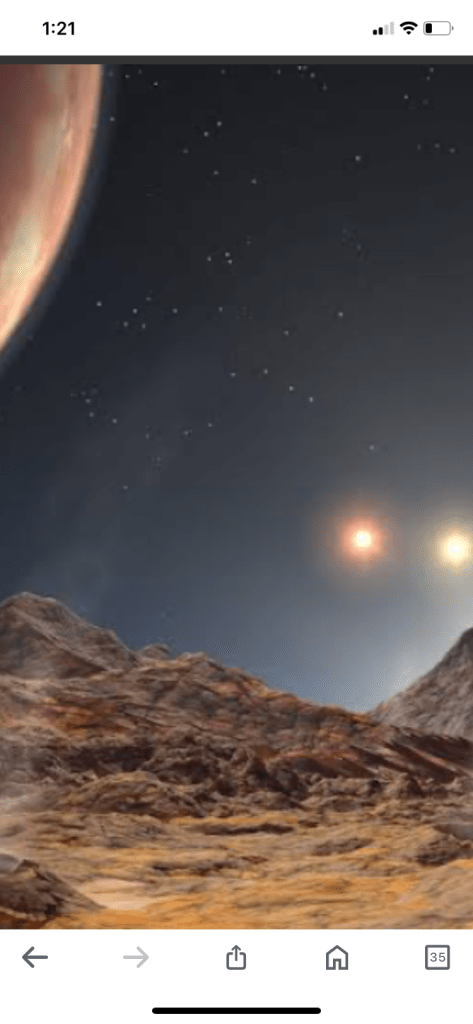
According to NASA, being part of a binary system may help larger stars, like our sun, form Earth-like worlds
According to Wikipedia, 50–60% of binary stars may support habitable terrestrial planets within stable orbital ranges. However, Space.com says that while binary systems have a habitable zone, life may find it difficult to gain a foothold.
According to Universe Today, habitable planets could exist around binary stars, but they would form differently than worlds around single stars. Yale researchers found that binary star systems with planets could be habitable, if the all the orbits in the system are aligned.
Most of the stars in the Milky Way are single stars. But between one-third and one-half of them are binary stars
As of July 2019, astronomers have found 97 planetary systems containing 143 planets around binary stars
Some exoplanets in binary systems orbit one star, with the other star much farther away. This is called an S-type orbit.
Planets can also orbit both stars in a binary star system. These types of planets are called “circumbinary planets”. The first circumbinary planet was discovered in 2011.
According to a Quora user, it’s unlikely that a planet in a binary system would have a stable orbit, which is necessary for life to evolve. However, some research suggests that low mass binary stars may be well suited to supporting life
According to Medium, gravity can draw binary stars closer together as other stars pass by, which can increase the habitable zone and make it more likely for life to develop.
According to a Reddit user, the main difference between a planet orbiting one or both stars would be the brightness and color of the stars, which would impact the type of pigment used by photosynthesizers
It is estimated that 50–60% of binary stars are capable of supporting habitable terrestrial planets within stable orbital ranges
The Alpha Centauri star system is the closest star system to the solar system, with components 4.2 to 4.4 light-years from Earth. The system contains three stars, including Proxima Centauri, which is the closest star to the Sun
Alpha Centauri A and B are two bright stars that orbit each other, forming a close binary system. Proxima Centauri is a small, dim star that is gravitationally bound to the other two stars. It is a red dwarf star that is only about one-tenth the mass of the Sun
The two bright stars, called Alpha Centauri A and B form a close binary system; they are separated by only 23 times the Earth – Sun distance. This is slightly greater than the distance between Uranus and the Sun. The Alpha Centauri system is not visible from much of the northern hemisphere
A binary star system is a system of two stars that orbit a common center of mass. The stars are gravitationally bound to each other, and each star has an elliptical orbit
Binary stars can be classified as either “wide” or “close”. In wide binaries, the orbits of the two stars keep them far apart from each other. In close binaries, the stars are close enough that mass can be swapped between the two stars.
Binary stars are important to astronomers because they allow the masses of stars to be determined
A binary star or binary star system is a system of two stars that are gravitationally bound to and in orbit around each other. Binary stars in the night sky that are seen as a single object to the naked eye are often resolved using a telescope as separate stars, in which case they are called visual binaries
The three types of binary star systems are:
- Visual These systems can be seen as two separate stars through a telescope. They have long orbital periods, often taking hundreds or thousands of years to complete one orbit.
- Eclipsing According to the shape of the light curves, eclipsing binaries can be divided into three types: EA, EB, and EW.
- Spectroscopic To derive the masses and radii of the system, we must be able to determine the orbital properties of the two stars
Here are some examples of binary systems:
- Spectroscopic binaries These are true binary star systems, where the two stars are so close together that they can’t be distinguished in an image.
- Eclipsing binaries If the orbital planes are roughly along the line of sight of the observer, each star may periodically eclipse the other. The amount of light received from such a system varies regularly.
- Cataclysmic variables These are binary star systems where mass is transferred from one star to another, leading to periodic eruptions or sudden changes in brightness. Examples include dwarf novae and recurrent novae.
- Triple star systems These are usually a version of the binary star system. There is a binary system of two close proximity stars at the center with the third star orbiting at a greater distance from the central pair.
Examples of binaries are Sirius, and Cygnus X-1 (Cygnus X-1 being a well-known black hole). Binary stars are also common as the nuclei of many planetary nebulae, and are the progenitors of both novae and type Ia supernovae
The Star Wars world Tatooine is one of the most recognizable planets in the realm of science fiction. It’s a harsh place, and its conditions shaped the hero Luke Skywalker in many ways. In the reality-based Universe, there may not be many worlds like it. That’s because, according to a new study out from Yale researchers, the Universe likes to be more orderly, and that affects planets and their environments.
The study, led by Yale assistant professor Malena Rice and two colleagues, looked at binary star systems with planets. In many of these systems, the planets orbit one of the two stars. “We show, for the first time, that there is an unexpected pile-up of systems where everything is aligned,” said Rice. “The planets orbit precisely in the same direction that the first star rotates, and the second star orbits that system on the same plane as the planets.”
Temperate Worlds in Binary Systems
If the study conducted by Rice and her colleagues applies to a lot of binary systems, what kinds of worlds would we expect to see? Certainly, the fictional Tatooine looks forbidding at the same it beckons for exploration. In reality, if the orbital alignments are stable, then it’s possible to think of habitable worlds around those stars. Depending on the conditions, some of them could be quite nice and welcoming
However, expecting a reasonable, temperate Earth-like climate at such a distant world is a bit of a stretch. It would be quite different from what we experience here at home. That’s because a planet in such a system gets light from two stars. During part of a year, any inhabitants would have continuous daylight from each star lighting up a side of the planet. The temperatures on the surface would vary as a function of stellar distance, however. And, at least some part of a year, one side of the planet would get heated up from both stars, making things pretty toasty for any inhabitants
Please like subscribe comment your precious thoughts on universe discoveries
Full article source google
Best books on heavy discount on Amazon Universe discoveries
Reduce word capacity !
LikeLike
Thank you for sharing this fascinating insight into binary star systems and their potential impact on planetary formation and habitability. The exploration of exoplanets in binary systems adds a layer of complexity to our understanding of celestial bodies.
The idea that being part of a binary system could aid the formation of Earth-like worlds is intriguing, and the various perspectives from NASA, Wikipedia, and Yale researchers provide a comprehensive view on the potential habitability of planets in such systems. The alignment of orbits in binary star systems, as highlighted by Yale researchers, adds an interesting dimension to the conditions that could support habitable planets.
The discovery of circumbinary planets and the consideration of stable orbits for life evolution raise thought-provoking questions about the diversity of planetary systems. The influence of gravity, as mentioned by Medium, and the potential for increased habitable zones further expand our understanding of the conditions necessary for life.
The differentiation in brightness and color of stars in binary systems, impacting photosynthesis as mentioned by a Reddit user, showcases the intricate interplay between celestial elements and the potential variations in planetary environments.
Overall, your compilation of information provides a comprehensive exploration of binary star systems and their implications for habitability, reflecting the vast and intricate nature of the cosmos. Thanks dear Satyam 🌹💖
LikeLiked by 1 person
Binary systems are so interesting and in science fiction movies like Star Trek they are shown accordingly my opinion and imagination I think all the aliens comes from this binary systems 🌹
LikeLiked by 1 person