
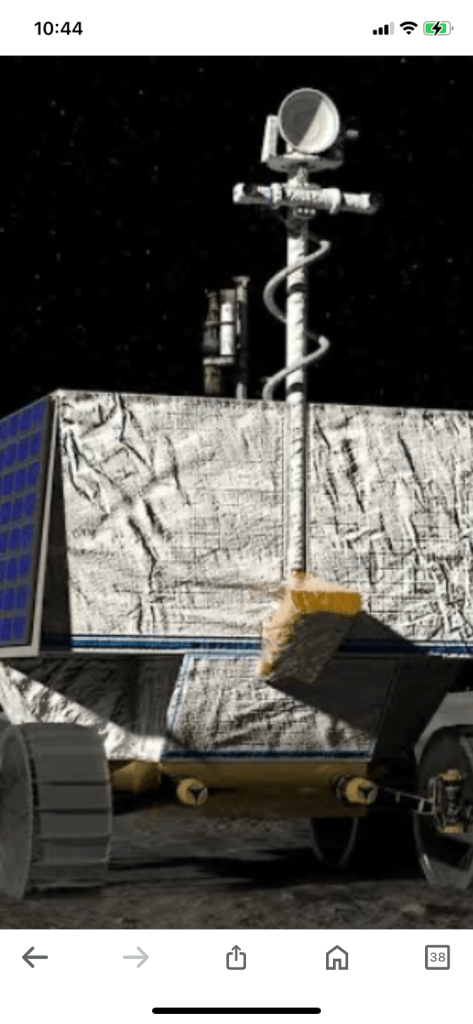
NASA’s VIPER (Volatiles Investigating Polar Exploration Rover) moon rover is scheduled to launch in late 2024. The rover is more than 80% built and has all of its flight instruments installed
VIPER is NASA’s first robotic lunar rover. Its mission objectives include:
- Searching for ice and other potential resources
- Learning about the origin and distribution of water on the Moon
- Determining how to harvest the Moon’s resources for future human space exploration VIPER will land on the Astrobotic Griffin lander on Mons Mouton near the western rim of Nobile crater close to the lunar south pole in late 2024. Over its 100 Earth-day mission it is expected to cover some 20 km, including trips into permanently shadowed craters.
VIPER has a top speed of 0.8 km/h and slows down to 0.4 km/h when prospecting for resources. It’s faster than many other Mars rovers, which have a top speed of 0.1 miles per hour.
Top speed of the rover is 0.8 km per hour. It will be driven from Earth in near-real-time. It will carry a 1-meter long drill and a quadrupole mass spectrometer. The rover is scheduled to be launched in late 2024.
NASA’s Johnson Space Center in Houston is designing and building the VIPER rover. The rover’s instruments are provided by Ames, Kennedy Space Center in Florida and commercial partner Honeybee Robotics in Altadena, California
NASA’s Ames Research Center is managing the rover project. The hardware for the rover is being designed by the Johnson Space Center, while the instruments are provided by Ames, Kennedy, and Honeybee Robotics
VIPER is part of NASA’s Commercial Lunar Payload Services (CLPS) initiative. The mission will help NASA analyze future landing sites for their Artemis program, which aims to establish sustainable human life on the Moon by 2028
VIPER’s findings will pave the way for future lunar habitats while also providing insights into the history and origin of water in the solar system. NASA hopes that the data collected by VIPER will move humanity closer to establishing a sustained presence on the moon.
As NASA’s first mobile robotic mission to the Moon, VIPER will directly analyze ice on the surface and subsurface of the Moon at varying depths and temperature conditions within four main soil environments
The VIPER rover’s mission is to better understand the availability and potential use of water resources on the Moon. The rover will explore the Moon’s surface for water ice and other resources, especially by mapping the distribution and concentration of water ice
The rover’s two main science objectives are to:
- Characterize the distribution and physical state of lunar polar water
- Understand the origin of other volatiles in lunar cold traps and regolith The rover’s mission also includes multiple stops at various science stations, chosen for their potential to contribute to understanding the moon’s water distribution and the evolution of lunar volatiles
VIPER will roam the Moon using its three instruments and a 3.28-foot (1-meter) drill to detect and analyze various lunar soil environments at a range of depths and temperatures
VIPER is about the size of a golf cart, measuring 1.5 x 1.5 x 2.5 meters and weighing 430 kg. It’s ideal for traversing the Moon’s South Pole
VIPER’s data can help shape future missions. For example, the rover’s data can help determine how to harvest water ice, which could eventually be used to sustain human exploration on the Moon and other planets. The data can also help NASA understand the environment where it plans to land the first woman and first person of color under its Artemis program
VIPER’s journey can also demonstrate how combining AI with human ingenuity can enhance our capabilities to understand space.
VIPER will face many challenges, including:
- Extreme temperatures The rover will experience harsh conditions with surface temperatures that can vary by 500 degrees Fahrenheit between sunlight and shade. The rover’s hardware, radiators, and heat pipe will help it survive between extreme cold and overheating.
- Lighting at the moon’s poles In polar regions, the sun is very low on the horizon and the shadows on the lunar surface are very long.
- Real-time drivers The Moon is much closer to Earth than Mars, so there will be little delay when transmitting commands to the rover.
- Staying connected to Earth VIPER needs to stay connected to Earth during all of its scientific operations.
- Lunar dust, cosmic rays, and lighting and temperature swings The rover’s components are rugged enough to withstand the encroachment of lunar dust, blasts of cosmic rays and dramatic swings in lighting and temperature.
According to Caltech, a spacecraft takes about three days to reach the moon. During that time, the spacecraft travels at least 240,000 miles (386,400 kilometers
As of 2021, NASA’s contract with Astrobotic Technology Inc. to deliver VIPER to the moon is $433.5 million for building and operating the rover, plus an additional $226 million to send it to the moon’s surface
The first robotic rover on the moon was Lunokhod 1, which the Soviet Union sent in November 1970. Lunokhod 1 was the first rover to land on another celestial body. It remained operational until October 1971
The Apollo 15 mission was the first to carry a lunar rover. NASA has sent three lunar rovers to the moon on Apollo missions 15, 16, and 17
The Soviet Union’s Luna 2 probe was the first man-made object to land on the moon in 1959. The probe intentionally crashed into the moon’s surface on September 13, 1959
Luna 2 was similar in design to Luna 1, another spherical spacecraft that launched in 1959. Both spacecraft had protruding antennae and instrument parts, and similar instrumentation.
The first man-made object to reach the moon was actually light, followed by radio waves and television signals
Here are some discoveries made on the Moon:
- Apollo 11 The Moon formed hot, was active for at least 800 million years, and the surface contains evidence of how it formed. The Moon’s oldest rocks are older than Earth’s oldest rocks. The Moon’s large, dark areas are impact basins filled with lava.
- Robotic missions The Moon is cratered and pitted, but the surface is strong enough to support weight. The Moon has no global magnetic field or atmosphere, and is made of common rock types.
- Lunar Reconnaissance Orbiter (LRO) In 2009, the LRO discovered water in ice and rocks at the Moon’s north pole. More recently, it has found areas that could be ideal for human settlement.
Please like subscribe comment your precious thoughts on universe discoveries
Full article source google
Best astrology books on heavy discount on Amazon Universe discoveries
Nice information
LikeLike
Very nice article ✅
LikeLiked by 2 people
Thanks 🙏
LikeLike