

TOI-270 d is a Neptune-like exoplanet that orbits an M-type star. It was discovered in 2019
TOI-270 d is about twice the size of Earth, with a mass of 4.2 Earth masses and a radius of 2.1 Earth radii. It takes 11.4 days to orbit its star, which is 0.0733 AU away.
TOI-270 d is considered a strong candidate for a hycean world. Observations of the planet’s atmosphere have revealed water vapor, methane, and carbon dioxide, which is consistent with a water world. However, there is disagreement among scientists about the details.
The equilibrium temperature of TOI-270 d is 340–350 K. TOI-270 d is a temperate sub-Neptune with an approximate radius of 2 R ⊕ and an effective temperature of 3386.0 ( -131.0 +137.0 ) K. TOI-270 d is a Neptune-like exoplanet that orbits a M-type star and has a mass of 5.18 Earths. It takes 11.4 days to complete one orbit of its star
Here are some other details about TOI-270 d:
- Distance: 22.453 (± 0.021) pc
- Radius: 0.38 (± 0.02)
- Orbital period: 11.3801±.0001 days
- Semi-major axis: 0.073±.004 AU
- Eccentricity: 0.03
The atmosphere of TOI-270 d is hydrogen-rich and contains water vapor, methane, and carbon dioxide. The planet’s chemical composition is consistent with a water world, with an ocean covering the entire surface. However, researchers have questioned the planet’s habitability
TOI-270 d is a sub-Neptune exoplanet that orbits the star TOI-270, located about 73.2 light-years away from our Solar System. It is tidally locked, meaning one side permanently faces its star and the other is bathed in eternal darkness. This creates an extreme temperature contrast, with the ocean being extremely hot on the day side and potentially habitable conditions on the night side.
The Hubble Space Telescope observed TOI-270 d and its observations suggested a hydrogen-rich atmosphere with some evidence of H2O. The James Webb Space Telescope also observed the planet and its analysis revealed an atmosphere containing water vapor, methane, and carbon dioxide.
The Hubble Space Telescope looked at TOI-270 d recently, and its observations suggested a hydrogen-rich atmosphere with some evidence of H2O. Those results warranted further examination with the more powerful JWST
Hycean planets may be able to host life even though they’re outside what scientists consider the regular habitable zone. Their thick atmospheres can trap enough heat to keep the oceans warm even though they’re not close to their stars.
The word hycean is a portmanteau of ‘hydrogen’ and ‘ocean’ and it describes worlds with surface oceans and thick hydrogen-rich atmospheres. Scientists think that they may be common around red dwarfs and that they could be habitable, although any life that exists on a hycean world would be aquatic
What does TOI stand for in exoplanets?
The acronym “TOI” refers to stars and exoplanets studied by TESS, and is short for: “Transiting Exoplanet Survey Satellite Object of Interest
TOI planets
- TOI-1452 b An exoplanet orbiting one of the dim red dwarf stars in the TOI-1452 star system.
- TOI-700 e A planet that is similar in size to Earth and is located over 100 light years away. It is one of two potentially habitable planets orbiting the distant star TOI-700.
- TOI-715 b A “super-Earth” that is about 1.5 times wider than Earth and is located 137 light years away.
- TOI-700 d The first Earth-sized exoplanet in the habitable zone discovered by the Transiting Exoplanet Survey Satellite (TESS).
- TOI-733 b A super Earth exoplanet that orbits a G-type star. It has a mass of 5.72 Earths and takes 4.9 days to complete one orbit of its star.
TOI-700 d is a super Earth exoplanet that orbits an M-type star. It has a mass of 1.25 Earths, and it takes 37.4 days to complete one orbit of its star. It was discovered in 2020 by a team of astronomers led by Emily Gilbert using the Transiting Exoplanet Survey Satellite (TESS
TOI-700 d is significant because it was the first habitable zone terrestrial planet spotted by TESS. It is also a robust candidate for a habitable world.
TOI-700 is interesting for a red dwarf star because it’s very close to the border between K-class and M-class stars. It is one of only a few known systems with two Earth-sized planets orbiting in the habitable zone of their star.
Both TOI 700 e and TOI 700 d are thought to be tidally locked, meaning one side of the planet is always facing its star.
TOI-700 d is a strong candidate for a habitable world. However, there are no other planets known to support human life.
TOI-700 d is in the conservative zone, where it’s more likely that liquid water and an Earth-like atmosphere could exist. The habitable zone is the range of distances where liquid water could occur on a planet.
TOI-700 is also a good candidate for hosting a potentially habitable planet because: It’s relatively small and cool, It has a moderate brightness, It has a relatively slow rotation rate, and It’s existed for over 1.5 billion years
Hycean planets
A hycean planet is a hypothetical planet with liquid water oceans and a hydrogen atmosphere. The term hycean comes from combining hydrogen
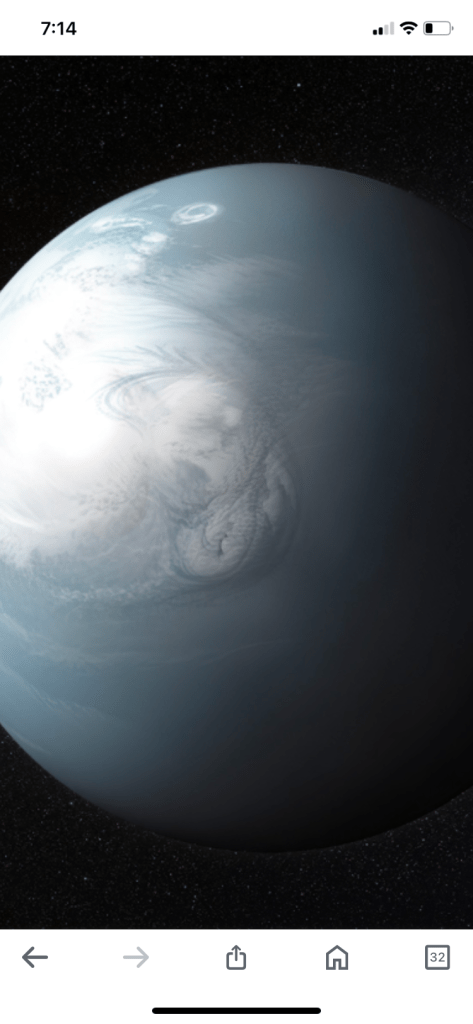
Hycean planets are a hypothetical type of planet with liquid water oceans and a hydrogen atmosphere. They are considered promising candidates for planetary habitability due to the presence of extraterrestrial liquid water.
Hycean planets are usually considered to be larger and more massive than Earth. They are expected to be common exoplanets, with both rocky Super-Earths and Sub-Neptunes fitting this type. As of 2023, there are no confirmed hycean planets, but the Kepler mission detected many candidates.
Hycean planets may be able to host life even though they’re outside what scientists consider the regular habitable zone. Their thick atmospheres can trap enough heat to keep the oceans warm even though they’re not close to their stars.
The term “hycian” is derived from combining hydrogen
The term “hycean” was first used in 2021, but the first exoplanet was discovered in 1992
In 2023, NASA’s James Webb Space Telescope discovered the presence of methane and carbon dioxide in the atmosphere of K2-18b, an exoplanet that’s nearly nine times the size of Earth. The telescope also detected signs of dimethyl sulfide (DMS), a molecule that’s only produced by living things on Earth. These findings suggest that K2-18b could be a Hycean exoplanet.
The term “hycean” is a combination of the words “hydrogen” and “ocean”. A hycean planet is a planet covered by a water ocean and a hydrogen-rich atmosphere
Hycean planets are thought to be common around red dwarf stars. They are considered a promising place to search for life beyond Earth.
Hycean planets are probably entirely aquatic. They are a type of super-Earth, with most of their mass as a watery ocean surrounded by a hydrogen-helium atmosphere.
Hycean planets that are mainly composed of water, with only a small rocky core, might be inhospitable to life. This is because water forms ices at high pressures that would limit access to the rock, which is needed for providing nutrients.
Hycean planets are similar to Earth in that they are mostly or completely covered by oceans. They are up to 2.6 times the diameter of Earth, with temperatures up to 200 degrees C (about 400 degrees F) and thick hydrogen atmospheres. This places them somewhere between Earth and giant planets like Neptune or Uranus. Hycean planets may have solid surfaces, like Earth
Hycean planets are thought to have a large mantle of high-pressure ice, like Neptune, but with a thinner hydrogen-rich atmosphere and an ocean surface.
The term “hycean” was coined in 2021 by Cambridge astronomer Nikku Madhusudhan, whose team got a close-up look at one possible hycean world, K2-18b, using the James Webb Space Telescope in 2023. K2-18b is the most promising candidate for a Hycean world, with the following characteristics:
- Orbits in the habitable zone of its star
- Water vapor is known to exist in its atmosphere
Please like subscribe comment your precious thoughts on universe discoveries
Full article source google
https://www.amazon.in/b?_encoding=UTF8&tag=555101-21&linkCode=ur2&linkId=297f43a202fd21cae0cefd214e486472&camp=3638&creative=24630&node=1984443031 Universe discoveries
Nice. Love the color- that’s fascinating about the planet
LikeLike
Very interesting!
LikeLike