
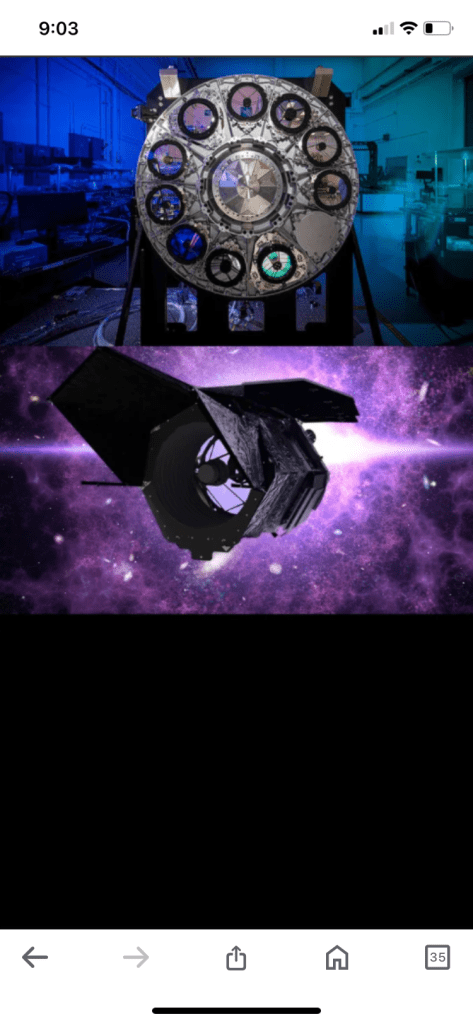
NASA’s Nancy Grace Roman Space Telescope (RST), also known as the Roman Space Telescope, is a space telescope that will launch in 2026 or 2027. It will study dark matter, exoplanets, and infrared astrophysics. The RST will have a field of view that’s at least 100 times greater than the Hubble telescope, and will be able to measure light from a billion galaxies. The RST will also be able to block starlight to directly see exoplanets and planet-forming disks
The RST will use a technique called microlensing to search for exoplanets, which are planets that orbit other stars. Microlensing is similar to Einstein’s magnifying glass, where the gravity of planets, stars, and galaxies can bend and magnify light from other objects behind them.
The RST will target stars and galaxies, as well as exoplanets. It will also be able to:
- Complete a statistical census of planetary systems in our galaxy
- Reveal untold cosmic objects
- Shine a light on dark matter and dark energy
The RST has a primary mirror that is 2.4 meters in diameter. It will launch from Cape Canaveral and have a five-year mission.
The Nancy Grace Roman Space Telescope, formerly the Wide Field InfraRed Survey Telescope (WFIRST), is a NASA observatory designed to settle essential questions in the areas of dark energy, exoplanets and infrared astrophysics
The Roman Space Telescope is more powerful than the Hubble telescope, and can survey the sky 1,000 times faster while maintaining similar sensitivity and infrared resolution. It can also capture an area over 200 times larger than Hubble’s infrared view. The Roman Space Telescope is also 100 times more powerful than the James Webb Space Telescope
The Roman Space Telescope is a combination of three proposed telescopes: the Microlensing Planet Finder (MPF), the Joint Dark Energy Mission/Omega (JDEM-Omega), and the Near-Infrared Sky Surveyor (NIRSS), with an added General Observer program. The telescope’s wide survey can be paired with the high-angular resolution and sensitivity of Webb, which would exponentially increase the scientific return.
The Roman Space Telescope will help us understand how representative Hubble and Webb’s snapshots are of the early universe. For example, the telescope will be able to detect the first traces of dark energy, giving scientists an idea of how the influence of this mysterious force has grown over time. The telescope will also be able to measure a specific kind of space dust littered throughout dozens of nearby planetary systems’ habitable zones. This information would help astronomers learn more about how rocky planets form and guide the search for habitable worlds by future missions

NASA’s Roman Space Telescope will allow astronomers to rewind the universe by taking in the bigger picture of the universe in the same image. The telescope can simulate tens of millions of galaxies in less than a day, which would take years using conventional methods. The data collected by the telescope can then be combined with data from Hubble and Webb to further hone in and rewind specific parts of the universe
The telescope will use three complementary techniques to collect data that will measure the expansion history of the universe:
- Type Ia supernovae The peak brightness of these supernovae will be used to measure expansion history.
- Weak gravitational lensing The distribution of dark matter structures will be measured through their effect on the light from distant galaxies.
- Primordial sound waves The imprint of primordial sound waves on galaxies’ clustering will be used to measure expansion history.
By comparing how fast type Ia supernovae at different distances are receding, scientists will trace cosmic expansion over time.
The telescope will also make use of a phenomenon called microlensing, which says that objects of tremendous mass “warp” the fabric of spacetime. As light travels past this warp, it is curved, and this can amplify the image of a background light source
Because of its broad coverage of the sky, the telescope will capture an unprecedented number of galaxies in its field of view and the distribution of those galaxies in our universe, which will allow us to understand the effect of dark energy on large cosmological scales and the clustering and evolution of galaxies
Roman telescope probably find aliens
NASA’s Nancy Grace Roman Space Telescope, set to launch in 2027, will help astronomers observe planets outside of our solar system, called exoplanets, in greater detail. The telescope’s Coronagraph Instrument has passed critical tests and could revolutionize how exoplanets are observed. The Coronagraph is a technology demonstration that uses groundbreaking technologies to increase the number of exoplanets that can be directly observed. The Coronagraph has been peppered with radio waves to test its response to stray electrical signals.
The telescope, formerly known as the Wide Field InfraRed Survey Telescope (WFIRST), is designed to answer questions about dark energy, exoplanets, and infrared astrophysics. The Coronagraph will help provide crucial information for the search for life beyond Earth
NASA’s Habitable Worlds Observatory (HWO)
NASA’s Habitable Worlds Observatory (HWO) is a proposed flagship mission that would search for signs of life on exoplanets. The HWO would use spectroscopy to identify and image at least 25 potentially habitable worlds. It would then study the atmospheres of these planets for “biosignatures,” such as gases like oxygen and methane, which could indicate life. The HWO would also block out the glare of stars that exoplanets orbit so that scientists can see fainter starlight that reflects off the planets’ atmospheres. The light reflects fingerprints of the elements in the planet’s atmosphere
The HWO would build on the scientific and technological achievements of the Hubble, Webb, and Roman space telescope flagship missions. The HWO would be an optical, UV, and infrared telescope that would use spectrographs to study planetary atmospheres and eclipse starlight.
The HWO was first proposed in January 2023, drawing upon two earlier mission concepts, the Large Ultraviolet Optical Infrared Surveyor (LUVOIR) and the Habitable Exoplanets Observatory (HabEx). The 2020 Astrophysics Decadal Survey recommended the HWO as NASA’s next flagship Astrophysics mission after the Nancy Grace Roman Space Telescope.
Please like subscribe comment your precious thoughts on universe discoveries
Full article source google
Best men shoes on heavy discount on Amazon
https://2ec59pip3wtq6-ge3qq6w8i417.hop.clickbank.net Universe discoveries
New invention of Rst for observation of glaxy stars.
LikeLike