
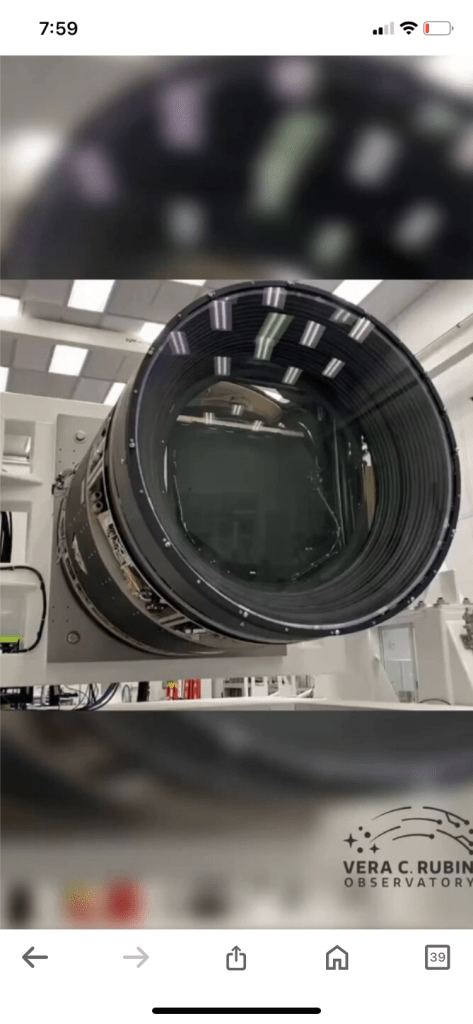
It Will Go Into the Vera Rubin Observatory. The Vera C. Rubin Observatory, formerly the Large Synoptic Survey Telescope (LSST), was formally proposed in 2001 to create an astronomical facility that could conduct deep-sky surveys using the latest technology
Nine years and 3.2 billion pixels later, it is complete: the LSST Camera stands as the largest digital camera ever built for astronomy and will serve as the centerpiece of the Vera Rubin Observatory, poised to begin its exploration of the southern skies.
The Rubin Observatory’s key goal is the 10-year Legacy Survey of Space and Time (LSST), a sweeping, near-constant observation of space. This endeavor will yield 60 petabytes of data on the composition of the universe, the nature and distribution of dark matter, dark energy and the expansion of the universe, the formation of our galaxy, our intimate little solar system, and more
The Vera C. Rubin Observatory, formerly the Large Synoptic Survey Telescope (LSST), was formally proposed in 2001 to create an astronomical facility that could conduct deep-sky surveys using the latest technology. This includes a wide-field reflecting telescope with an 8.4-meter (~27.5-foot) primary mirror that relies on a novel three-mirror design (the Simonyi Survey Telescope) and a 3.2-megapixel Charge-Coupled Device (CCD) imaging camera (the LSST Camera). Once complete, Rubin will perform a 10-year survey of the southern sky known as the Legacy Survey of Space and Time (LSST
In particular, astronomers are looking forward to using the LSST Camera to search for signs of weak gravitational lensing. This phenomenon occurs when massive galaxies alter the curvature of spacetime around them, causing light from more distant background galaxies to become redirected and amplified. This technique allows astronomers to study the distribution of mass in the Universe and how this has changed over time. This is vital to determining the presence and influence of Dark Matter, the mysterious and invisible matter that makes up 85% of the total mass in the Universe
This largest digital camera ever constructed for astronomy is roughly the size of a small car and weighs around 3000 kilograms. It has a front lens that is over 1.5 metres across — the largest lens ever made for this purpose
There is another lens that is 90 centimetres (3 feet) wide and it is specially designed to seal the vacuum chamber that houses the camera’s enormous huge focal plane. That focal plane is made up of 201 individual custom-designed CCD sensors, “and it is so flat that its surface varies by no more than a tenth of the width of a human hair. The pixels themselves are only 0.01 mm (10 microns) wide.”
What will this camera do
The LSST Camera will generate an enormous trove of data on the southern night sky that researchers will gather for new insights into dark energy, dark matter, the changing night sky, the Milky Way galaxy and our Solar System
With the completion of the unique LSST Camera at SLAC and its imminent integration with the rest of Rubin Observatory systems in Chile, we will soon start producing the greatest movie of all time and the most informative map of the night sky ever assembled,” said Director of Rubin Observatory Construction and University of Washington professor Željko Ivezić.
The goal is to create an unprecedented catalog of the cosmos. It’ll be “the first time a telescope will catalog more galaxiesthan there are people on Earth,” the lab explained. Every 20 seconds, the giant digital camera will capture a 15-second exposure. The camera is so big that each image covers a zone of sky over 40 times the area of a full moon
The Vera C. Rubin Observatory, also known as the Large Synoptic Survey Telescope, is an astronomical observatory being built in Chile. It will carry out the Legacy Survey of Space and Time (LSST), a 10-year project that will image billions of objects in six colors across more than half the sky. The LSST will generate 500 petabytes of data and images that will help researchers understand the structure and evolution of the universe. The data will address questions like dark matter and dark energy, the solar system, the Milky Way, and the transient optical sky.
The observatory will have an 8.4-meter telescope and a 3200 megapixel camera. The LSST Camera is being built at SLAC National Accelerator Laboratory, and is expected to produce over 5.2 million exposures in 10 years. The data will be available to researchers worldwide, and can be accessed and analyzed through the Rubin Science Platform.
The Rubin Observatory is a joint project between the National Science Foundation (NSF) and the Department of Energy (DOE
What is Vera Rubin known for?
National Medal of Science recipient in 1993 “for her pioneering research programs in observational cosmologywhich demonstrated that much of the matter in the universe is dark, and for significant contributions to the realization that the universe is more complex and more mysterious than had been imagined
Five Things to Know About Boundary-Breaking Astronomer Vera Rubin
- She found inspiration in some of science’s greatest women. …
- She was the first woman to legally use a famous telescope. …
- Her discovery turned science on its head. …
- She never got her Nobel
Did Vera Rubin discover dark matter?
Rubin’s work was the cornerstone of dark matter research. Her findings revealed a large missing chunk of the Universe and opened up a new field for the following generations of astronomers to explore
How did Vera Rubin change the world?
Vera Rubin, American astronomer who established the presence of dark matter in galaxies, measures spectra in the 1970s.
Who influenced Vera Rubin?
Rubin was inspired to pursue an undergraduate education at Vassar College – then an all-women’s school –, and she was also inspired by Maria Mitchell, who had been a professor in that same college in 1865
How many awards has Vera Rubin won?
Vera Rubin received more than a dozen awards for her scientific work. These awards include membership in the National Academy of Sciences, the Pontifical Academy of Sciences, and the American Philosophical Society.
What was named after Vera Rubin?
Vera C. Rubin Observatory
Vera herself offers an excellent example of what can happen when more minds participate in science, and we’re proud to honor her every time our facility is called by its name: Vera C. Rubin Observatory
How did Vera Rubin discover dark matter?
Most coverage suggests that Vera Rubin discovered dark matter by observing flat rotation curves in 1978 and that was that
Please like subscribe comment your precious thoughts on universe discoveries
Full article source google
https://42a35mopz2q2ksbh61fho8jpbe.hop.clickbank.net
Best science and mathematics books on good discount on Amazon
Best cameras on heavy discount on Amazon Universe discoveries
Interesting
LikeLiked by 1 person
Yes very interesting my friend 🌹
LikeLiked by 1 person
Satyam, the Vera Rubin Observatory, with its LSST Camera, represents a monumental achievement in astronomical research. The Legacy Survey of Space and Time promises to provide unparalleled insights into the universe’s composition and evolution, including the study of dark matter and dark energy. The engineering marvel of the LSST Camera, with its massive size and precision, underscores humanity’s dedication to pushing the boundaries of scientific exploration. Thank you for sharing this remarkable endeavor. 💐👍🏻🙏
LikeLiked by 1 person
Thanks a lot dear friend 🌹🌹
LikeLiked by 1 person